Tag: art history

  • We’ve All Been Bergotte Lately

    On AI, aesthetic jealousy and the unbearable nearness of perfection
    In The Captive (1923) and The Fugitive (1925), Marcel Proust — the writer the French revere and Americans keep meaning to finish — recounts the death of Bergotte, a novelist of moral precision and exhausted genius. Once celebrated for the spiritual lucidity of his early work and later dismissed for its ornamental perfectionism, he’s the kind of artist whose life narrows into a single pursuit: perfect aesthetic expression.

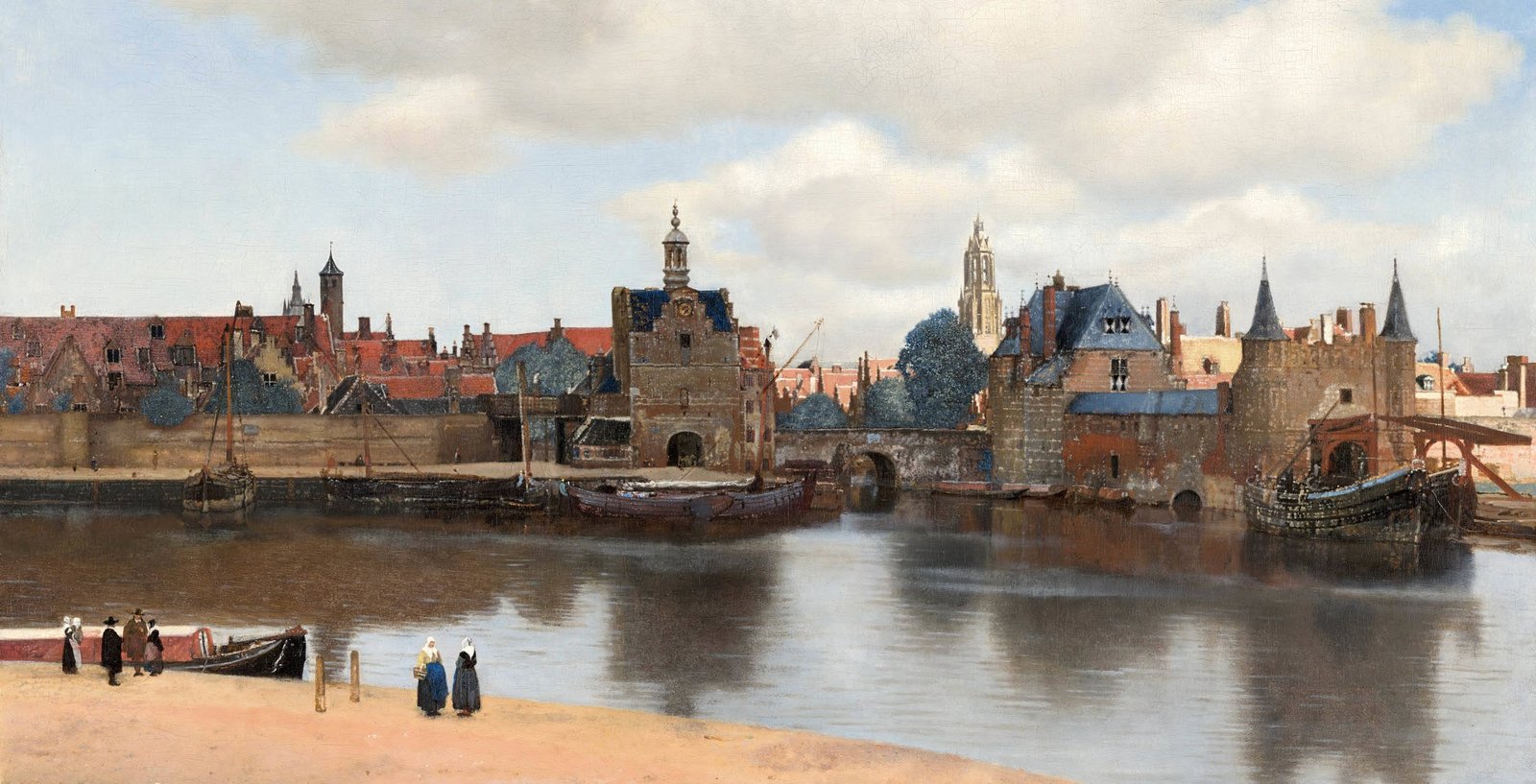
    Bergotte attends an exhibition of The View of Delft by the seventeenth-century Dutch painter Johannes Vermeer. Across this and Vermeer’s thirty-two other surviving paintings, space and perceptual elements are balanced into visual harmony, allowing looking to settle into a stillness where radiance emerges. What Bergotte feels, and what generations of museum-goers have also experienced, is similar to what Tibetans call rigpa — a mystical awareness of the divine present.

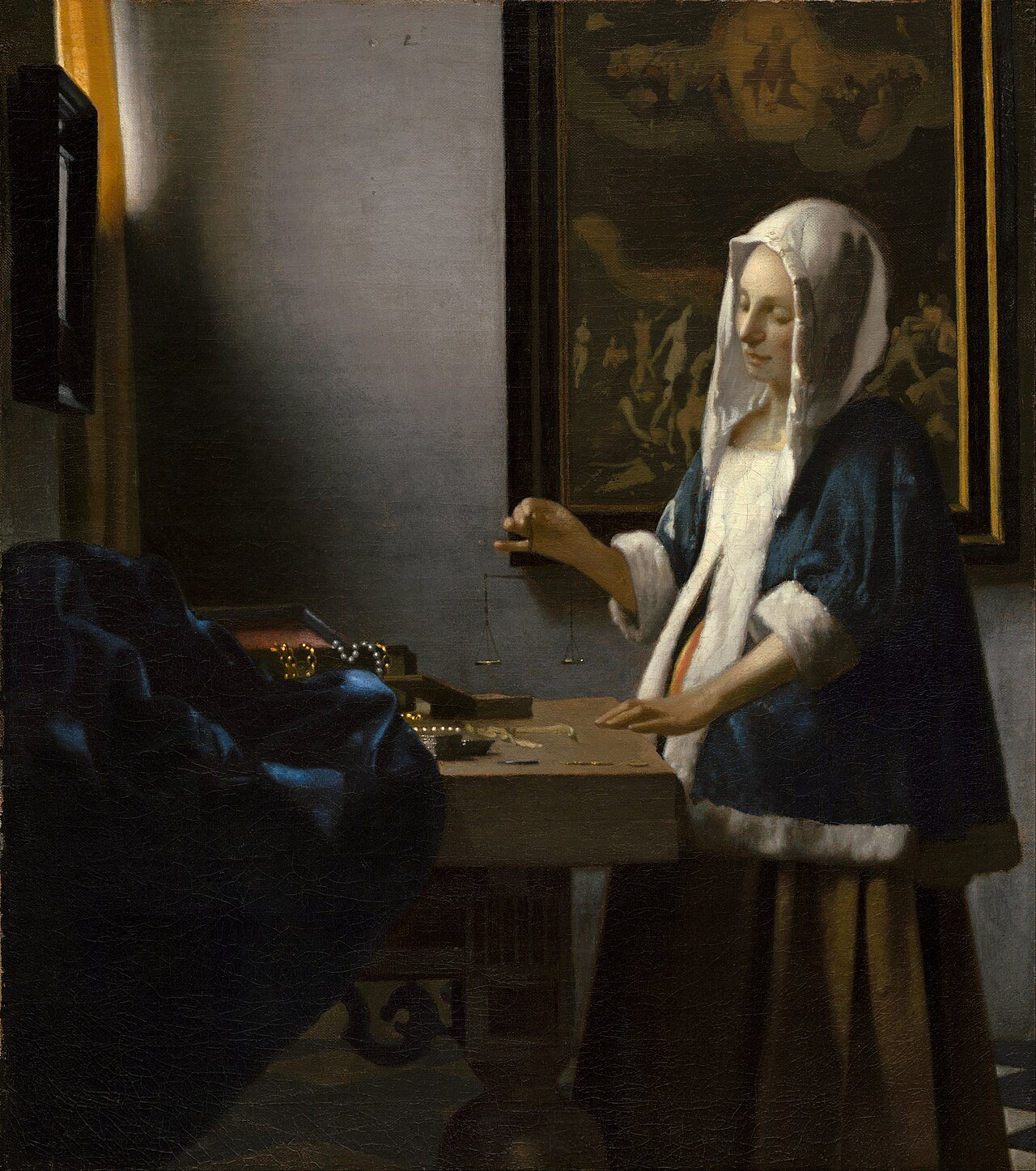
    In Woman Holding a Balance, light bends across a wall, a woman holds a set of scales at the moment when they come into stillness. The harmony is deliberate, every detail measured with care, producing sensations that feel almost otherworldly.

    I. Aurea mediocritas: “golden moderation” or the middle path

    In our time, the most intense forms of aesthetic balancing are, ironically, done by machines. The requirements for perfect shape or mixing, especially in the manufacturing sector, far outstrip clumsy human ability — centuries and centuries after Vermeer mastered his craft.

    One of the most noteworthy technologies for precise balancing and recombinging data to product an aesthetic output is the large language model. LLMs have structures so intricate they move with the hidden rhythm of thought, as if computed or quantified language were remembering how to think. LLMs perform a similar kind of seeing as Vermeer, in terms of calibrated balance, but at an impossible speed.

    In them, we glimpse the merging of reflection and instruction, where the machine draws on the shared intelligence of millions to meet an individual mind in real time. It teaches as it learns, absorbing our habits of speech and curiosity while giving them back refined, expanded, re-ordered. The exchange feels intimate because it is: in the most positive conception of this process, both query and response are a gift to the future — a potential priceless insight for another faceless “user,” or maybe, “interlocutor.”

    As a poem called “Marginalia” by Billy Collins says about this timeless process: “Even Irish monks in their cold scriptoria/jotted along the borders of the Gospels/brief asides about the pains of copying,/a bird singing near their window,/or the sunlight that illuminated their page–/anonymous men catching a ride into the future/on a vessel more lasting than themselves.”


    II. When form learned to run

    In another era, these aesthetic pursuits might have remained private ideals — the province of artists or mystics — each laboring toward an unseen perfection. The work used to be slow, devotional and often invisible to the world that would later worship it. Now these pursuits have become public and continuous, scaled into mass data and quantum velocity. The patience of Vermeer finds its mirror in computation, where billions of operations approximate in seconds what once required years — a lifetime really — of looking. Today we generate beauty collectively, continuously, almost without pause.

    Artificial intelligence offers new kinds of creation, but it also repeats an ancient rhythm: discovery, exaltation, exhaustion. What feels new is not the pattern itself but its proximity — how directly it reaches into the mind, touching the circuits of language, memory and desire. The quest for perfect form is no longer private contemplation; it has become the shared condition of a culture that can’t stop refining its own reflection.

    At the exhibition Proust describes, Bergotte stops before The View of Delft and notices “a little patch of yellow wall, with a sloping roof.” It’s a small, almost throwaway detail, yet it detonates something in him — the sharp, unmistakable jealousy of the artist, burning through the gut like a live coal (every creator’s oldest fear and most reliable fuel). For Bergotte, it’s the deathblow.

    Bergotte thinks, “That’s how I should have written — with more harmony, like that yellow wall.” He repeats the phrase, leans closer and dies soon after — we can imagine— on a circular settee in the middle of an art gallery, probably with his forearm on his forehead and his eyes lolling back. It’s almost too French: a novelist so overcome by the formal perfection of a painting that he expires mid-revelation, felled by envy, taste and insight in equal measure.

    Proust understood that beauty never kills from afar; it’s the closeness that does it — the glimpse of perfection just barely beyond reach. In many ways, AI is the same: a distilled best-practice engine capable of driving any hard-working professional slightly mad across a hundred disciplines.


    III. The melodrama of perfection

    What kills Bergotte is not the beauty itself but the recognition that perfection might be possible, and that he will never reach it. We react to our technologies with a similar melodrama. Each new wave of AI brings artists prophesying extinction, ethicists predicting apocalypse, regulators arriving late with a handbook and a palm open for greasing. The reaction is operatic, telling and totally predictable.

    The spectacle of collapse is part of the ritual; the fear of being replaced is a way of confessing how much we worship the machinery of precision, expression and pleasure. It’s a drama as old as Mefistofele, Arrigo Boito’s 1868 opera of the Faust legend — Promethean fire bargained for, the artist seeking mastery and finding, in the bargain itself, a mirror of his undoing.

    The bargain repeats itself, only the stage has changed. AI has become a collective obsession, equal parts ecstasy and despair. A new model appears like an annunciation and the internet convulses in recognition, as though a small god had been born online. Then comes the familiar liturgy: panic, prophecy and the slow return to dependence.


    IV. The beautiful things that undo us

    The pull is not pathology so much as the usual physics of the sublime, pleasure braided in with the wish to be undone by it. We keep returning because it is beautiful and a little lethal, the way serious art always is: it makes you want to go on and to give in. We’ve reached a threshold where the technology itself evokes the sublime in Edmund Burke’s eighteenth-century sense of the word: “awe and terror mingled in the same breath.”

    In his Philosophical Enquiry (1757), Burke described the sublime as the feeling produced when the mind confronts something vast enough to unmake it. LLMs now mirror thought with such precision that their fluency feels alive. It’s too intricate to dismiss, too uncanny to fully trust and that tension — between admiration and fear — has always been the hook of addiction.

    The future won’t demand new emotions from us, only stronger doses of the old ones. To see what’s coming, we have to look back at how humans have always managed the beautiful things that undo them: with ritual, regulation and a touch of denial.


    V. Exit through the gift shop

    Museums understand mania better than most industries. The path through an exhibit is never accidental: lights dim, colors heighten, the air grows quiet and just as attention reaches its peak: there’s the exit, lined with glossy merchandise. Banksy’s Exit Through the Gift Shop (2010) captured this perfectly: how modern culture turns aesthetic revelation into commerce, how the moment of transcendence slides seamlessly into the impulse to buy.

    The trick is neurological, not moral. After prolonged focus, the brain flushes with dopamine and relief — the perfect state for transaction. Designers know this. Red excites hunger, gold suggests transcendence, curved pathways keep visitors circulating steadily. The same principles guide casinos, social feeds and streaming interfaces: control the rhythm of stimulation and exhaustion and you can predict when people will spend, scroll or stay. It isn’t cynicism so much as architecture — a geometry of attention built to harness the physiological aftermath of wonder.

    AI now occupies that same psychological space. Each conversation, each generated image, feels like stepping through another exhibit, dazzling, precise, slightly unreal. The thrill is cognitive rather than visual: the brain lighting up at its own reflection. What we used to call inspiration has been externalized, automated and made conversational. We keep asking questions not because we expect surprise, but because the rhythm of answering feels like understanding.


    VI. Everyone dies on the settee

    AI is only the newest proof that we’d rather risk mania than endure stillness, that we crave the spark more than the calm that follows. Proust’s Bergotte died chasing a patch of yellow paint, Boito’s Mefistofele bartered for divine fire and Burke called the sublime “full of awe.” Each was describing the same geometry — the way beauty, power and knowledge converge at the edge of what the human mind can safely bear.

    AI brings both the closeness and distance into sharper focus, urging imagination to move faster than its technological reflection. What matters now is learning to work with that perfectly terrifying reflection — to use iteration itself as a creative force, pushing past imitation and “good enough” toward something truer, stranger and even more humane. We have to remember that its brilliance is, in the end, a real reflection of our own capacity to create.

    The danger isn’t damnation or death; it’s thinking the painting is finished. Perfection keeps moving through pigments, through pixels, through us. The best we can do is keep painting, keep prompting and try not to die mid-sentence.
  • From Cambridge Chapels to Salt Lake’s B’nai Israel Temple

    Composite image

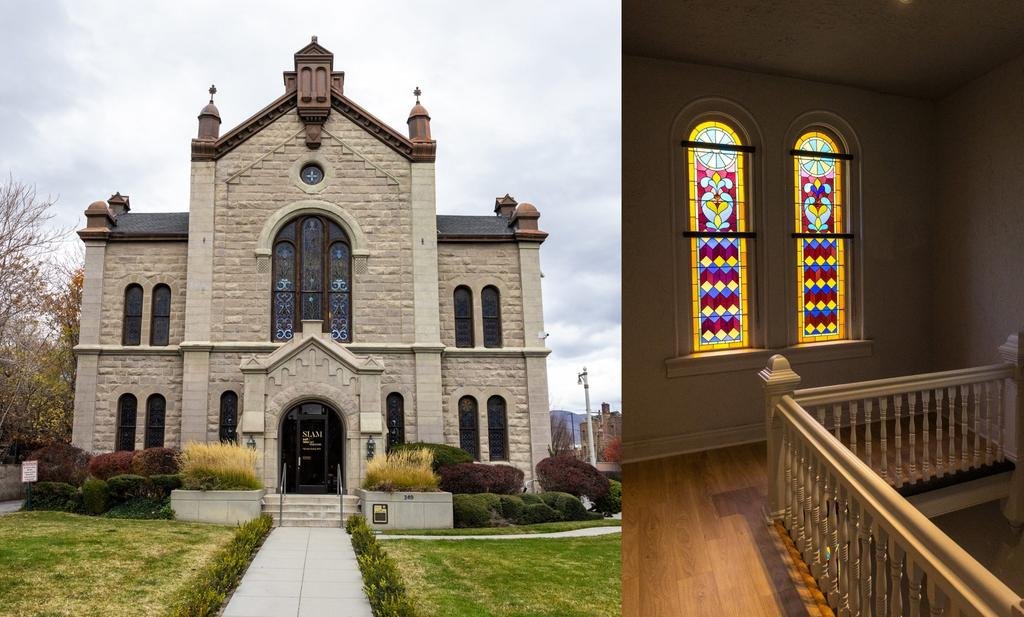
    Yesterday I was reminicing about the churches I knew and loved in Cambridge — stone chapels tucked into side streets or towering over intersections, the kind of places that hold memory simply by continuing to stand. Today I’m thinking about another piece of historic architecture much closer to home: the B’nai Israel Temple in Salt Lake City, where the Salt Lake Art Museum (SLAM) is beginning to take shape. I recently published an article about the building’s long history and its new institutional future. The thread between the two posts is preservation — how inherited spaces carry memory and what it means when a community chooses to keep or discard the places that define it.


    The tragedy of the Pantages Theater

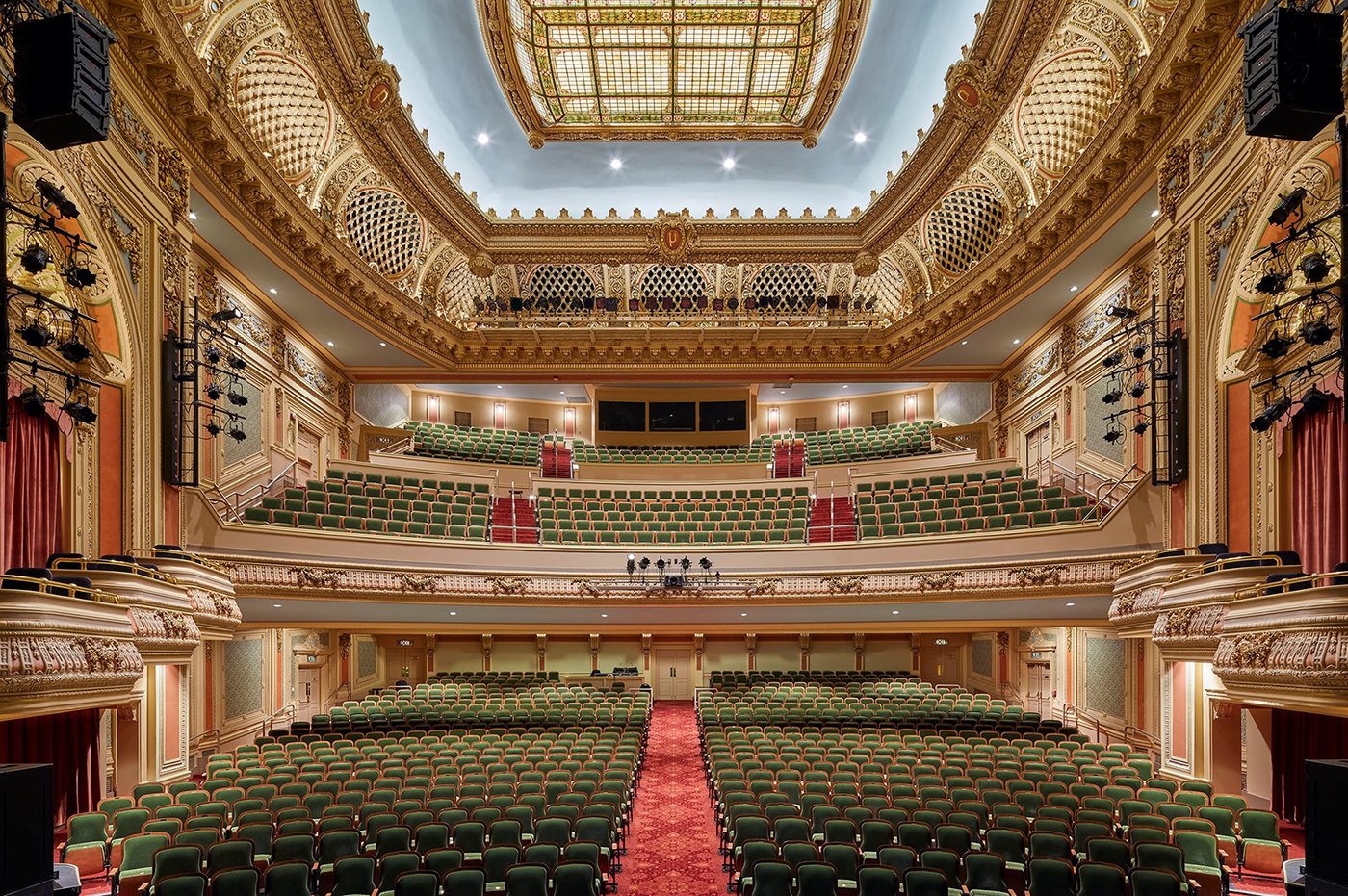
    My interest in preservation became personal during the Utah Pantages Theatre debacle in 2021, when I researched, wrote and anonymously published an article about the zero-dollar deal that handed a nationally significant 1918 theatre to developers for demolition (read it in SLUG).

    The story had been in the news for a while and continue to gain traction, written up by multiple reporters at The Salt Lake Tribune and elsewhere. Months later, I learned that the Mayor’s office had contacted SLUG asking about the author behind the piece — an unexpected development that sharpened the sense of risk many preservation advocates already felt. When the city ultimately went through with the demolition during the pandemic, I remember standing on Main Street and looking at the cleared site where the theatre had stood.

    Composite image

    What followed has only underscored the loss. The redevelopment tower promised in exchange for tearing down the theatre has yet to materialize. According to recent reporting, the property has been cleared and is being used as a temporary surface parking lot while the high-rise project remains stalled. The developer has requested paving and interim-use approvals and the site continues to sit empty — an absence rather than a new beginning.

    In the words of the Salt Lake Tribune, the theatre was “torn down in 2022 … to make way for a parking lot,” a bitter outcome when the city gave up a historic landmark and a (rumored to be) priceless Tiffany skylight, taken from the site before the demolition. The RDA has been rebranded the CRA, with no mention of the name change on the city’s websites.

    Composite image
    Composite image

    One success story

    Against that backdrop, the work happening at the B’nai Israel Temple feels like a rare counterexample. Instead of another teardown or another “too expensive to save” narrative, the building is being restored in a way that reconnects it to the community that built it. SLAM’s founder, art historian Micah Christensen — whose family operates Anthony’s Fine Art & Antiques just a few blocks away—has rooted the museum’s vision in the building’s layered cultural history and in the relationships his family has maintained within the area for generations (more in the 15 Bytes article). The museum’s presence inside the old sanctuary weaves together family history, art and the cultural life of the neighborhood. It’s a reminder that preservation can be generative — not just resistance to loss, but a way of making room for future stories inside an inherited space.

    Preservation always sits somewhere between memory and power. Cambridge taught me that some places endure because whole communities quietly steward them. Salt Lake taught me that some buildings require a public fight and that those fights sometimes come with unexpected personal costs. The B’nai Israel Temple — and the work SLAM is beginning inside it — offers a different model: a moment where the city, the institution and the community align long enough to let history remain visible. After watching the Pantages reduced to a cleared lot awaiting a project that still hasn’t begun, that alignment feels worth noting.


  • Image Gazing

    Sometimes when I get overwhelmed, I stare at images. I think a lot of art historians secretly like to do this. A few minutes stolen from the day to look at something aesthetically balanced, proportioned, harmonized—something that happens, almost mysteriously, to be tuned to one’s own internal frequency, whenever or wherever the image was made.

    I keep a lot of photographs of the rural villages and small churches I loved in England—especially around Walsingham, where I did my field work. One church in that religious-architecture-dense village is the Church of the Holy Transfiguration. It was one of the first places where I encountered the idea of an ikon, despite having studied art history as an undergrad. Their website describes it simply: “Ikons are, for Orthodox Christians, windows into the eternal dimension of reality. They are not realistic depictions or even works of art, but are a means by which Christ and his saints are made present to us.”

    Walsingham sits in Norfolk, that green, shaggy corner of England facing the North Sea, a region shaped by the old Norþfolc—“the north people.” The county looks outward toward Normandy and after the Norman conquest of 1066, it became one of the first areas drawn tightly under their rule. You can still see the imprint of that history: earthworks softened by centuries of rain, hamlets that feel older than they appear and Walsingham itself, a place formed by centuries of crossing and return.

    The Chapel of St Seraphim isn’t especially beautiful as “a building,” but there’s something about it—something I always felt drawn to. Then again, I’m biased; I’ve always had a soft spot for red brick. It almost looks like the house I grew up in.

    Composite image

    Another image I return to, struck by its emotional impact, is of Mount Kailash. In the traditions of Hinduism, Buddhism and Jainism, this mountain is seen as a celestial link between earth and heaven—a gateway to the divine. Its names carry some of that meaning, too. The Sanskrit name Kailāśa is likely derived from kelāsa, meaning “crystal.” And the Tibetan name Gangs Rinpoche (གངས་རིན་པོ་ཆེ) combines “gang/gāng” (snow peak) and “rinpoche/rin po che” (precious one), often rendered as “precious jewel of snows.”

    There are also references that place Kailash inside Buddhist cosmology. One source notes: “It’s central to its cosmology and a major pilgrimage site for some Buddhist traditions.” Taken together, the names and descriptions sketch the outline of a mountain regarded by many as sacred, even before you ever see its shape.

    Composite image


    Praise to Buddha Shakyamuni
    O Blessed One, Shakyamuni Buddha
    Precious treasury of compassion,
    Bestower of supreme inner peace,

    You, who love all beings without exception,
    Are the source of happiness and goodness;
    And you guide us to the liberating path.
    Your body is a wish fulfilling jewel,
    Your speech is supreme, purifying nectar,
    And your mind is refuge for all living beings.
    With folded hands I turn to you,
    Supreme unchanging friend,
    I request from the depths of my heart:
    Please give me the light of your wisdom
    To dispel the darkness of my mind
    And to heal my mental continuum.
    Please nourish me with your goodness,
    That I in turn may nourish all beings
    With an unceasing banquet of delight.
    Through your compassionate intention,
    Your blessings and virtuous deeds,
    And my strong wish to rely upon you,
    May all suffering quickly cease
    And all happiness and joy be fulfilled;
    And may holy Dharma flourish for evermore.
    — Geshe Kelsang Gyatso Rinpoche

    My image as seen by others

    When I was in Europe, I experienced a variety of different types of prejudice. Class is very important there, so my class was known and felt immediately. But I benefited from the “celebrity” implications of my American accent as well. People were interested and invited me places – I tried not to step on toes, eat too much, talk too much, or annoy anyone. I failed on every count almost every month, but Cambridge is a remarkably forgiving and welcoming place and I was lucky enough to call an international college, Hughes Hall, home.

    Even still, the person who hurts us most is always closest. Some of the worst American stereotypes applied to me were from my long-time French boyfriend. The one that hurt most… he told me: You’re a walking hippie stereotype. No one had ever called me that. I had almost never encountered other “hippies” in my life, although I’d written my high school thesis on the Beatles and Tom Wolfe. I think it was obvious it was only a matter of time until I fell for the Grateful Dead, but not before I’d spend years curled up with Leonard Cohen and Janis Joplin. I’d been to San Francisco only once before I flew to England (the same summer in 2013, in fact), but other than that, I’d been raised around traditional, respectable, be-khakied people in the far-off land of OOTTAWW, as I had to mouth slowly for the French. Although my mom was born in Marin Hospital, my grandparents were more beatniks-turned-respectable.

    I fell in love with Buddhism in England, actually. Making my weekly stop-off in the Tibetan store across from Kings, I gasped when I walked in at the same time as the owner. “Did you really meet the Dalai Lama?” Excuse a girl for having a naive sense of wonder (about everything, but especially about Buddhism).

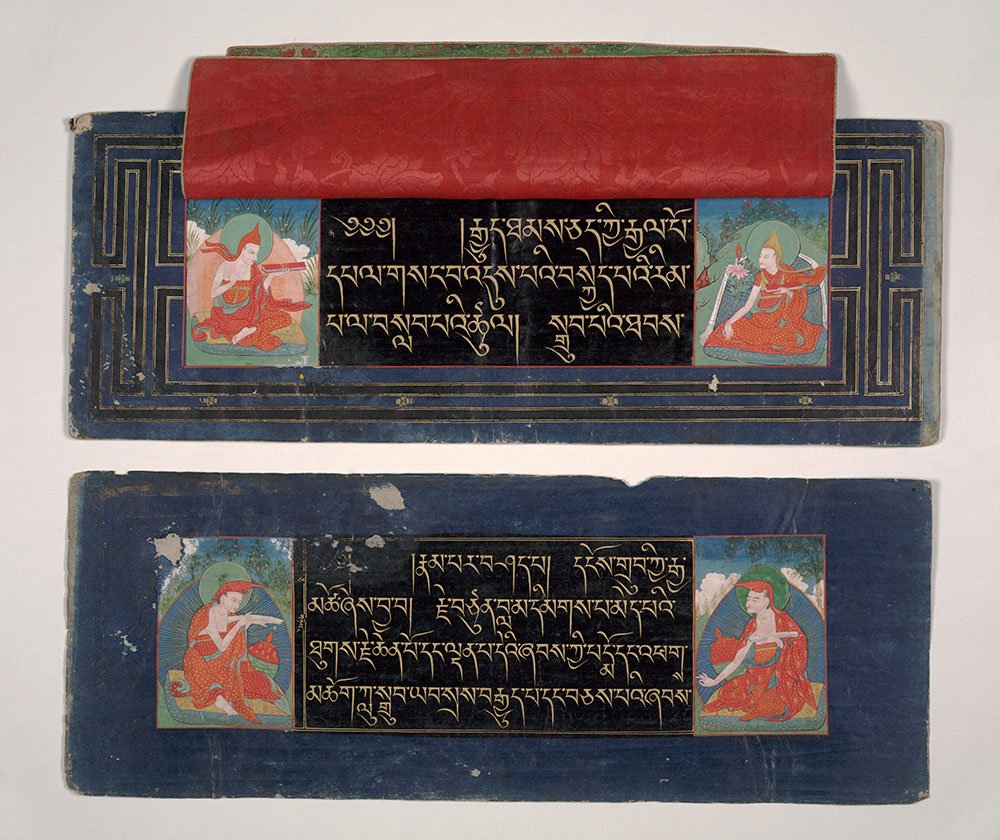
    I don’t think I ever totally felt comfortable with my boyfriend after that, seeing myself in that way so denigrated in my sincere beliefs. I’d worked on an exhibit at the MAA called Buddha’s Word, which was the first exhibition of Tibetan material in Cambridge and the first time in the Museum of Archaeology and Anthropology’s history that its Buddhist collections had ever been presented together. It was developed in partnership with the Mongolia and Inner Asia Research Unit, supported by the Arts and Humanities Research Council and the Frederick Williamson Memorial Fund and drew on collections from across Cambridge — the MAA, the Sedgwick Museum of Earth Sciences, the Fitzwilliam, the University Library, even Emmanuel and Pembroke Colleges.

    buddha's word

    buddha's word

    It mattered to me. The project mattered, the materials mattered, the scholarship mattered. Buddhism wasn’t a phase or an affectation — it was part of my intellectual and spiritual life, tied to real work I was doing inside these institutions. So when he reduced it all to a stereotype, it wasn’t just a careless comment; it was a small betrayal of how deeply I cared about something he never bothered to understand.


    Pareidolia: the velvet knife of the unbothered

    Speaking of image gazing: Pareidolia is the tendency of the human mind to perceive recognizable forms — especially faces — in random or ambiguous stimuli. In American intellectual history, the concept has appeared in several distinct contexts. During the 19th century, writers associated with Romanticism often referenced pareidolic perception when describing heightened imagination, seeing symbolic meaning in nature, or interpreting landscapes as expressive. In medical and psychological discourse of the late 19th and early 20th centuries, pareidolia was sometimes discussed in relation to certain mental-health conditions, particularly those involving misinterpretation of sensory information.

    In popular culture, it has repeatedly surfaced in narratives about “seeing signs,” spiritual imagery and the interpretation of natural forms. Across literature, psychology and journalism, pareidolia has functioned as a descriptive term for how people project patterns, meanings, or emotional significance onto otherwise neutral visual cues.

    If Europe taught me anything, it’s that mis-seeing can also be an art form and a particularly glaring one in some university contexts. Not always intentional, not always cruel, but pervasive — especially among the confident, the class-assured, the ones who glide through rooms believing their interpretations of others are simply facts.

    Pareidolia isn’t just seeing faces in clouds; it’s assuming before they’ve spoken a full sentence. My grandmother used to say, “to assume is to make an ASS of U and ME.” To criticize spirituality has become the reflex of the elite and unbothered: a velvet knife disguised as scientific clarity. However, there is, as we saw in the last post about Surrealism, the unconscious, chance and AI, a level of hallucination required to see something special in an image, an ordinary building, or in general. Maybe we art historians really are all crazy.

    Composite image

    Composite image

  • Paint like sound (when it’s thin)

    Color shifts by degrees —
    heat, distance, saturation.
    Peach into rose, rose into air.
    A thin white line cuts through —
    it hums but doesn’t waver.

    Edges blur then settle orange against shadow,
    geometry built from hesitation.
    Pattern like breath, repeated but never exact.

    Leaves or shapes —
    stamped like wallpaper,
    or under a child’s boot;
    rhythm steady either way,
    a pulse made visible.

    In another frame —
    pink and lilac flirt with yellow,
    a tone held long enough to remember.

    Paint behaves like sound when it’s thin —
    frequency without noise,
    the same horizon
    at different times.

    Bernini PlutoBernini Quote