So, you think you’re a Romeo
Playing a part in a picture show
Well, take the long way home
Take the long way home
‘Cause you’re the joke of the neighborhood
Why should you care if you’re feelin’ good?
Well, take the long way home
Take the long way home
There are times that you feel you’re part of the scenery
All the greenery is comin’ down, boy
And then your wife seems to think you’re part of the furniture
Oh, it’s peculiar, she used to be so nice
Supertramp, Lost Tart
Supertramp formed in London in 1969, built around the songwriting partnership of Rick Davies and Roger Hodgson. They cycled through early lineups and struggled for several years before finding their signature sound in the mid-1970s: a mix of piano-driven art rock, distinctive high-register vocals (Hodgson), and Davies’s more grounded, blues-leaning writing. Their breakthrough came with the 1974 album Crime of the Century, which established them as a major British act.
The band reached international success with Even in the Quietest Moments (1977) and especially Breakfast in America (1979), an album recorded in Los Angeles that unexpectedly became one of the best-selling records of the era. That American success is part of Supertramp’s odd identity — a British band whose biggest impact happened across the Atlantic. Songs like “Take the Long Way Home,” “The Logical Song,” and “Goodbye Stranger” became staples of U.S. radio, even as the band remained rooted in English lyricism and sensibility.
Hodgson left the group in 1983, and although Supertramp continued under Davies’s direction, the classic era is really the 1970s partnership: two distinct voices trading perspectives within the same band, creating music that felt both introspective and expansive.
Breakfast in America, Church-Hopping in Cambridge
Cambridge is full of churches. You can’t walk more than a few blocks without running into another one — a Norman chapel, a Victorian spire, a medieval fragment holding onto a small patch of grass. Graveyards sit close to the street, usually behind iron gates. From the 900s to the 1900s the city built in layers, and you can see the whole range at walking speed: carved doorways, patched stonework, handrails worn down, gates that still open with a small resistance. The buildings are different in mood and proportion, but they repeat the same pattern of yard, threshold, and interior space that marks time across a thousand years.
Nine Centuries of Change
The Round Church has a kind of presence that feels almost modern in its simplicity—a clean, circular nave tucked across from St John’s and Trinity colleges, solid enough to outlast whatever has bloomed and vanished around it. Its form is so pared down, so elemental, that it reads less like medieval architecture and more like an early experiment in minimalism. Built around 1130 and modelled on the rotunda of the Church of the Holy Sepulchre in Jerusalem, it belongs to the brief English fashion for round churches: imported sacred geometry rendered in local stone. The circular plan wasn’t arbitrary; it deliberately echoed the Anastasis rotunda that enclosed Christ’s tomb, a shape Crusaders and pilgrims treated as the architectural emblem of the Holy Land. Inside, the spatial compression is striking—an entire English church plan folded inward and held together by a ring of Norman pillars whose rough, earnest carvings catch the light in narrow planes. The building feels steady, almost contemplative, as if it were designed to resist not only weather but distraction.
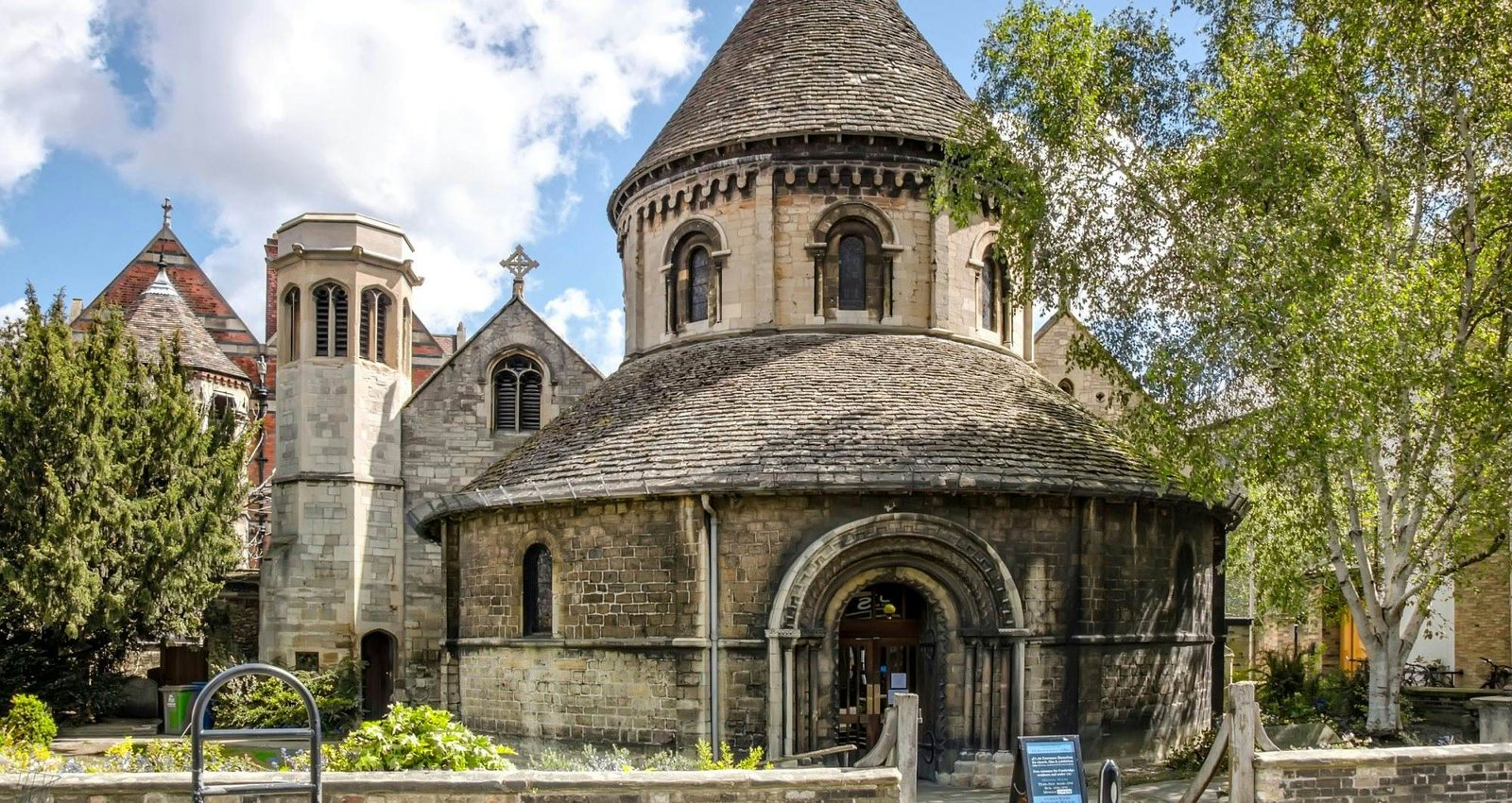
And yet the Round Church has been anything but static. It has absorbed centuries of change—given a Perpendicular Gothic east end in the 15th century, patched and propped through long periods of wear, nearly collapsing before the 19th-century Cambridge Camden Society intervened with its own idea of medieval purity. Each generation left a different layer of intention: practicality, embellishment, repair, theory. The result is a structure that appears seamless but carries every era within it, a small architectural palimpsest disguised as a pure geometric form. It never boasts about its age or its endurance. It simply stands there—compact, circular, and improbably current—holding nine centuries of shifts inside a shape that still feels timeless.
The Victorian Shift
Further south, on the way into town from the train station—now remodeled in that clean, functional Silicon Fenn style that didn’t exist even when I finished grad school—the Church of Our Lady and the English Martyrs shifts the mood completely. Standing at the corner of Hills Road and Lensfield Road, it rises out of the commuter flow with a confidence only the late nineteenth century could produce. I worked less than a block away, and each morning as I walked toward town, the spire cut upward so sharply it looked like a tear in the horizon. Its 214-foot tower, stained glass, and assertive Victorian stonework were built between 1887 and 1890—more than seven hundred years after the Round Church first enclosed its tight ring of Norman pillars. In that stretch of time Cambridge remade itself over and over: monasteries dissolved, colleges multiplied, empires came and went, scientific revolutions unfolded. Yet this newer church stakes its claim immediately, behaving like a landmark whether or not you ever mean to step inside.
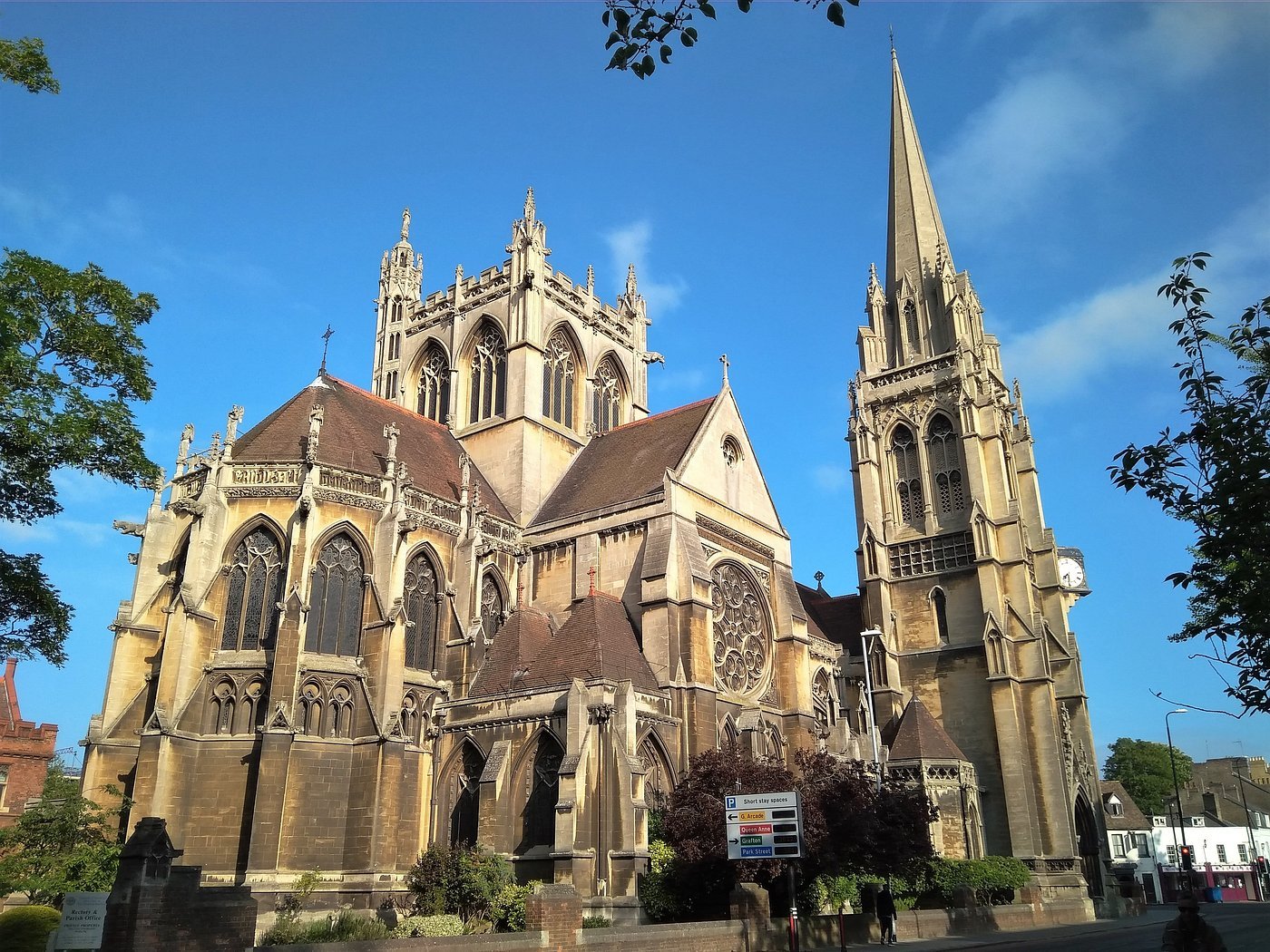
The junction churns constantly at its feet—buses braking, students crossing, cyclists threading diagonally through the lights—but the church does not adapt to the movement around it. It holds its ground with Victorian certainty, all height and aspiration, a deliberate counterpoint to the compact, contemplative geometry of its medieval predecessor. Where the Round Church gathers space inward, Our Lady and the English Martyrs sends its presence upward, announcing its era with scale and stained glass. Together they stretch the city across its centuries: two buildings separated by seven hundred years of change, still holding their places as Cambridge reshapes itself around them.
The Walk Up Castle Street
St Peter’s on Castle Street is the opposite: small, quiet, and almost always open. A remnant of a larger medieval church, it contains a 12th-century font, a 13th-century doorway, and an octagonal 14th-century spire that still carries its small dormers. Rebuilt on a reduced scale in 1781, it feels like a kept fragment rather than a parish center. Its occasional use for exhibitions through Kettle’s Yard only emphasizes that quality.
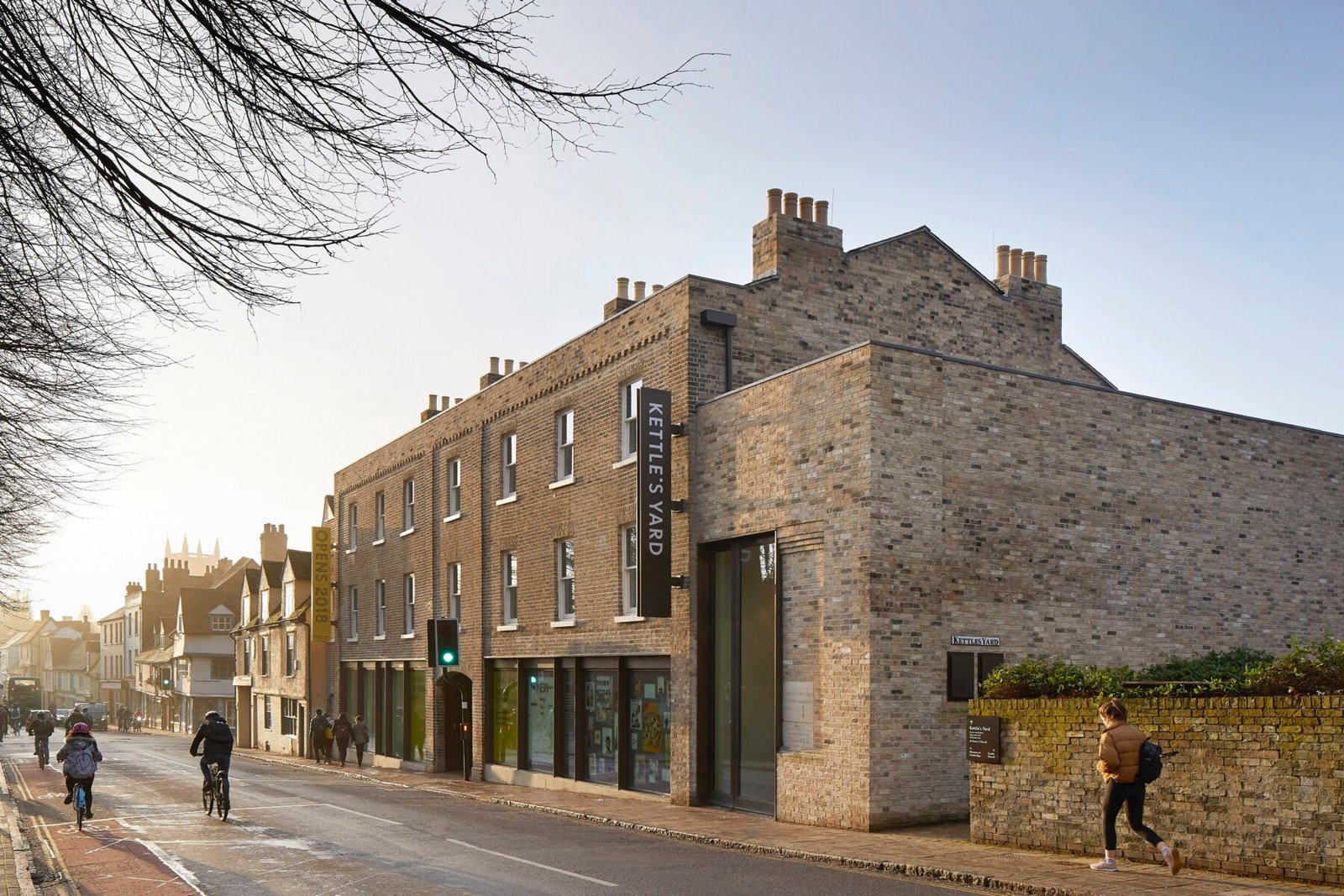
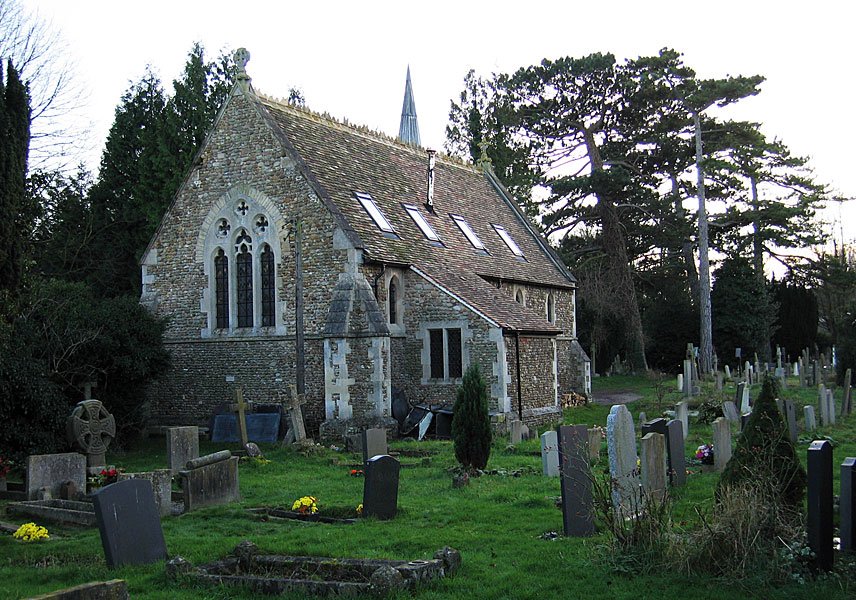
You reach St Peter’s by walking up Castle Street from Magdalene Bridge. The street kinks slightly after the Pickerel Inn — Cambridge’s oldest pub — and the traffic softens as the hill begins. Halfway up, a row of modest cottages appears almost without announcement. I used to walk past Kettle’s Yard every day after work. I lived near an overgrown graveyard full of 19th century carvings (I loved to hang out in) on Bermuda Street.
The Making of Kettle’s Yard
Jim Ede spent years living on the property and turning it into the contemporary art space: Kettle’s Yard, a domestic constellation of rooms where art and ordinary objects coexist with an ease that feels both studied and utterly natural. The approach shifts your pace; you start to look more closely, instinctively, before you even step inside.
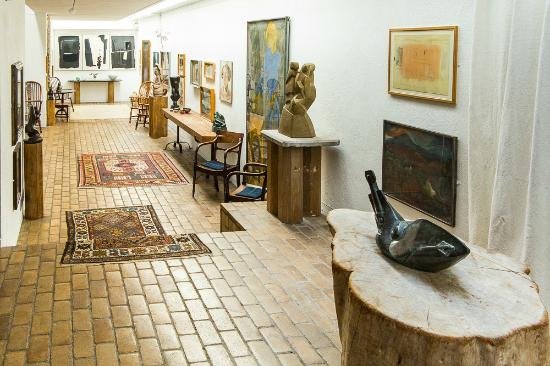
The interior of Kettle’s Yard teaches you how to see. Ede, a former Tate curator with a lifelong ear for the quiet conversation between artworks, believed that art belonged in the flow of daily life rather than locked inside museum conventions. He filled the rooms with modern and contemporary works — Brâncuși, Gaudier-Brzeska, Winifred Nicholson — and placed them beside pebbles, feathers, glass bottles, and hand-thrown pots, each object chosen for shape and calm rather than prestige. Light enters softly through low windows, moving across surfaces instead of spotlighting them. Paintings rest on ledges rather than hang in stiff rows. A chair faces a single stone. A shallow bowl answers the curve of a shadow on the wall. Even today, as a contemporary art museum, Kettle’s Yard keeps this domestic clarity intact. Students can borrow works from the collection to keep in their rooms — a tradition Ede began to dissolve the hierarchy between “museum art” and the lived spaces of ordinary life.
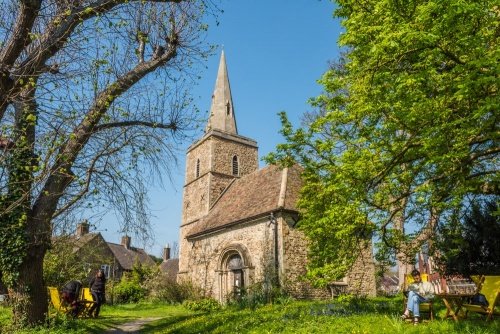
When you continue up the rise toward St Peter’s Church, that attention carries with you. The small medieval building sits just above Kettle’s Yard, slightly withdrawn from the street, as if it had stepped back to give the cottages room. St Peter’s is the opposite of Cambridge’s grander churches — small, quiet, more surprised to find you there than eager to be seen.
Across from Kettle’s Yard
St Giles’ Church sits directly across the road from Kettle’s Yard, on ground where a church has stood since 1092. The original Norman building shifted in form over the centuries before being fully replaced in 1875, leaving a Victorian structure that still carries the memory of its earlier footprint. It is quieter than the churches in the city centre, a little withdrawn from the university’s gravitational pull, and its interior reflects that distance: high Victorian arches over a modest nave, a softness to the light, the faint overlap of Anglican and Romanian Orthodox traces from the two congregations that now share it. St Giles “with St Peter” — the name it took after its smaller neighbour became redundant — feels more like a continuation than a monument, a church that has absorbed nearly a thousand years of substitutions without losing its calm.
The result is a building that doesn’t insist on itself. It sits on the corner as though it has always been there and always will be, holding its many layers — Norman origin, Victorian ambition, Orthodox chant drifting through the current parish schedule — with a steadiness that makes it easy to wander inside without any sense of trespass.
Ashitaka, San, and the Red Deer
I was living at the time with an Australian psychology student on Bermuda Street, beside the graveyard I’ve already mentioned. She watched my long-distance relationship — stretched thin by my job in Cambridge and my boyfriend’s limbo while he waited to be fully accepted into his doctoral program — with the gentle detachment of someone observing a charismatic lab experiment. One afternoon over tea she told me that Abraham and I were the strangest couple she’d ever met, not unkindly but with the calm of a clinician noting an unexpected variable. “I can’t decide which of you is odder,” she said, “or which of you I like more.” She meant it warmly, and she wasn’t wrong. Cambridge collects eccentricities the way other cities collect traffic cones; ours just happened to be temporarily cohabiting, rearranging the kitchen shelves, and taking long, circuitous walks up Castle Street.
When he was finally accepted and able to join me in Cambridge — me working in tech, him newly minted with the right to be there — we visited St Giles together. One of my clearest memories of that hill is the two of us stepping inside the church after climbing up from the river. Just past the doorway he said, very matter-of-factly, “Did you know St Giles is the patron saint of my family?” I said, “Why would I know that,” and he laughed in that slightly unhinged, overeducated French way that made everyone love him (almost as much as me). Then, in a rare and exhilarating moment, he pulled me close and said, “If you ever converted to Catholicism, we could get married, and he’d be your patron saint too.” I said, “You wouldn’t marry me unless I converted to Catholicism?” and he said, “I may be nearly an atheist, but I’m also from a very French family.”
Saint Giles — Saint Gilles — is the patron saint of the disabled, the outcast, and anyone who shelters the wounded. His legend tells of a red deer he protected in the forests of Provence, a hind pursued by hunters. An arrow meant for the animal struck Giles instead, and the wound marked him for the rest of his life — a saint made not by triumph, but by taking the injury meant for another. He was the “joke of the neighborhood” and I felt that.

I never converted, but I am pretty sure that St Giles accepted me as member of the family right then and there anyway… but that is a story for another time.
Non-attachment & Religion
When I was very young, I spent a lot of time on our brown shag carpet with a cassette player. On an outing to our local thrift shop, we found a huge plastic book of Old Testament cassettes. The plastic book of cassettes was heavy and scratched, and made a satisfying click when you slid the tapes into the stereo. I sat on the brown shag carpet, which matched our brown kitchen cabinets and wooden wall panels, and listened to the tapes. After a few years, I knew long stretches of obscure biblical lore simply from repetition.

Around that same age — six or so — my mom enrolled me in public education classes: ceramics, calligraphy, a few after-school workshops meant to keep kids occupied. But what I really wanted was the chess class. That was the one I insisted on. I loved knights, fairies, and medieval stories, in addition to the ancient stories from the Torah. I was an eccentric kid at a young age, but I also think there’s something about biblical history and a love of chess that’s naturally intertwined: the strategies, the categories of battles, the sense of wins and losses, good and evil, black and white.
When I got older, I moved away from organized religion. By sixteen or seventeen I wasn’t participating anymore, but the early exposure stayed with me in a different form. Being non-denominational now, and outside any religious structure, gives me the distance to look at belief and culture with appreciation but also, at times, the non-attachment that makes analysis deeper.