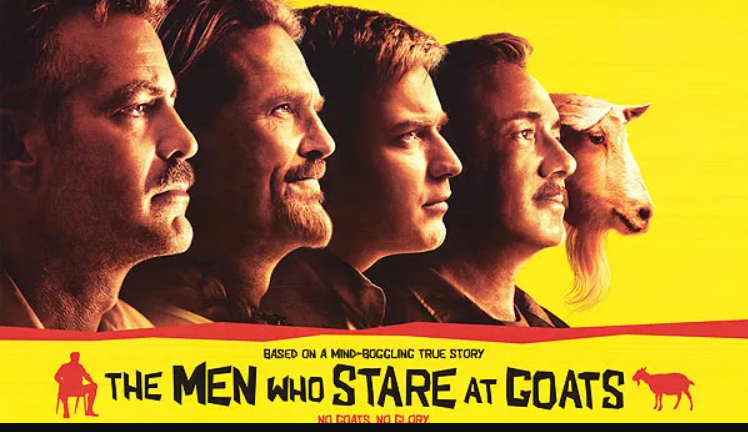
In The Invention of Lying, Ricky Gervais plays a man living in a world where nobody ever evolved the ability to lie, a premise that shapes every part of the movie’s universe. Like all good speculative fiction, the film commits to the bit: conversations feel like brutally honest Yelp reviews, people casually tell dates they’re unattractive like they’re commenting on traffic, and television seems to consist almost entirely of depressing historical lectures.
For about twenty minutes, it is one of the funniest premises imaginable. What makes the concept work is that the hypothetical world only feels convincing because the underlying logic feels plausible. Gradually, the premise starts revealing something much stranger underneath. In this universe, saying something comforting instead of brutally factual would be treated almost like fraud. The people in The Invention of Lying seem to be suppressing a constant stream of humiliating observations, while civilization exists mainly as a giant conspiracy to prevent them from saying these things out loud.
The premise only really makes sense if you accept the movie’s deeper assumption that politeness, tact, romance and social grace are fundamentally forms of dishonesty rather than fragile cultural achievements.
A movie that could launch a thousand uncomfortable conversations.
Part of what makes the movie funny is that it captures a real cultural shift born from early internet forum culture, where mocking and inverting ordinary social norms felt rebellious, clarifying and somehow more honest than everyday life. Online, the rude interpretation gained prestige because it violated polite consensus. The internet promised access to whatever society suppressed: pornography, piracy, fringe politics, anti-social thoughts, humiliating desires. What previous generations concealed out of shame or discretion suddenly appeared online with the force of revelation. Beneath civilization’s soft performances, internet culture insisted, lurked a darker and more brutally honest reality.
The Invention of Lying quietly absorbs this worldview without fully questioning it. The movie assumes the harshest interpretation of reality is also the truest one: cruel intrusive thoughts become honesty, cynicism becomes wisdom, romance becomes delusion. Politeness and emotional protection are treated as embarrassing lies people tell themselves to avoid confronting status, money, sex and self-interest.
But why should inversion automatically count as truth? The internet trained an entire generation to associate transgression with authenticity because online culture developed largely in opposition to institutional authority. Sometimes that exposed hypocrisy or created space for marginalized identities and dissenting ideas. But over time, especially in the United States, that mindset hardened into something closer to a worldview: what I’ve started calling Materialistic Utilitarianism. The Invention of Lying turns out to be one of the clearest portraits not just of that worldview, but what it produces in people.
The Prosperity Gospel of Abs
By the time I returned to Utah in 2019 after years living in France and the UK, I already felt I had crossed some invisible civilizational fault line. Since then, I’ve found myself trying to understand the strange bipolarity of Utah culture, especially the ex-Mormon dating scene, which often feels less like a rejection of Mormonism than its distorted mirror image. When my much younger, gym-obsessed ex-boyfriend showed me The Invention of Lying in 2024, my visceral disgust clarified something I had been struggling to articulate for years. It also exposed something I recognized in myself, dating a Gen Z boyfriend with a nasty case of body dysmorphia.
At one point, he was taking steroids after apparently consulting ChatGPT for fitness advice while simultaneously treating alcohol, especially beer and wine, with total disgust. A glass of wine at dinner was framed as bodily sabotage; beer became symbolic of laziness and decline. The contradiction fascinated me: synthetic hormones injected in pursuit of aesthetic perfection registered as rational self-improvement, while wine with pasta bordered on moral collapse.
That mentality feels especially intense in Utah, where alcohol rarely exists as something neutral or ordinary. Even after raising grocery-store beer from 3.2% to 5%, the state still maintains the strictest DUI threshold in the country at 0.05%, and alcohol remains wrapped in a culture of regulation, purity and supervision. What increasingly unsettled me, though, was how easily this merged with the hyper-optimized logic of internet culture and modern dating discourse.
When I asked him what felt “authentic” about the movie, he answered immediately: “Everything.” That, he explained, was more or less how he actually saw the world. So I asked the obvious follow-up question. If that worldview were really true, would he immediately trade me in for one of the surgically optimized Utah Valley women described, without irony, as “the top of the genetic food chain”?
“Well, not exactly,” he said.
He explained that our shared experiences together — including, very bluntly, some of the best sexual experiences of his life — created a kind of internal ranking system in his mind. Those experiences raised my overall “score” enough that whatever physical flaws or “deformities” he perceived in me could still pass some threshold of desirability. Listening to him felt a little like sitting through a quarterly performance review conducted by a Tinder algorithm that had recently discovered evolutionary psychology.
Marcel Proust and the radical act of wasting time
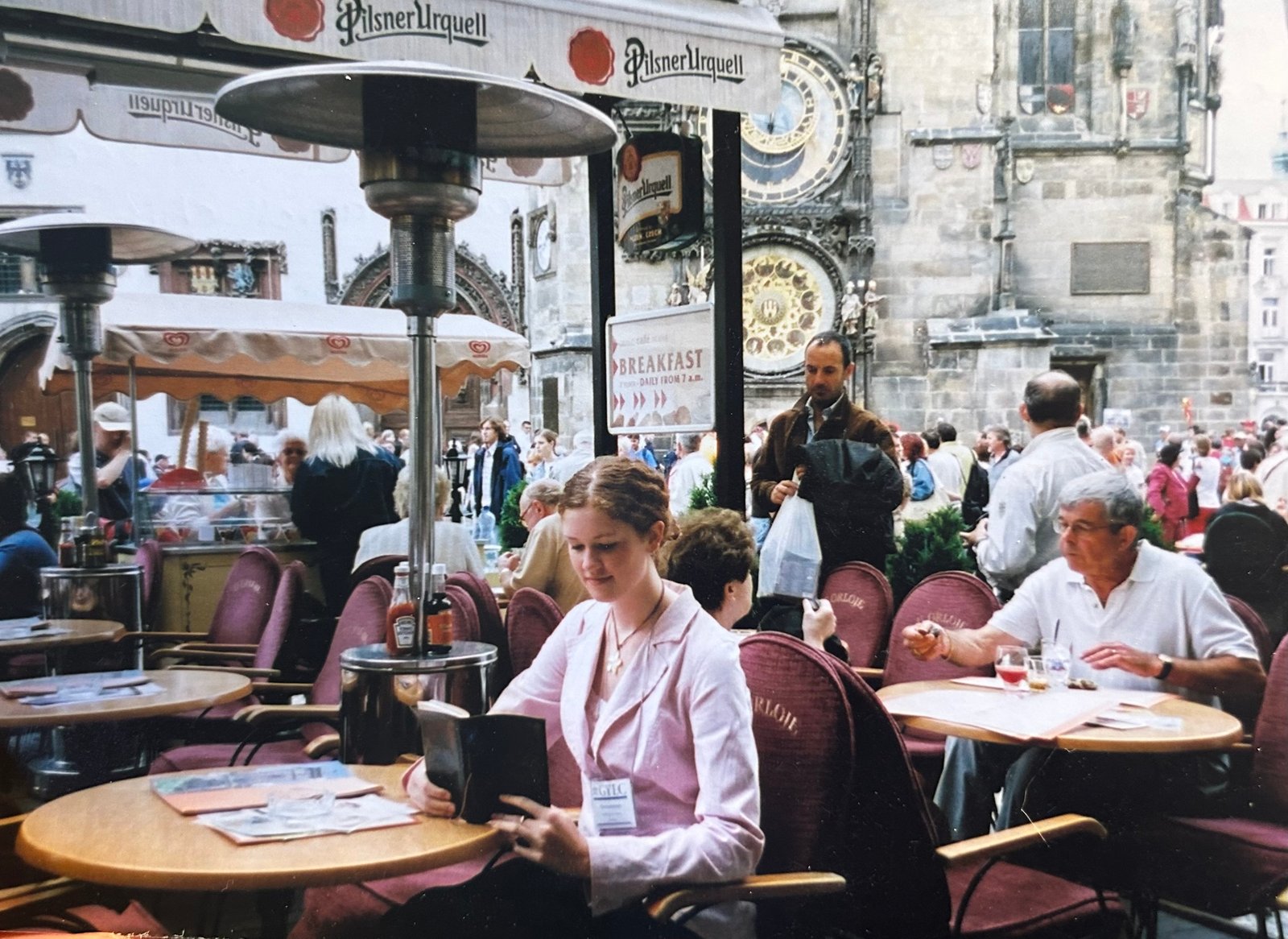
When I went to Europe the first time during a high school trip in 2005, I couldn’t help noticing that people lingered in cafés debating books, philosophy, music and politics. Thinkers were admired like celebrities, and museums displayed artists’ belongings like religious relics. The low-level depression and isolation I had carried for years seemed to dissolve. From that point on, I became convinced I had been born on the wrong continent.
Me in a cafe at 15
A few years later, armed with a Eurail pass and a head full of Before Sunrise, I joined the international backpacker-Couchsurfing community (“Couch Surfers™: we put the ‘cult’ in cultural exchange”). I drifted through Paris, Barcelona, Rome and Athens, where spending three hours in a hostel kitchen debating philosophy with strangers somehow counted as a normal evening rather than evidence you were unemployable.
At 2am in Athens, I once climbed onto a massive boulder overlooking the Acropolis with a South African girl named Tecla, passing cheap bottles of wine back and forth while she explained her obsession with classical mosaics made from tiny colored stones called tesserae. She loved the faint echo between her name and the word, even though the connection was more poetic than linguistic: Tecla came from the Greek Thekla, associated with divine glory, while tessera derived from tessares, meaning four, after the small four-sided tiles used in mosaics. She liked the accidental resemblance anyway, which felt very characteristic of the kind of people one meets at 2am in Athens discussing linguistics instead of measurable goals.
Athens, 2010; I may never be this happy again…
It remains one of those strangely treasured memories that appear to serve no practical purpose whatsoever. I still loosely follow her on Instagram, but the real magic arrives whenever I see some news story about a newly uncovered mosaic in Herculaneum. For a moment, I remember her, remember that perfect night in Athens and catch myself smiling off into space, wasting time again.
Proust’s interior world in In Search of Lost Time (1913–1927), with its obsession with memory, aristocratic decay, undercurrents of homosexuality and almost supernatural sensitivity to social nuance, more or less encapsulates the “not very American.” Nothing happens for hundreds of pages except perception itself. People sit in drawing rooms decoding glances, misremembering conversations and psychologically disintegrating over seating arrangements. The entire project is radically anti-utilitarian.
France treats Proust less like an embarrassing overeducated niche interest than part of the national inheritance. Intellectual life there still retains traces of public prestige in a way that feels almost incomprehensible within modern American culture, where intelligence is often expected to justify itself through market value, productivity or technological application. Reading difficult literature in public in the United States can sometimes feel faintly transgressive, as though you are visibly failing to monetize your own consciousness correctly.
A postcard from La Croix Rouge in Fourqueux
Back in Fourqueux in 2018, I shared a love of French philosophers and thinkers with my French boyfriend, his elderly mother and their retired neighbors, who spoke no English and had little connection to modern American culture (I was in Heaven, truth be told). Abraham and I eventually agreed that Proust was too mainstream to function as a true marker of intellectual seriousness. Instead, I picked up Stéphane Mallarmé and studied Guy de Maupassant while trying my hand at Gothic short stories in my favorite neighborhood café, La Croix Rouge.
The modern La Croix Rouge, where I spent long afternoons reading and writing.
What would Ricky Gervais’s character say about me reading Hemingway in a French café that has barely changed since the Second World War?
“Are you actually reading that or just trying to look intelligent?”
“You know the book could’ve been, like, 900 pages shorter.”
“This café has been here since World War II? Why hasn’t somebody turned it into luxury apartments yet?”
“You sat here talking about philosophy for five hours and nobody made any money?”
“You paid for a ridiculously tiny espresso in a porcelain cup when you could’ve had an XXL soda with twenty flavors?”
The jokes work because most Americans immediately recognize the type being mocked: the overeducated pseudo-intellectual lingering in cafés performing aesthetic sensitivity instead of participating in the economy correctly. “French culture versus American culture” is basically its own comedy genre at this point, but beneath the jokes sits a real cultural divide about utility, intellect and the growing pressure to justify human activity in practical terms. Cue annoying American laugh track:
Q: What is it called it when you take someone, put them in a middle of a room and cue a large group of strangers to mock them? A: Los Angeles and New York City
The Swamp of Sadness in The Neverending Story
One of the things that saddens me most about the past few years is how easily everything around you begins absorbing the logic of Materialistic Utilitarianism once you start living inside it long enough. The worldview does not remain confined to dating apps, podcasts or ironic internet subcultures. It starts colonizing ordinary emotional life. The optimization fetish my ex carried into every area of existence — body composition, productivity, status, self-improvement, emotional detachment — made it impossible for me to believe he genuinely cared about me. Everything felt provisional or ranked. Affection felt algorithmic, as though love had quietly been replaced by a constantly updating performance metric, which as an “older woman” made me more irrelevant and replaceable, ironically, the more time we spent together.
One afternoon, sitting in a café, for a few seconds, I was pulled backward into memory: pre-social-media childhood, quiet afternoons before life became quantified, then, sitting with Abraham and his mother in Fourqueux discussing literature while the afternoon dissolved outside the window. The moment felt soft, irrational, almost offensively sincere.
Then, I looked across the table at my ex-Mormon boyfriend and heard myself say, “I think our relationship has been about a 4/10, if I’m being brutally honest.”
One day when I was three years old, my mom walked in the front door holding me and my infant brother to discover dog blood splashed all over the house. After a series of strange and abusive incidents (this was the “final straw”), my mom filed for divorce.
Pets have become so central to our lives that they’ve progressed past the classification of animals as subhuman, without rights, owned beings, to “fur babies.” Like so many other cultural shifts, this is a fraught issue, and the tension has been very obvious in my family.
Rural people necessarily have different relationships to animals than those living in suburban or urban areas, and most of my family is about as rural as they come. It’s my intention to go easy on the family members who obviously loved animals, but, working with them on farms, often used approaches that might read as abusive by more modern standards.
But I also know Mormon family members and neighbors who abused animals, sometimes as a way of asserting power within family structures. From there, it’s not hard to see the connection to corporal punishment and other forms of abuse. These incidents were often hushed up or instinctively explained away, but certain patterns emerge when viewed through the lens of power and control. And while many Mormons frame abuse as a divide between a “backwards conservative Right” and an “enlightened progressive Left,” that often feels like a red herring.
To me, the issue is embedded in parts of the religion and culture itself — a foundation shaped by ideas like “spare the rod and spoil the child” that still linger beneath the surface. It’s something I’ve spent the last sixteen years distancing myself from, along with the family structures that normalized or excused abuse. I don’t even really consider myself “ex-Mormon” anymore. The label never quite fit. I somehow managed to leave the church without developing the stereotypical ex-Mormon sex addiction, although the caffeine fixation is something I’m quite proud of.
The Black Mirror episode, The National Anthem, explores the role of animal abuse in hazing (implied) and blackmail.
Closely intertwined with my concerns about Mormon culture, with its rigidly ordered social hierarchies: men > women > children > dogs > cats > other animals — and its clear binaries: male and female, adult and child, acceptable and not acceptable, rulers and ruled — is the question of what animal and domestic abuse actually are. That question becomes hard to answer in a culture where such behavior is normalized, and even raising it can be dismissed as dangerous mental illness… or feminism.
These questions have stayed with me for decades, shaped by memories I can’t entirely set aside and an ongoing interest in how cultures normalize harm while still claiming moral order. One good thing to come out of that legacy is my interest in animal rights, along with an enduring love of Immanuel Kant. As he wrote: “Out of the crooked wood of humanity, no straight thing was ever made.”
Socially accepted animal and domestic abuse: Judeo-Christian heritage?
These dynamics persist within communities and in certain pockets of the country, especially when fundamentalism cycles back into fashion, in moments like the present, when people lose faith in government or secular authority.
How does a man demonstrate power, something central to his identity within hierarchical systems? In more moderate, urbane communities, overt violence — like hitting a wife or a child — may be punished by religious authorities or the police. What remains largely unspoken is how harming a wife’s or child’s pet can function as an effective, and socially overlooked, substitute.
These patterns of abuse, and the scripts people reflexively repeat to justify them, run through Mormonism and many other religious communities. Those of us who’ve left often find ourselves tracing these patterns like “conspiracy theorists” mapping connections that authorities insist are imaginary.
The shape of hierarchy ▲
Systems built on hierarchy depend on recognizable demonstrations of control. That helps explain why religious institutions so often resist the kinds of academic scrutiny they openly disdain: modern scholarship has made it harder to ignore the relationship between social power and coercion, especially when that power must be enacted and recognized by others. It also becomes uncomfortable when frameworks like “pyramid scheme” or MLM law begin to map similar dynamics of structural dependence and abuse.
What complicates this picture is the role of discipline and the constant negotiation of conflict within families and communities. These cycles of escalation and de-escalation don’t disappear, even in financially stable households, though material stability can soften or redirect them.
This is familiar territory in philosophy and cultural critique. What I would push further is that, even in more progressive Mormon or other “Judeo-Christian” communities, certain forms of voyeurism and stalking are replacing overt, physical demonstrations of power. Increasingly, acceptable mechanisms — surveillance, social monitoring, reputational pressure and digital harassment — operate as substitutes, with physical punishments sometimes still following, but in ways that are difficult to trace or fully understand.
The “anxiety perpetuated by social media” is often attributed to social jealousy — a pat explanation so frequently repeated it’s become infuriating. That framing asks us to overlook something else: the normalization of constant surveillance by employers, the FBI and other intelligence agencies (a very large portion of which are Mormon, including some of my own family members), along with the “weird accidents” and ambient paranoia experienced by people who are never quite sure whether they are being routinely watched.
We also know, on some level, that religious authorities understand exactly what happens and many see nothing wrong with any of it. They know what happens in hazing, when a father is “under stress” or when “teaching a lesson” involves spilling blood. Many of these practices are celebrated in secret, or may even be part of ritual initiations or wider abuse patterns increasingly described as “Satanic Ritual Abuse (SRA).”
The White Ribbon
Michael Haneke’s The White Ribbon (2009) is set in a Protestant North German village in 1913–1914, exploring the authoritarian, repressive upbringing of children just before World War I. It portrays a rigid patriarchal society where brutal emotional and physical punishment are passed down. The film implies these children, subjected to extreme, hypocritical discipline, become the generation that embraces the rigid cruelty of Nazism.
Broader Mormon culture, to this day, remains in denial about how often the logic of abuse takes hold, how it is normalized and how it is used to control those lower in the hierarchy. It’s true that, even though men and boys are positioned as rulers — or, in Nietzsche’s terms, “the masters” — their punishments can be more visibly physical and brutal, especially if they are perceived as feminine or as having “something else wrong with them.”
And let’s be clear: in my own family, the survivors — children and adults alike — were the ones labeled, diagnosed and marked as unstable, made to carry the consequences of abuse. Meanwhile, many of the men who molested, raped or beat others, or who tortured and killed animals openly, were sometimes and sometimes not disciplined by religious authorities. Some faced no meaningful consequences at all, the most severe case resulted in decades of prison time. The result is a system that has, at times, echoed the hypocrisy depicted in Michael Haneke’s The White Ribbon.
There is a strange solidarity among people who have left tightly ordered religious worlds. Mormons are sometimes jokingly referred to as “mountain Jews,” a reference to 19th-century settlers who adopted rigid interpretations of the Old Testament to justify polygamy and other cultural practices. When you speak with others who have stepped away from religion — atheist Jews, ex-Evangelicals and others — the stories begin to echo: similar patterns, including accounts of community-sanctioned animal or domestic abuse that, for many, became the breaking point.
Pre-programmed or “knee-jerk” reactions to animal and domestic abuse
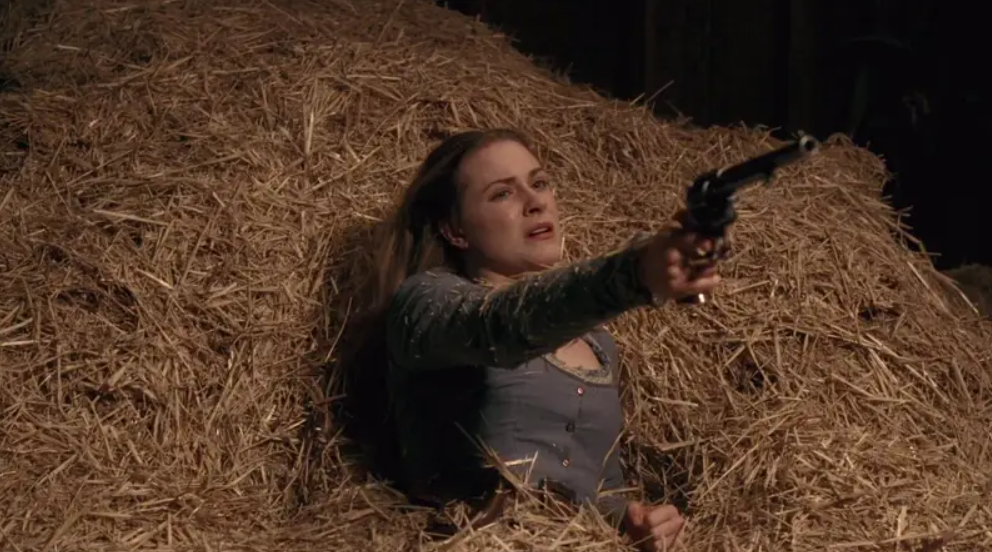
In Westworld (2016–2022), filmed in Spanish Valley, Utah, wealthy elites pay to abuse androids in a theme park setting. Dolores, programmed to submit, begins to override her own programming and fight back.
Certain responses to abuse are so ingrained they feel automatic — less like choices than scripts people have been trained to repeat.
Minimization — “It wasn’t that bad,” “he didn’t mean it,” “everyone loses their temper.”
Moral reframing — abuse recast as discipline, correction or “tough love,” especially toward children or animals.
Victim responsibility — asking what the victim did to provoke it or why they didn’t leave.
Deference to authority — assuming religious leaders, fathers or institutions are better positioned to judge the situation.
Compartmentalization — treating harm to animals, children or spouses as separate issues rather than expressions of the same underlying dynamic.
Silence as virtue — framing non-intervention as loyalty, humility or respect for privacy.
Normalization through repetition — once something is seen often enough, it stops registering as exceptional.
The worst hypocritical kicker: “Jesus wants you to love everyone and forgive everyone. Jesus doesn’t believe in grudges or vengeance.” (I beg to differ.)
These reactions don’t arise in a vacuum; they’re learned, reinforced and expected. People absorb them early and repeat them reflexively, often without recognizing them as part of a larger system. In Westworld, this logic is made explicit. The android hosts are programmed not only to endure abuse, but to rationalize it within their narrative loops. They reset, reinterpret and continue, unable to register what is happening to them as something that can be resisted. The guests, meanwhile, rely on a different script: that what they are doing “doesn’t count,” because the victims are not fully real.
What makes Westworld so unsettling is how little invention is required. The hosts’ compliance and the guests’ justifications mirror real-world patterns — learned responses that allow systems of domination to persist without constant overt force. Over time, the script becomes internal: people anticipate the role they are expected to play and perform it without needing to be told.
Sadists make the rules — and rule the world
Have you noticed that the “Sex Positivity’s Movement” has, in reality, obscured the central relationship between masochism and sadism in human relationships and sexuality? Ipso facto, if sexuality must be positive, the gratification individuals derive from abusing must not be sexual. Or rather, because this extremely common sexual orientation is so “problematic” and explains so much about culture, we must purge this “sex negative” quandary from our consciousnesses.
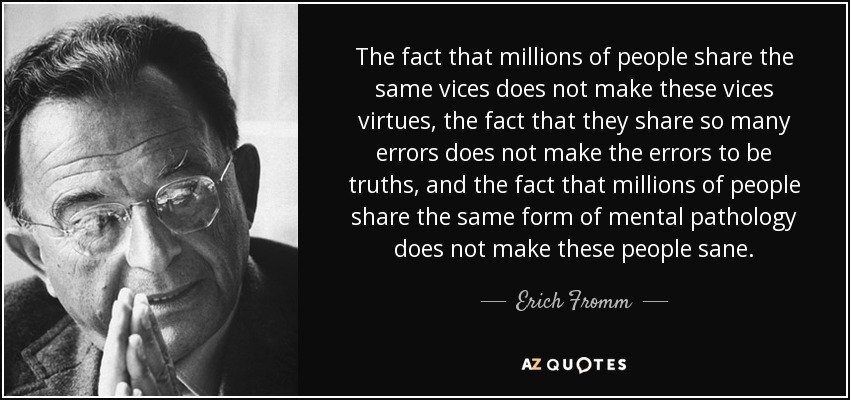
Sorry, I was never very good at Orwellian doublethink — maintaining that level of cognitive dissonance on command isn’t really in my skill set. Erich Fromm had it right: authoritarian systems don’t just demand obedience, they flood people with contradictions until thinking for themselves becomes difficult; they create conditions that erode independent thought, until contradiction no longer even registers.
As someone who has spent years reading Freud, Campbell, Jung and the early internet’s attempts to catalog human sexuality, I’ve come to a blunt conclusion: sadism is often built into systems of control because that’s what powerful people like. If as whispers on the internet about Freemasonry and its close sibling (child?) Mormonism are to be listened to, people in power might go from abusing family to abusing whole communities with coordinated Ritual Abuse. These dynamics, especially as they are actively explained and normalized to this day, have started to look like a feature, not a bug.