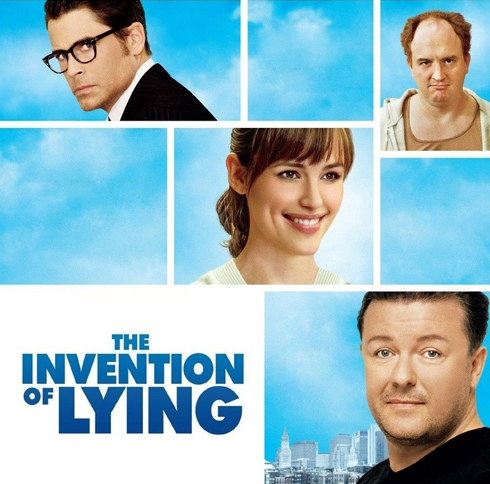
In The Invention of Lying, Ricky Gervais plays a man living in a world where nobody ever evolved the ability to lie, a premise that shapes every part of the movie’s universe. Like all good speculative fiction, the film commits to the bit: conversations feel like brutally honest Yelp reviews, people casually tell dates they’re unattractive like they’re commenting on traffic, and television seems to consist almost entirely of depressing historical lectures.
For about twenty minutes, it is one of the funniest premises imaginable. What makes the concept work is that the hypothetical world only feels convincing because the underlying logic feels plausible. Gradually, the premise starts revealing something much stranger underneath. In this universe, saying something comforting instead of brutally factual would be treated almost like fraud. The people in The Invention of Lying seem to be suppressing a constant stream of humiliating observations, while civilization exists mainly as a giant conspiracy to prevent them from saying these things out loud.
The premise only really makes sense if you accept the movie’s deeper assumption that politeness, tact, romance and social grace are fundamentally forms of dishonesty rather than fragile cultural achievements.

Part of what makes the movie funny is that it captures a real cultural shift born from early internet forum culture, where mocking and inverting ordinary social norms felt rebellious, clarifying and somehow more honest than everyday life. Online, the rude interpretation gained prestige because it violated polite consensus. The internet promised access to whatever society suppressed: pornography, piracy, fringe politics, anti-social thoughts, humiliating desires. What previous generations concealed out of shame or discretion suddenly appeared online with the force of revelation. Beneath civilization’s soft performances, internet culture insisted, lurked a darker and more brutally honest reality.
The Invention of Lying quietly absorbs this worldview without fully questioning it. The movie assumes the harshest interpretation of reality is also the truest one: cruel intrusive thoughts become honesty, cynicism becomes wisdom, romance becomes delusion. Politeness and emotional protection are treated as embarrassing lies people tell themselves to avoid confronting status, money, sex and self-interest.
But why should inversion automatically count as truth? The internet trained an entire generation to associate transgression with authenticity because online culture developed largely in opposition to institutional authority. Sometimes that exposed hypocrisy or created space for marginalized identities and dissenting ideas. But over time, especially in the United States, that mindset hardened into something closer to a worldview: what I’ve started calling Materialistic Utilitarianism. The Invention of Lying turns out to be one of the clearest portraits not just of that worldview, but what it produces in people.
The Prosperity Gospel of Abs
By the time I returned to Utah in 2019 after years living in France and the UK, I already felt I had crossed some invisible civilizational fault line. Since then, I’ve found myself trying to understand the strange bipolarity of Utah culture, especially the ex-Mormon dating scene, which often feels less like a rejection of Mormonism than its distorted mirror image. When my much younger, gym-obsessed ex-boyfriend showed me The Invention of Lying in 2024, my visceral disgust clarified something I had been struggling to articulate for years. It also exposed something I recognized in myself, dating a Gen Z boyfriend with a nasty case of body dysmorphia.
At one point, he was taking steroids after apparently consulting ChatGPT for fitness advice while simultaneously treating alcohol, especially beer and wine, with total disgust. A glass of wine at dinner was framed as bodily sabotage; beer became symbolic of laziness and decline. The contradiction fascinated me: synthetic hormones injected in pursuit of aesthetic perfection registered as rational self-improvement, while wine with pasta bordered on moral collapse.
That mentality feels especially intense in Utah, where alcohol rarely exists as something neutral or ordinary. Even after raising grocery-store beer from 3.2% to 5%, the state still maintains the strictest DUI threshold in the country at 0.05%, and alcohol remains wrapped in a culture of regulation, purity and supervision. What increasingly unsettled me, though, was how easily this merged with the hyper-optimized logic of internet culture and modern dating discourse.