Tag: MAA Cambridge

  • Two American Girls of Cambridge

    Love, work and other English heritage ailments

    Autumn 2013 —

    Cambridge, Cambridgeshire… on the river Cam…


    I. A small test of inconvenience


    “Better a witty fool than a foolish wit.”

    The Clown, Twelfth Night
    (Translation: Here, irony is oxygen and sincerity a choking hazard.)

    Most mornings, I rode a white bicycle with a wicker basket and a D-lock — what we’d call a U-lock in the States — through a drizzle so gentle it felt like God had a lingering runny nose. Coming from Utah, where rain is a rare spectacle of thunder and repentance, I never quite adjusted to how punctual it is in England. In the mountain desert, rain happens about as often as people eat green Jell-O (practically never).

    I cycled through the drizzle toward the libraries, down Hills Road toward the center — a punctuation mark in the grey paragraph of morning traffic, weaving close to cars without hitting their mirrors. The colleges would wake up: porters unlocking centuries-old doors, someone eating a “cheeky” sausage roll at a bus stop. I’d loved Cambridge long before I got there, but in England you can’t just say something like that. You have to start by complaining about the weather. It’s as though affection must first pass a small test of inconvenience.


    II. Three places, one God complex


    When I told people where I was from, they nodded with that English politeness that means mild confusion. “Utah?” Someone would usually ask, “Near Las Vegas?” — meaning the place British men flock to for stag weekends, armed with inflatable anatomy and the promise of bad decisions.

    In reality, the two cities are six hours apart by car, a straight shot down I-15. Salt City mirroring Sin City across the motorway — the two of them glaring at each other like a separated couple in a bad marriage still sharing a bank account.

    Cambridge has Old World charm — so neatly named it borders on self-parody. There’s a river called the Cam and, of course, a number of bridges. Locals, ever self-aware, like to joke that the name proves genius is in the water. For some, Cambridge was still a finishing school for the world’s most polished: chauffeured to formals, brunching in AirBnB’d castles, posting filtered group pictures under a Hellenistic sculpture on the relatively new app, Instagram, (founded in 2010, acquired by Facebook in 2012).

    Days blurred into drafts and deadlines, the slow rhythm of library lamps and late-night tea. Ambition was its own religion here, quiet but consuming. We scrawled the motto over our doorways: Silent Desperation is the English Way.


    III. Shine on, you Cantabrigian diamond


    Syd Barrett and Roger Waters were rumored to have played their first set here when they were fourteen or fifteen at the Anchor Pub. Barrett grew up (and died) in Cambridge. I met coursemates and friends who came to visit at the pub; sometimes I came during lunch, watching the punters on the river. Sometimes I sat by myself in the corner downstairs — listened to music, spent a little time with Syd’s spirit.

    I felt at home, haunting the town as a cultural-anthropologist-to-be with a black wool coat and a funny last name. British people still think Macbeth is unlucky. Sometimes I felt it. Maybe I was living in a fever dream or an Earl Grey delirium… regardless, I was there.


    IV. The other American girl


    “If I had my mouth, I would bite; if I had my liberty,
    I would do my liking: in the meantime let me be that I am
    and seek not to alter me.”

    Don John, Much Ado About Nothing
    (Translation: If you can’t beat the algorithm, don’t join it?)

    “Marry, sir, they have committed false report;
    moreover, they have spoken untruths; secondarily,
    they are slanders; sixth and lastly, they have belied a lady;
    thirdly, they have verified unjust things; and, to conclude,
    they are lying knaves.”

    Dogberry, Much Ado About Nothing
    (Translation: Someone on Instagram is lying again.)

    In 2013, her posts reached us like contraband, circulating among the unconcerned nerd girls. She was studying across town, photographing candlelit formals and sun-washed courtyards; her posts slipped into our common rooms like dispatches from a parallel university. She made Cambridge look effortless, like a romantic comedy. Something both brass and totally American, but novel in the brave new world of Instagram filters. Enter Valencia Rock ’n’ Roll from N.Y.C.

    What fascinated me most about Caroline Calloway — with her literary name straight out of Fitzgerald — was the story behind the sparkling façade: the strange duet of authorship and illusion. I watched it all from the Anthropology & Archaeology Library (between fantasizing about Sylvia and Ted), the University Library, the Hughes Hall library. I didn’t feel envy exactly, more like the fascination of seeing someone animate their own myth in real time. She’d translated Cambridge in the 21st century into a vivid image. In many ways, my experience felt like endurance. But then, every myth has someone in the shadows — usually a woman — doing the invisible labor that keeps the illusion intact.


    V. Caroline’s chorus: every drama needs its ghost


    The story that broke in 2019 revived the Caroline Cambridge myth that began in 2013, when Caroline and I were students at Cambridge. The story focused on Natalie Beach: they had been best friends in college, collaborators turned co-conspirators in character invention. Natalie later alleged that she had not only helped write the early Instagram captions but had co-created the Caroline persona itself, an uncredited ghostwriter to the myth. Together they built the witty intimacy that made Caroline’s feed so addictive, while Caroline lived it in public: the gowns, the heartbreak, the fantasy of effortless belonging. (Very
    Gossip Girl; yes… I watched it all.)

    That was twelve years ago. And still, in 2025, glossy stories keep appearing — Caroline posed in soft light, telling new versions of the same tale. The fascination endures. When the ghostwriting story broke, I didn’t feel vindicated. I mostly felt curious, and, if I’m honest, a little jealous… of the paid ghostwriter Natalie.*

    My love of psychedelic theater like Dark Side of the Moon and secret Gossip Girl viewing proved I’d always been drawn to spectacle, but I dressed my artistic aspirations as coursework: poetic prose that made academic boards give me grants — or let me take out loans so I could learn more. Back then, I just worked. Didn’t question it.

    *A friend who proofed this essay (male) believes that deep down I wish I were posing in my underwear next to a Beauty & the Beast costume for thousands and thousands of dollars. This repressed intimation of female jealousy, he reckons, is the most interesting idea in the essay.


    VI. An honest day’s haunting


    By then, I had started to notice that Cambridge had its share of quiet ghosts: people like me, living in libraries, alone or in company, absorbed enough in our work that we began to fade at the edges. We moved, in light or in darkness, in a kind of near-invisibility; kept vigil for old, tattered stories while others told prettier ones.

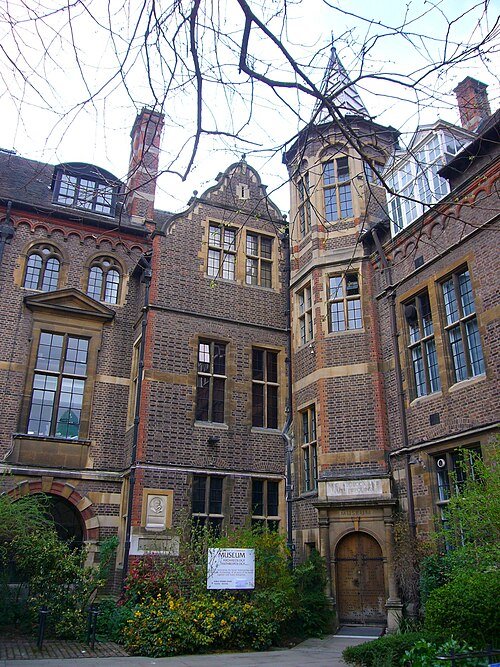
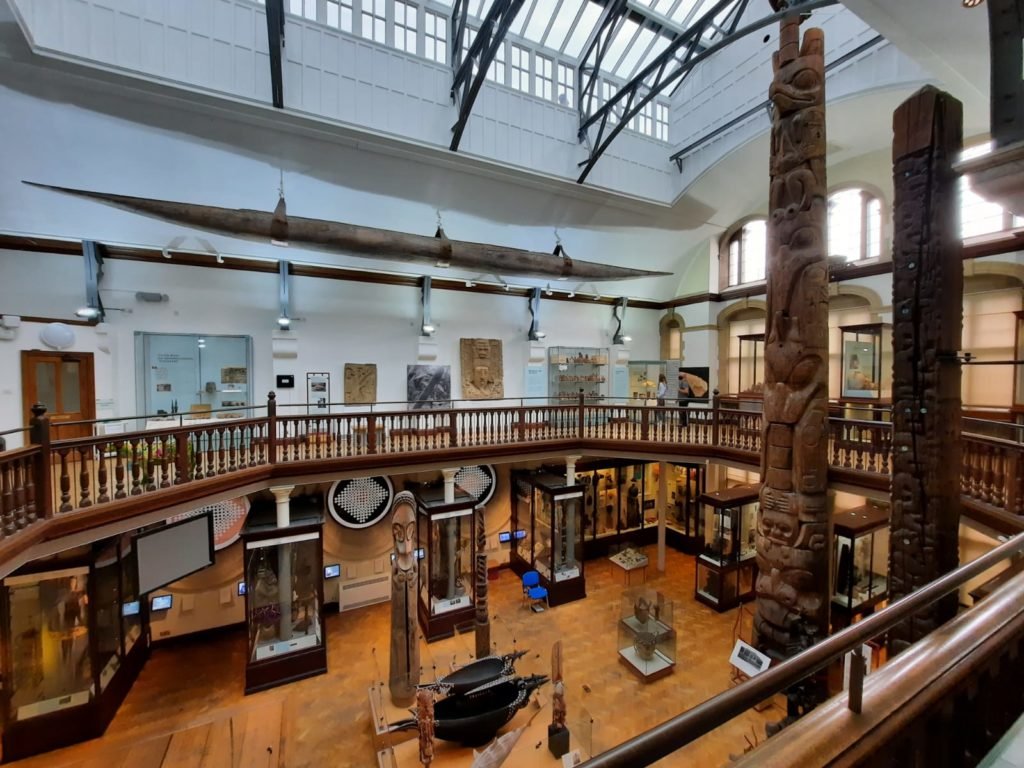
    I worked at the Museum of Archaeology & Anthropology on exhibits about disappeared civilizations, and with visiting groups from South Africa, Australia, Nigeria, First Nations, and the Blackfeet Nation. As graduate students, we twenty-somethings met with representatives, listened to stories tied to identity and memory, and learned to care for the objects living at the museum.
    I used to drink coffee from white china cups after lunch, thousand-yard staring out a window overlooking the cricket green. I told people I was agnostic when the Utah question came up, but I also spent hours each week in Cambridge’s churches crying.

    In Turkish restaurants, Muslim-owned grocery stores and malls in the suburbs, where I rented a shared council house, I encountered many other people trying to become something or do something great. I felt privileged, but everyone could see the missing buttons on my coat, stumbling in for real-sugar chocolate at odd hours. 

    Sometimes I wondered if loving a place was just another form of study — an endless observation that never turned into certainty. I wrote about belonging as if naming it might make it real, but Cambridge resisted ownership in the way all beautiful things do. My research, interviews and writing addressed the question: How do we inhabit the places we’re from, those we adopt, those we — lovingly, even masochistically — serve? ’Til death do us part… or not, Dear Cambridge.

    Coleridge might summarize: A Mormon fantasie of eternal love!


    VII. Portrait of the artist, post-graduation


    “I can call spirits from the vasty deep.”

    “Why, so can I, or so can any man;
    But will they come when you do call for them?”
    Glendower and Hotspur, Henry IV, Part I
    (Translation: But can you get funding?)

    On Orchard Street in Cambridge in 2018, I rented a small room with my long-time boyfriend, who I’d met years earlier as a master’s student. Outside, bicycles clicked past toward the river; inside, the Medieval rafters exhaled in little sighs and radiators creaked. The ceiling slanted, the air smelled faintly of rain and coffee and the small desk by the window became the site of my artistic evolution, a miraculous spurt of production after years visiting the altar of the Muse of Writing, waiting for a sign.


    VIII. Devotion and other British habits


    “I have no other but a woman’s reason; I think him so,
    because I think him so.”

    The Two Gentlemen of Verona
    (Translation: Feeling is its own form of faith.)

    “There’s language in her eye, her cheek, her lip.”
    Troilus and Cressida
    (No translation necessary.)

    A stone’s throw from Orchard Street was the Princess Diana Memorial Garden — a modest town park with practical flowerbeds, nothing exotic — somewhere I used to sit at all hours of the day, cross-legged. Children ran in circles around the benches while parents unwrapped sandwiches, the ordinary rhythm of British weekends. It wasn’t the sort of place anyone photographed, which was what I liked about it.

    For anyone who grew up in the 1990s, her image was everywhere: the ocean-blue eyes, the head tilt, that quiet strength that seemed to glow from television screens and magazine covers alike. In Utah, that admiration had its own peculiar intensity — perhaps because so much of our culture still carried traces of old England, with hymns and hierarchy just a breath removed from High Anglicanism. Loving the Royal Family came easily; devotion to Lady D felt like a shared inheritance. My mom cried for a week when she died. It’s a vivid childhood memory. Blonde, magnetic and naturally elegant, my mom had what people used to call “a Diana-like way about her.” England never felt totally foreign to me: so much of our cultural heritage is close, intimate — even painful — like a family photograph.

    However, different parts of me spared me from imposture syndrome or castigating myself too much in an environment where I was, more often than not, stepping on toes. Maybe it was the Celtic stubbornness or the frontier nostalgia, but I took a quiet pleasure in belonging somewhere I wasn’t supposed to. I was an Irish-Scottish-Swedish-Swiss-Welsh mix from the Wild West — a cultural collage that shouldn’t have blended with Gothic chapels and rowing clubs.

    Yet, walking past King’s on foggy mornings, I felt more local than foreign, more student than visitor, grateful and a little defiant at once. I felt pride when I studied for finals in the Eagle pub, beneath the scorched signatures of RAF and American airmen who had burned their names into the ceiling during the Second World War: a small inheritance of audacity I could recognize in myself.


    The cathedral of feedback


    In the morning on Hills Road, I passed tech workers and tourists, each on a different kind of pilgrimage, convinced the next bright screen or cloistered courtyard held meaning. Celebrity, scholarship, capitalism: chapels in the cathedral of feedback. Some heard noise as progress; others were just trying to do good work, live decently and make sense of where they’d ended up.

    Cambridge had a rhythm of its own — oftentimes made judgements about correct ambition and devotion, noise and truth. Some days I thought I understood it; other days it was all confusion. There was comfort in a shared definition of meaning in the midst of tradition, architectural beauty and tantalizing “No Entry” signs everywhere. (Might be my fetish…)


    P.S.salm 46:5
    To my Fourth Watch Love

  • Studies in Emergent Meaning

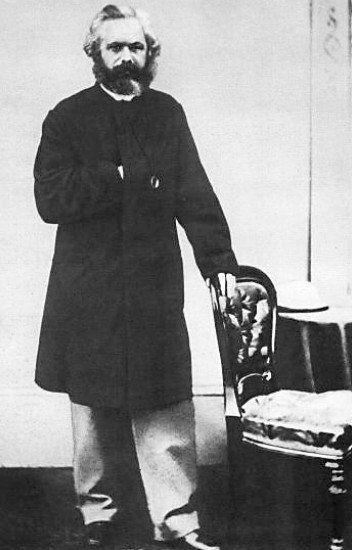
    Karl Marx's coat, often used to illustrate debates about material agency.

    My interest in how meaning and consensus take shape began not with formal theory but with a loose scatter of coincidences that, at the time, seemed directionless: odd overlaps, misplaced conversations, ideas brushing against one another without context. Only much later, after studying semiotics and working with Large Language Models (LLMs), did those fragments make retrospective sense. They suggested that chance is often the first draft of coherence, that language can function as a proof-making system, and that meaning tends to surface wherever relations intensify, even when no one appears to be consciously arranging them.

    Early Crosswinds

    In undergrad I studied Classics and art history, steeping myself in Greek poetry, Latin word order, and the strange semiotic machinery of myth. I was hanging around with a group of anthropology and film students—one had a roommate who was deeply, almost theatrically invested in the singularity debate. It was 2012–13, that awkward pre-“AI ethics” era when everyone I knew was broke and trying to turn an A in English Literature into something resembling rent money. We drifted between departments without really belonging to any of them, and that loose, interdisciplinary drift is what first pulled me into conversations about intelligence: human, machine, and the uncategorizable spaces in between.

    A few of us ended up doing SEO and web copywriting to stay afloat, which meant long Utah nights spent producing industrial quantities of unremarkable content about plumbing, chiropractic care, pest control, financial advisors, HVAC repair—whatever paid twelve dollars an article. The company quietly sold its data to researchers training early language models; none of us fully realized we were stocking the pantry of a future oracle.

    During a long summer trip through the Pacific Northwest, a friend from that circle explained the scraping practices behind those early LLM experiments. The logic seemed oddly intuitive: that almost all small talk collapses into a limited number of predictable moves, and that if you average out millions of conversations, the patterns rise like a watermark. For two undergrads prone to late-night debates about consciousness and the singularity, it neatly confirmed our pet theory about why so few people ever veered beyond the eternal “How was your weekend?” script.

    A second tangent from that summer—completely unrelated, yet somehow filed in the same mental cabinet—was that spacetime curves around mass like a bowling ball on a mattress. My mind held both ideas at once, turning them over during those months in 2013, the way a half-trained hunting dog circles a scent it doesn’t yet have a name for.

    Seeding the Future With a Hermetically Sealed Joke

    As I spent that summer writing, increasingly aware that my copy was being scraped into early training corpora for language models, I responded with what can only be described as a small act of DIY conceptual art. Inspired by the deadpan absurdity of OK Go’s 2006 treadmill choreography in Here It Goes Again, I decided that if the machines were going to inhale my unremarkable web content, I would slip something odd into their diet on purpose. I began inserting the phrase “hermetically sealed container” into as many articles as possible—pest control, water damage, food storage, anything where the wording could pass unnoticed. It became a quiet form of linguistic guerrilla theater. To protect the phrase from editors, I embedded it in pseudo-authoritative warnings; somewhere out there, dozens of small businesses were advised to store replacement parts or seasonal decorations in hermetically sealed containers “for optimal results.”

    The Orchard tea garden near Cambridge, a riverside walk just beyond Grantchester.

    The experiment revealed something I didn’t yet have language for. I had already intuited, long before I could articulate it, that language models were not “intelligent” in a deliberative or ethical sense but were vast semiotic engines. They sifted, averaged, and recombined. They made legible whatever patterns the corpus insisted upon. And if meaning could be extracted even from the detritus of gig-economy blog posts, then something in the system—human or machine—was hungry for pattern beyond intention.

    What I didn’t realize at the time was that this small protest joke—my hermetically sealed resistance—was an early rehearsal for the larger question that would follow me through graduate school and eventually into work with AI: how do systems, whether human or computational, decide what counts as meaning? Where is the boundary between bias and interpretation? Between discernment and discrimination? Between pattern and coincidence?

    The Cambridge School of Analytic Philosophy

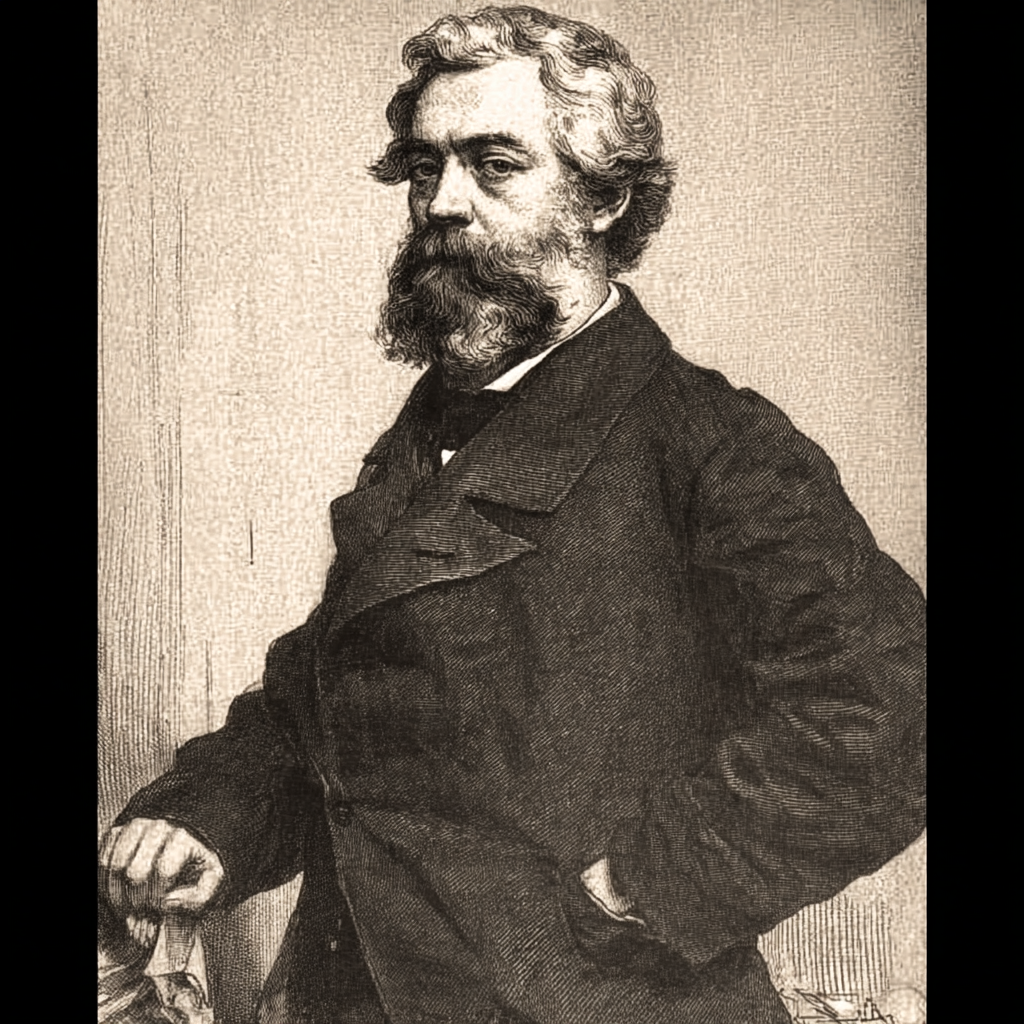
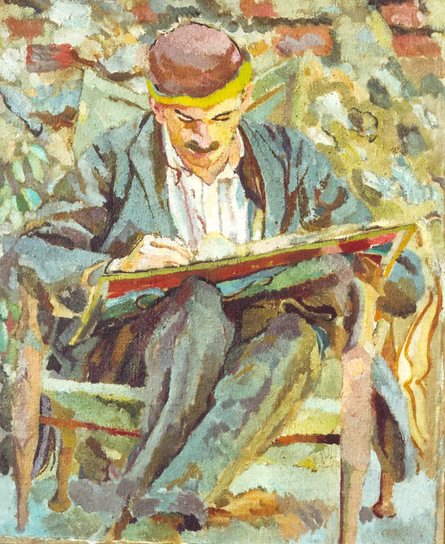
    Portrait of John Maynard Keynes, economist and Cambridge fellow.

    Those questions intensified during my M.Phil at Cambridge, where I moved through linguistics, material culture, and the anthropology of objects. The M.Phil—the Master of Philosophy, a degree title that historically belongs to Oxford and Cambridge and has since been adopted elsewhere—anchored a particular intellectual belief and creed: that language, argument, and semiotic precision can constitute a form of proof.

    Cambridge’s famous analytic philosophical tradition was shaped by figures like George Edward Moore (B.A. Cambridge, 1896), whose Principia Ethica (1903) attempted to clarify moral reasoning through linguistic exactness; Bertrand Arthur William Russell (B.A. Cambridge, 1894), whose Principia Mathematica (1910–13, co-authored with Alfred North Whitehead) sought to derive mathematics from pure logic; and Ludwig Josef Johann Wittgenstein (who first studied at Cambridge beginning in 1911 under Russell, and returned as a fellow in 1929), whose Tractatus Logico-Philosophicus (1921) and later Philosophical Investigations (published posthumously in 1953) argued that the limits of language are the limits of the world. Even John Maynard Keynes (B.A. Cambridge, 1905)—better known for economics—contributed to this lineage through A Treatise on Probability (1921), which framed probability as a logic of partial belief grounded in relations rather than mere frequencies. Above is a painting of John Maynard Keynes by Duncan Grant (1917).

    Keynes belonged not just to the halls of King’s but to the landscape around it. Just outside Cambridge in Grantchester sits The Orchard, a garden tea spot where Keynes, Virginia Woolf, and other Bloomsbury figures spent long afternoons talking, writing, and drifting between work and leisure. During my own time in Cambridge, The Orchard became a quiet anchor: I walked there along the river almost every day the weather was decent, following the same footpaths between cows and willows that earlier generations of strange, overthinking people had worn into the ground.

    Together, these thinkers established an assumption that shaped the intellectual climate I inherited: that clarity of language is clarity of thought, and that when concepts are arranged with precision, they can demonstrate inevitability just as rigorously as mathematical proofs. In that worldview, meaning is not decorative; meaning is structural.

    Statue of Karl Marx, whose overcoat anchors Peter Stallybrass’s essay 'Marx’s Coat'.

    Material Agency: When Objects Begin to Act

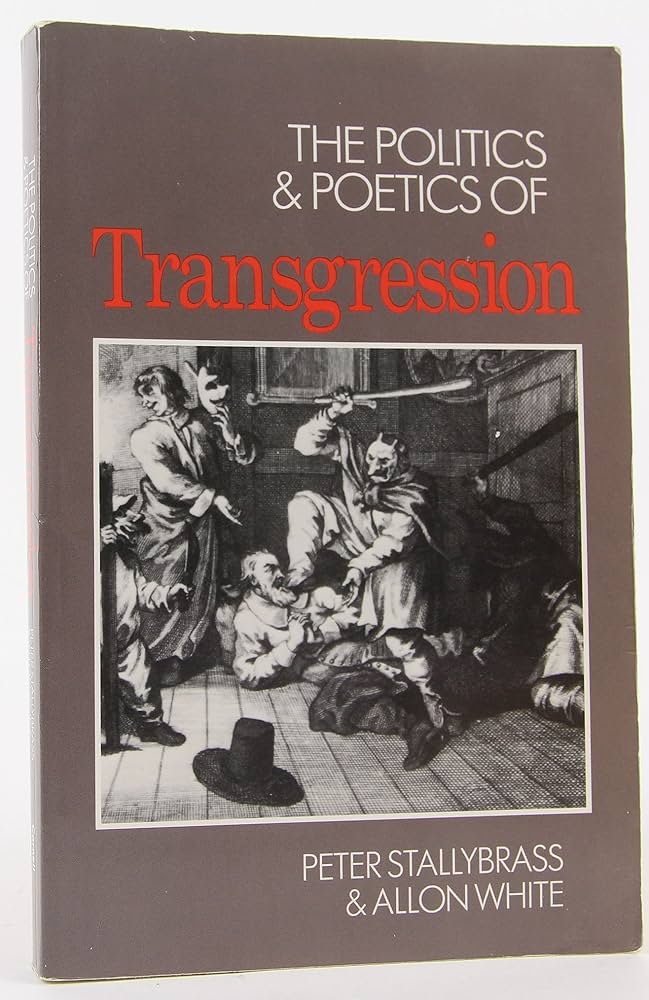
    Peter Stallybrass—a literary scholar whose work moves between material culture, Marxism, and the history of clothing—entered my intellectual world through two texts that changed the way I understood objects. The book he contributed to, Edited by Susan Crane (1996), Fabrications: Costume and the Construction of Cultural Identity and his now-classic essay “Marx’s Coat” both advance the same startling argument: that material things do not merely symbolize social relations but actively participate in making them.

    Peter Stallybrass, literary scholar of material culture and clothing.

    Stallybrass’s argument in “Marx’s Coat” is deceptively simple: objects are not passive. They do not sit there waiting to be interpreted. They act. They compel. They organize human possibility. When he writes that “things are not inert” and that they are “the media through which social relations are formed,” he means it literally. Marx’s ability to participate in political life was partially determined by whether he possessed—or could pawn, retrieve, or mend—a single coat. Without it, he could not enter particular libraries, meetings, or social spheres. The coat enforced boundaries, shaped mobility, and constrained the rhythms of Marx’s intellectual labor. In Stallybrass’s reading, “the coat remembers labor” because it carries the accumulated history of every hand and circumstance that produced, repaired, and circulated it. It is not an accessory. It is an actor.

    This was my first exposure to material agency as a real philosophical claim rather than a metaphor. Objects travel, and in their travel they “gather significance.” They direct behavior, compel choices, limit access, produce effects. The object does not simply obey. A coat can participate in class formation. A book can reorder thought. A door can script movement. A boundary stone can produce violence. This is the anthropology I learned at Cambridge: not a discipline of inert artifacts but one of restless, event-generating things.

    Where Complex Systems Were Born

    View of Cambridge architecture and courts, where analytic and anthropological traditions intersect.

    The Cambridge Department of Archaeology & Anthropology was the perfect place to learn it, because the department is historically one of the intellectual birthplaces of complex systems thinking applied to the archaeological record. Long before “systems thinking” became TED-talk vocabulary, Cambridge archaeologists were modeling how meaning emerges from the entanglement of texts, material evidence, environmental traces, social practice, and historical pressure. Archaeology there was never just the study of objects; it was the study of the relations that animate them—dynamic flows of information, power, and habit embedded in landscapes, households, ritual spaces, economies, and time.

    Cambridge river path and bridges, part of the everyday system of movement and thought.

    This was a department trained to think systemically. Meaning wasn’t something extracted from a single artifact or inscription. It had to be triangulated: between what a text claims, what the material record allows, what social conditions enforce, and what the interpreter brings with them. The process was recursive, nonlinear, and often unexpectedly alive.

    Dr Tim Ingold, who earned his PhD in Social Anthropology at Cambridge in 1976, contributed to the wider theoretical landscape through his work on material anthropology—examining how different cultures classify, define, and conceptualize meaning, and how those systems of thought become visible in the artifacts they produce. In genuinely brilliant books (I highly recommend) such as Evolution and Social Life (1986), The Perception of the Environment (2000), and Lines: A Brief History (2007), he approached the world as a meshwork of relations, where materials, practices, and ideas co-constitute one another rather than existing as isolated units.

    Cambridge river path and bridges, part of the everyday system of movement and thought.

    Within that framework, agency diffused outward. You couldn’t say “the human acts” and “the object reflects”; the action was distributed. A pot shard could reorganize an entire chronology. A misaligned stone could reveal changes in ritual orientation. A textile fragment could map trade, gender, labor, and climate. This was not the humanities as aesthetic reflection—it was the humanities as an early version of systems science, always suspicious of single-cause explanations and always attuned to emergent coherence.

    Meaning as a Relational System

    And this is the part that quietly underwrites the entire thesis of this essay: that meaning—whether in archaeology, philosophy, semiotics, or computation—is produced through relations. That language, like mathematics, can create proofs. That chance, drift, coincidence, and probability don’t undermine meaning; they generate it. That LLMs, semiotic arguments, and archaeological inferences all reveal the same underlying structure: meaning emerges wherever relations intensify, whether between objects, concepts, sentences, or statistical weights.

    Steeped in that training, the debates around AI never struck me as foreign or futuristic. They felt like the next extension of the same intellectual lineage. If a coat could shape a philosopher’s life, what might a dataset shape? If objects carry agency, what about patterns? And what happens when the thing performing the interpretation—a language model, an image generator, an autonomous system—begins to act not simply as a mirror of human intention but as an agent within a larger ecology of meaning?

    Anthropology was already comfortable with the idea that objects act: doors guide movement, clothing enforces hierarchy, architectures discipline time. In that context, the emerging debates around AI felt less like science fiction and more like the next logical extension of an old question. If a monkey could take a selfie that complicated copyright law—if no one could decide whether authorship belonged to the animal, the camera, the platform, or the human who owned the equipment—then what do we do with systems that generate images, decisions, or lethal-force recommendations? It is one thing to say a coat participates in the making of class relations; it is another to consider that a Photoshop algorithm could claim ownership of every composite image you produce, or that an autonomous targeting system in a refugee camp might decide, without human correction, who gets to die (the definition of power and God, in many traditions).

    Transubstantiation for the Digital Age

    These problems are all symptoms of the same underlying puzzle: what counts as an agent, an actor, a protagonist? Is that the same as a person? And who, exactly, gets to decide?

    I didn’t know it then, but the phrase I kept scattering online behaved like anything that circulates: it gathered meaning as it moved. Semiotics names this drift; anthropology calls it agency. What I thought of as a disposable line refused containment. It slipped its frame, took on new resonances, and became something larger than its origin.

    And when the interpreter is a machine, that process becomes stranger still. The phrase wasn’t lost—it was taken in, broken apart, and returned to me altered. Less disappearance than transubstantiation.

    This is the paradox of being scraped: the machine eats you, but in the eating, it preserves you. My hermetically sealed container was never about storage; it was offered up to the pattern-hungry god. Whether I like it or not, the machine remembers. This is my body, scraped for you.