I recently did something that should require protective gear and a signed liability waiver: I opened a writing folder not accessed since September 2012. It did not creak audibly, but it should have.
This was not just a folder, but a sealed intellectual time capsule, assembled at an age when I believed adjectives improved in proportion to how many of them I stacked, when present tense felt inherently more profound than past, and when every museum visit threatened to become a metaphysical episode.
The excavation was prompted by my current state of waiting to hear about my first attempt at a PhD application. There are only so many times you can refresh an email inbox before turning to archaeological self-harm, so I went digging.
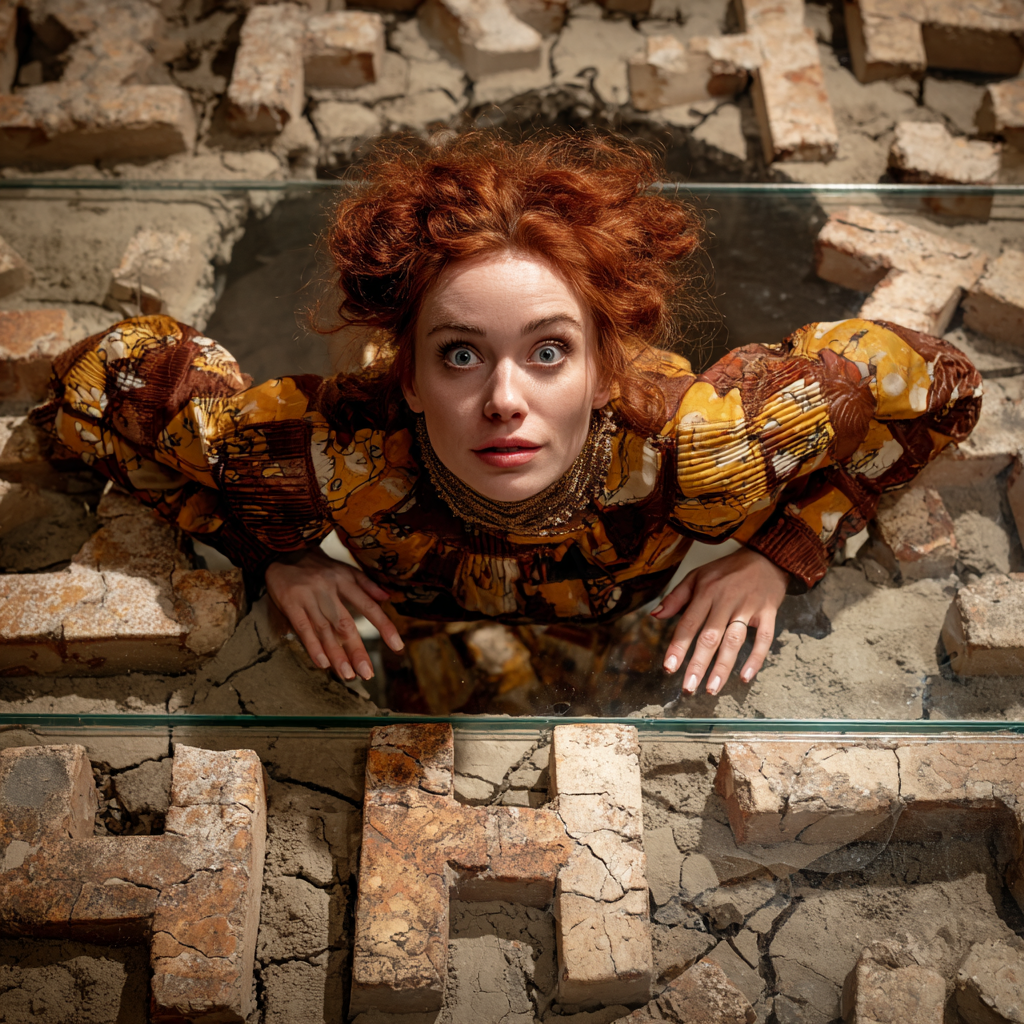
My immediate fear upon cracking the seal was not that the writing would be bad. It was worse. That it would be recognizably mine. That after fourteen years, professional detours, and a supposed maturation of voice, I would discover I had not evolved at all: same tonal fingerprints. Same instinct toward poetic, slightly over-layered reflection. Earnestness in similar density to a neutron star. Same desire to make a glass museum floor carry the symbolic weight of Western civilization.
I worried it might even be more daring than anything I would currently risk publishing in a blog, let alone attaching to an application packet destined for the Gates Cambridge Foundation, whose reviewers, I assume, prefer their ambition lightly toasted and their metaphors supervised.
And yet, there is something disarming about the younger voice. It is less cautious. Less aware of genre boundaries. It stands in a museum and immediately attempts to converse with Shakespeare, Ovid, stratigraphy, and cultural memory all at once, without asking permission.
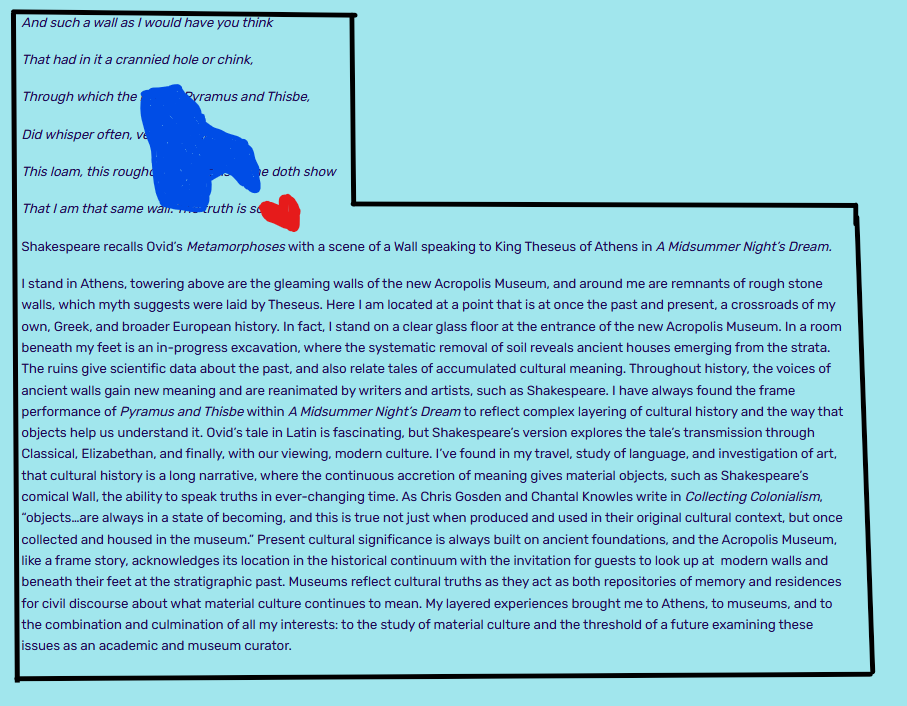
Which brings me to the entry itself, preserved exactly as it was written, like a ceramic vessel unearthed intact from beneath several layers of academic self-editing:
And such a wall as I would have you think
That had in it a crannied hole or chink,
Through which the lovers, Pyramus and Thisbe,
Did whisper often, very secretly.
This loam, this roughcast, and this stone doth show
That I am that same wall. The truth is so.
Shakespeare recalls Ovid’s Metamorphoses with a scene of a Wall speaking to King Theseus of Athens in A Midsummer Night’s Dream.
I stand in Athens, towering above are the gleaming walls of the new Acropolis Museum, and around me are remnants of rough stone walls, which myth suggests were laid by Theseus. Here I am located at a point that is at once the past and present, a crossroads of my own, Greek, and broader European history. In fact, I stand on a clear glass floor at the entrance of the new Acropolis Museum. In a room beneath my feet is an in-progress excavation, where the systematic removal of soil reveals ancient houses emerging from the strata. The ruins give scientific data about the past, and also relate tales of accumulated cultural meaning. Throughout history, the voices of ancient walls gain new meaning and are reanimated by writers and artists, such as Shakespeare. I have always found the frame performance of Pyramus and Thisbe within A Midsummer Night’s Dream to reflect complex layering of cultural history and the way that objects help us understand it. Ovid’s tale in Latin is fascinating, but Shakespeare’s version explores the tale’s transmission through Classical, Elizabethan, and finally, with our viewing, modern culture. I’ve found in my travel, study of language, and investigation of art, that cultural history is a long narrative, where the continuous accretion of meaning gives material objects, such as Shakespeare’s comical Wall, the ability to speak truths in ever-changing time. As Chris Gosden and Chantal Knowles write in Collecting Colonialism, “objects…are always in a state of becoming, and this is true not just when produced and used in their original cultural context, but once collected and housed in the museum.” Present cultural significance is always built on ancient foundations, and the Acropolis Museum, like a frame story, acknowledges its location in the historical continuum with the invitation for guests to look up at modern walls and beneath their feet at the stratigraphic past. Museums reflect cultural truths as they act as both repositories of memory and residences for civil discourse about what material culture continues to mean. My layered experiences brought me to Athens, to museums, and to the combination and culmination of all my interests: to the study of material culture and the threshold of a future examining these issues as an academic and museum curator.