
Forking paths and unrealized worlds
In several short stories in Ficciones, Jorge Luis Borges describes time as a branching structure in which multiple outcomes coexist, though only one is experienced at any given moment. A narrative unfolds in a single line of text snaking back and forth across the page, but it gestures toward a system in which that particular assemblage of words, spaces, and punctuation is only one of many possible outcomes. In “The Library of Babel” (1941), the possible organizations of text in an infinite library expand into a metaphor for the ordering of reality itself.
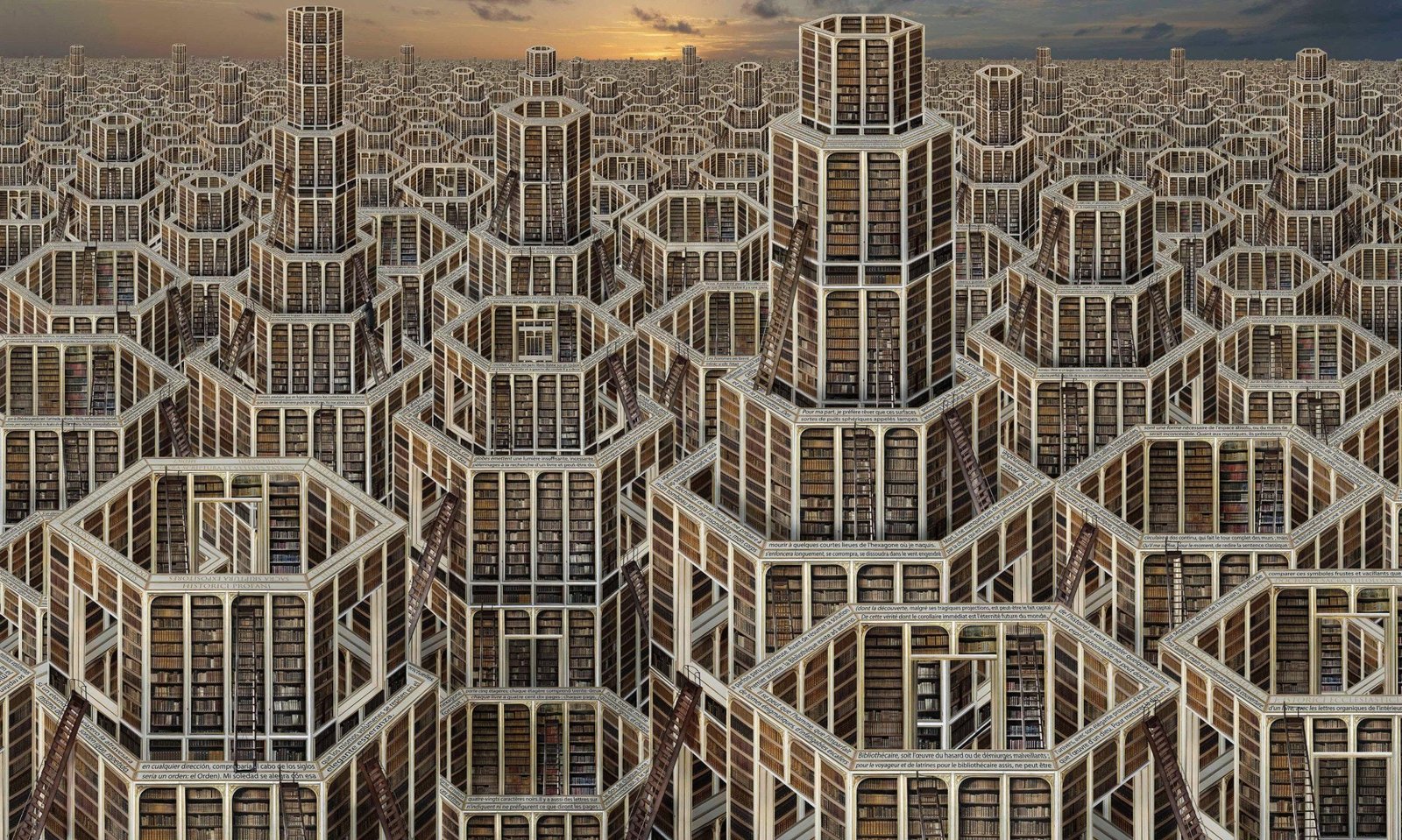
The other possible universes, other ways of arranging the same finite alphabet of letters, spaces and punctuation within Borges’s Library of Babel, are not visible once you type out a page or select a book from the Library. But these unrealized possibilities remain structurally present. They can be computed, inferred and even generated by creative algorithms operating through variable inputs. The absences, not only the presences, shape the meaning of what is perceived, even when those absent possibilities are never encountered. In this sense, Borges’s fictional cosmology also suggests something about the relation between visible and invisible structures in physical reality. The perceivable world may itself be partially constituted by forces and potentials that remain unseen, much as contemporary physics proposes interactions between observable matter and forms of dark matter that can be inferred.
In some interpretations of physics, outcomes are described probabilistically, with multiple possibilities held in tension until one is realized. The unselected paths don’t vanish. They remain embedded within the structure that defines what could occur. The language differs across theories, whether branching timelines, probability distributions or parallel states, but the underlying idea remains: lived experience emerges from only one traversal through a largely invisible field of rippling, infinite complexity.
A similar logic appears in computational modeling. In machine learning and statistics, Hidden Markov Models are designed to infer hidden states from visible sequences unfolding over time. The system never encounters the full structure directly. It observes partial outputs, then estimates the unseen conditions most likely to have produced them by tracking patterns, transitions and accumulated probabilities across a sequence. As new information appears, the model continuously revises its understanding of the invisible structure underlying what can be observed. Over time, absences, unrealized transitions and latent relationships become legible (probably) through dynamic inference.
This produces a useful analogy for perception itself. Experience follows a single path through a wider structure of unrealized possibilities, while the mechanisms generating those possibilities remain only partially visible. What is encountered is shaped not only by what appears, but also by the invisible architectures, probabilities and excluded states surrounding it.
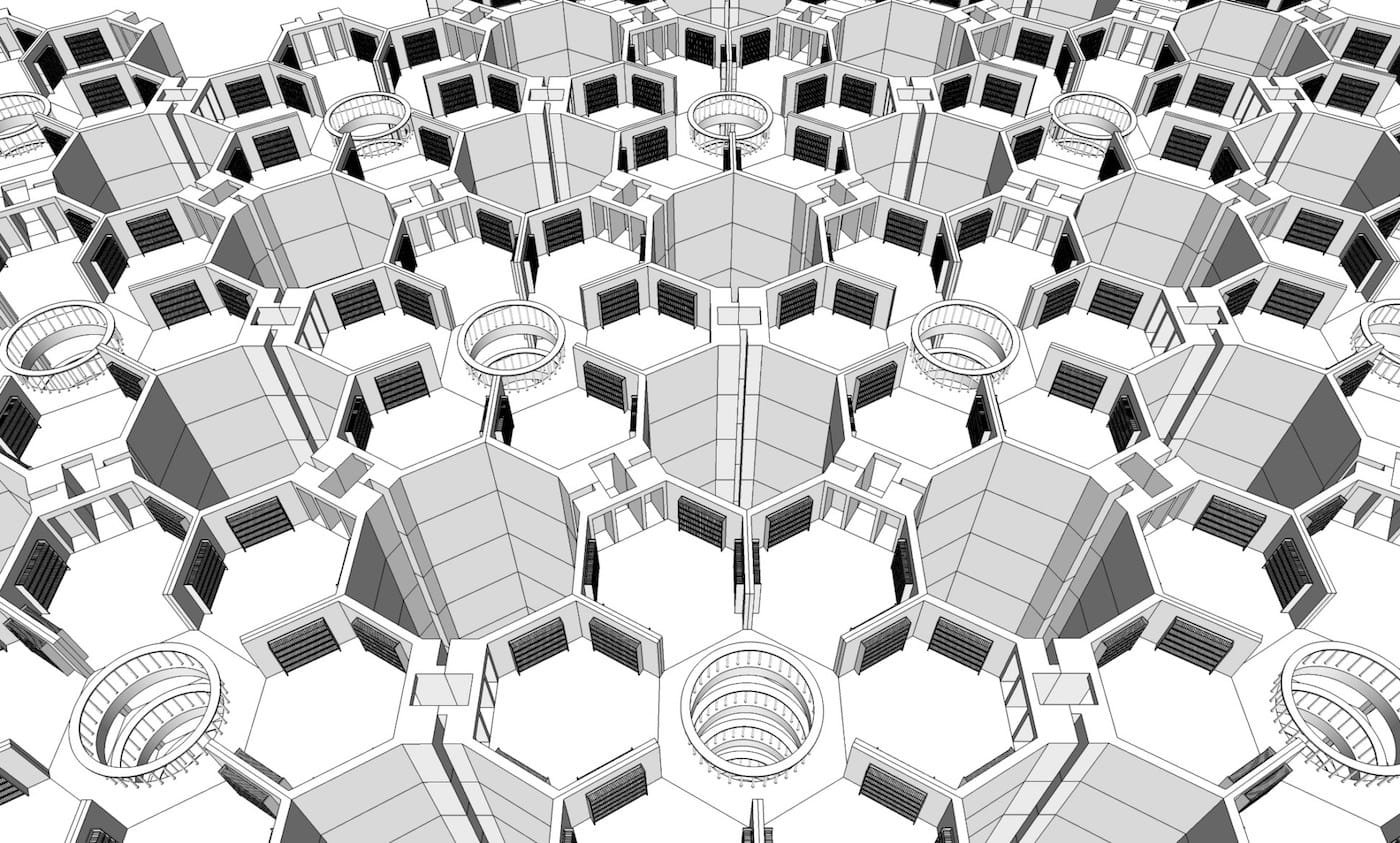
Seen this way, dimensionality begins to describe more than space. It starts to look like the underlying structure through which anything becomes intelligible at all. Human perception doesn’t arrive fully formed or evenly distributed. It develops in layers, moving from simple relations toward more integrated forms of interpretation. At first, those structures feel like limits: they define what can and can’t be grasped. But over time, they begin to function differently. What was once a constraint becomes something that can be used. Patterns are recognized, then anticipated, then arranged. The shift is gradual, but it changes the character of experience. Perception becomes something that can be shaped and, to a certain degree, directed to become more than what it may initially seem to be.
The higher order of polygons
“Flatland: A Romance of Many Dimensions” (1884), written by Edwin A. Abbott, provides a useful starting point because it treats perceptual limitation as a structural condition. Abbott spent much of his professional life at the City of London School while writing theological works shaped by the growing tension between Anglican doctrine, biblical criticism and scientific modernity in nineteenth-century England. That intellectual climate informs Flatland’s deeper premise: reality may extend beyond what a system is capable of perceiving, even when the inhabitants of that system experience their worldview as complete.
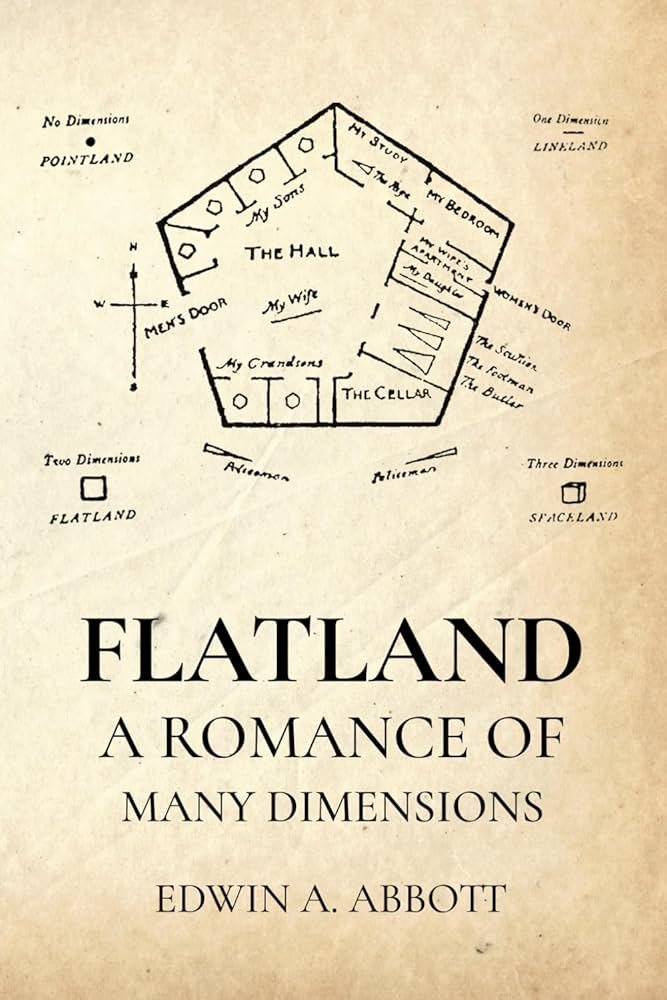
Its two-dimensional universe demonstrates how a perceptual structure determines what can be known from within it, while anything outside that structure appears only in partial or unstable forms. The boundaries described in Flatland are therefore not simple absences. They are constraints built into the system itself. Certain relations can be perceived and organized coherently while others remain inaccessible because the dimensional framework cannot accommodate them. This idea parallels the logic underlying probabilistic modeling and Hidden Markov systems, where visible outputs provide only partial evidence of a larger hidden structure unfolding across time. Meaning emerges through inference, pattern recognition and the gradual organization of incomplete information.
The novel’s rigid geometric hierarchy also extends this problem into social life. In Flatland, a being’s status is determined by the number of its sides, transforming dimensional difference into an organizing principle for class, authority and legitimacy. Social perception becomes inseparable from structural limitation. Individuals cannot fully recognize realities their system has not prepared them to interpret, and unfamiliar forms are often dismissed as irrational or impossible. What can be seen depends upon the architecture through which information is filtered, organized and given meaning.
From within that system, higher dimensions do not appear directly. They are inferred when the existing structure begins to fail. Patterns emerge that cannot be fully accounted for, regularities that remain consistent but unresolved. The introduction of a new dimension does not add more detail to the same view. It reorganizes the field entirely, allowing those patterns to become intelligible.
In this sense, progression between dimensions is not a matter of accumulation but of reconfiguration. Earlier structures remain in place, but they are taken up differently, as part of a broader system. What changes is not the presence of information, but the way it can be related, interpreted and used.

The problem Abbott stages is about knowledge, and about the limits built into any system of perception. A two-dimensional being cannot perceive depth. It can only infer it, and even that inference remains partial. When the sphere appears in Flatland, it does not register as a coherent object. It appears as a circle that expands and contracts, an event that is visible but not fully intelligible. Something is happening, and the evidence is there, but the structure behind it does not quite resolve. The gap between perception and explanation persists.
That gap matters because it marks a change in the terms of understanding. Introducing another dimension doesn’t add information to what is already known. It alters the framework within which information is organized. What once seemed complete begins to show its limits. What felt stable becomes provisional. The shift has the quality of a misalignment, a recognition that the structure in use has been narrower than it appeared. From within that recognition, new forms of organization become possible, along with a more deliberate relationship to the structures that shape experience in the first place.
Self-reference and dimensional shift
The limitations Abbott describes do not stop at spatial perception. They show up in formal systems as well. In Gödel, Escher, Bach: An Eternal Golden Braid (1979), Douglas Hofstadter follows this problem into the realm of symbolic logic and self-reference, asking how meaning arises from systems built out of simple rules and relations. These systems are capable of producing remarkable complexity, but they remain bounded by their own structure. What cannot be represented within the system does not fully appear from inside it. It may leave traces, or produce effects, but it does not resolve cleanly.
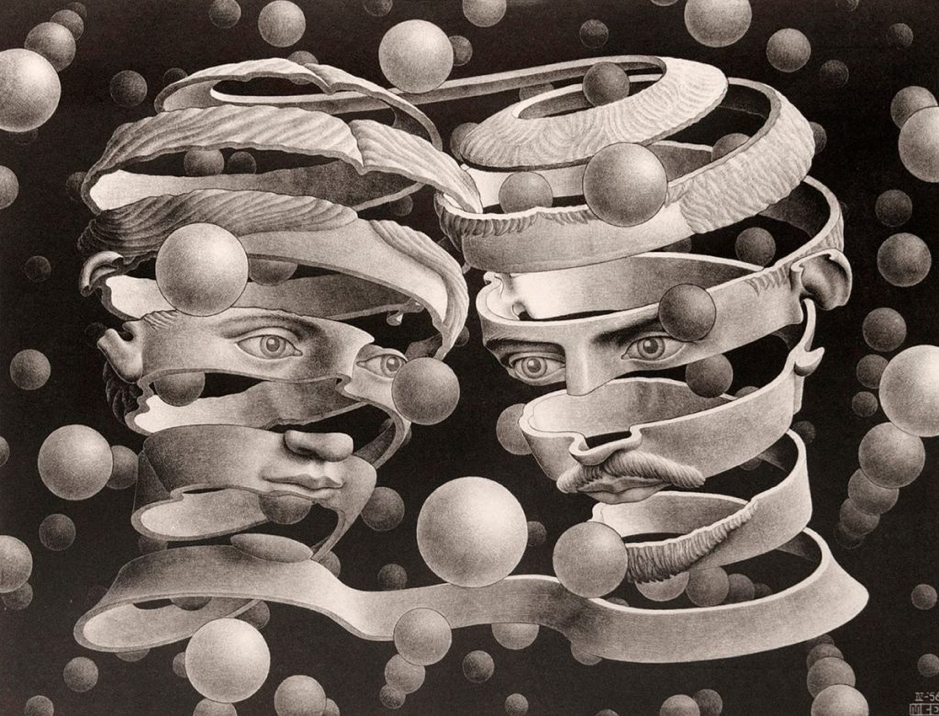
Gödel’s incompleteness theorems make this visible in a precise way. Any sufficiently expressive formal system contains statements that are true but cannot be proven within that system. The structure holds, and at the same time it reveals its limits. A similar pattern begins to emerge. A system organizes perception at one level while keeping the terms of its own organization out of reach. To recognize those terms requires a shift in perspective — a step outside the system, or at least a change in how it is being used.
Perception develops in layers and moves between structures, each of which brings certain relations into focus while leaving others implicit and largely invisible. With each shift, what can be seen, connected and understood is reconfigured. Earlier layers remain in place, but they are taken up differently according to the perceptual and interpretive capacities of the observer, becoming part of a larger and more nuanced arrangement.
A working theory of the fifth dimension
Following a severe case of walking pneumonia in 2020, that profoundly altered my sense of reality and left me physically and mentally depleted for a long time, I’ve been trying to understand what higher dimensions are. Closely related questions: how human beings experience them and how to communicate aspects of reality that resist ordinary language.
The idea of a fifth dimension has been claimed more than once, and rarely in the same way twice. In physics, it appears as an extension of spacetime, sometimes compact and invisible, sometimes folded into higher-dimensional models that resist visualization. In philosophy, it tends to surface as a name for what exceeds ordinary perception: consciousness, possibility or some expanded mode of awareness. In more speculative traditions, it is treated as a threshold where the structure of reality gives way to interpretation, where perception itself becomes malleable.
This movement has often been described in more speculative or symbolic terms. In the language of alchemy, it’s part of the Great Work, a process of refinement that transforms and deepens how reality is perceived and engaged. Read in this light, the effort to apprehend higher dimensionality can occur only through a corresponding inner transformation, allowing the lower layers to be perceived differently and brought into a more coherent relation with one another.

Once symbolic structure, spatial orientation and temporal flow are experienced as coordinated and meaningful, they may also be composed and shaped as meaningful experience to communicate more complicated information to others. Each type of art has specific genre conventions, or more complex methods, for reflecting higher levels of reality or more complex truth. In terms of film, confined space with limited visibility produces a different response than an open environment with steady pacing and clear sightlines, and through repetition, the body learns these arrangements well enough to react to them as “types of experiences” that produce “certain feelings.”
Under conditions of extreme stress or exhilaration, perception becomes intensified. In the real world, responses to stimuli shift with exhaustion, altered states or changes in perception itself, affecting how space is read, how time is felt and what is taken to matter. In moments like the suspended clarity of a car crash, attention narrows while sensory information sharpens, producing the feeling of being completely inside the flow of events as they unfold. Small movements, changes in rhythm or shifts in atmosphere become unusually legible, and the body begins anticipating outcomes before conscious thought fully catches up. What is often described as “extra sensory” perception may emerge from this heightened coordination of attention, timing and pattern recognition, when every perceptual system becomes temporarily aligned around survival.
In this working theory, the fifth dimension is in small part what writers clumsily call “genre.” It shapes how rules, space and time are organized, guiding the experience that unfolds across them. Horror, nostalgia, suspense or reverence don’t depend on content alone, they take form through the patterned coordination of symbolic cues, spatial framing and temporal pacing, which can be recognized, and, with practice, deliberately constructed.
The reader inside the labyrinth
In Borges, genre is not only employed but exposed as a structural device. Stories such as “The Garden of Forking Paths” and “Tlön, Uqbar, Orbis Tertius” are presented as essays, reports or discovered texts, often embedding fictional documents within ostensibly factual frames. The effect is a reconfiguration of how symbolic systems, spatial orientation and temporal sequencing interact. The reader must navigate multiple layers at once: the narrated world, the textual artifact and the frame that presents it. These layers, sometimes expressed as metadata, press together and blur the boundaries between fiction, commentary and reality.
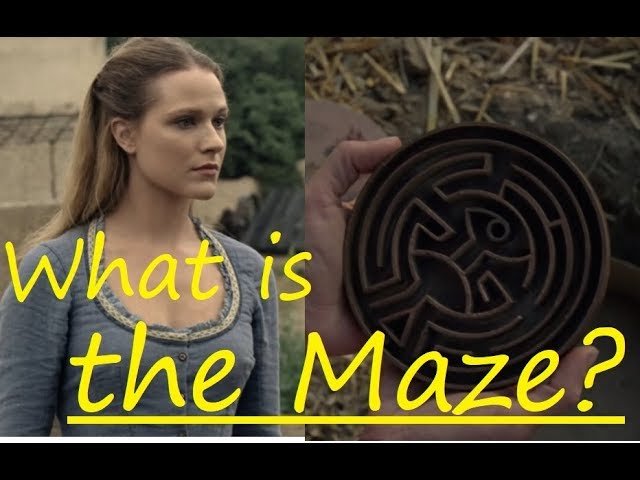
What Borges makes explicit is the transition this model describes. Earlier dimensions remain present — symbolic relations, spatial orientation, temporal sequence — but they no longer operate independently, and their coordination begins to register within the act of reading itself, as structure comes into view without fully stabilizing. Genre no longer sits outside the experience as a label. It becomes part of what the reader encounters, something that can be followed, anticipated and, at times, noticed in the moment it takes hold.
The coordination of dimensions
Through repetition, these arrangements become familiar enough to produce reliable patterns of emotional and cognitive response, altering how attention moves and how meaning is assembled, often before those effects are consciously recognized. Genre operates less like a fixed category than a larger perceptual field within which individual subgenres function like classes in programming: reusable structures carrying inherited rules, constraints and expected behaviors that can be instantiated across different contexts. These structures communicate recognizable forms of emotional and symbolic information because they organize perception according to patterns already sedimented within collective memory and cultural experience.
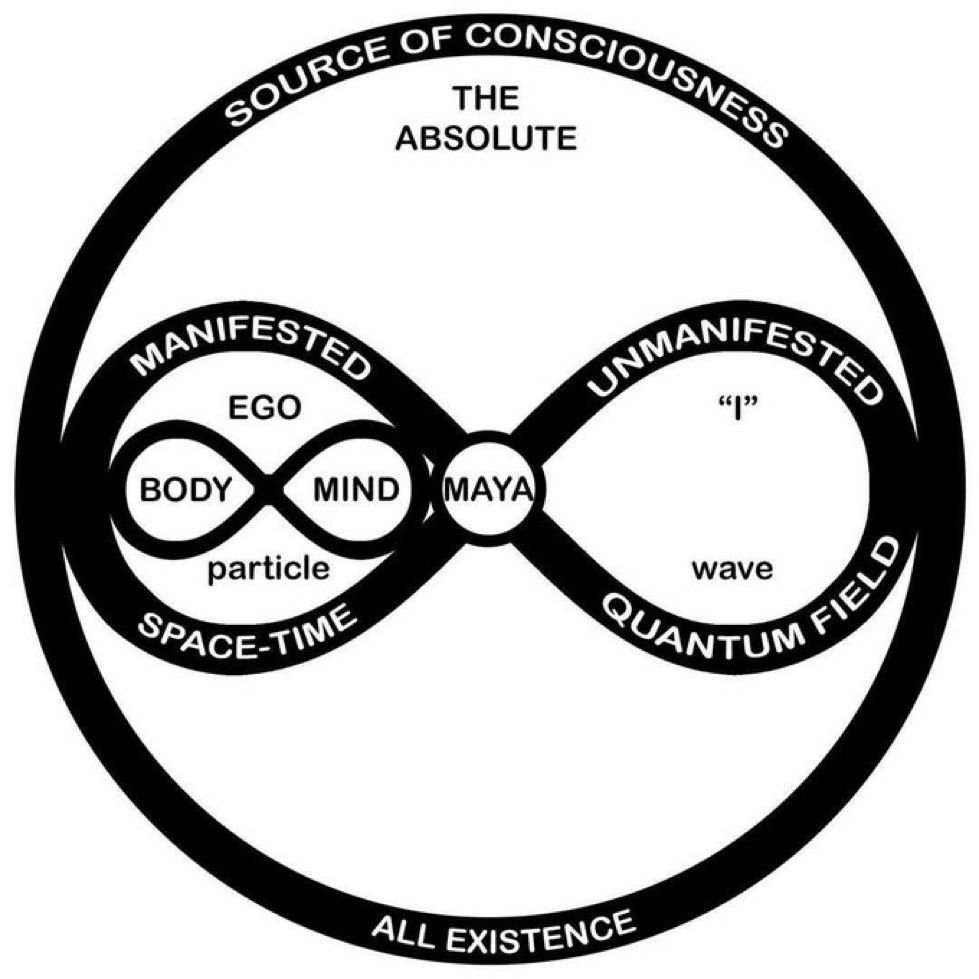
This resembles the logic underlying Hidden Markov Models, where observable outputs provide only partial evidence of larger hidden states unfolding across time. Surface details vary, yet recurring structures allow the perceiver to infer the underlying pattern generating them. Genre’s cues point toward broader latent structures organizing expectation and interpretation beneath conscious awareness, while meaning partly emerges through the interaction between what can be directly perceived and what must be inferred through repeated effects.