Tag: cambridge

  • Born Into a Spoiler Alert: Notes from a Macbeth Descendant

    Placeholder image

    Today is December 7th, 2025, the day after my mom’s and brother’s birthdays, and I’m back in one of my favorite places: the Marriott Library. I got my lucky spot, the exact one I used to sit in, like it had been waiting for me. In terms of lucky coincidences, things like this happen more than they should.

    My mom used to say, “A golden cloud follows you around.” However, other sayings exist too, like: “She’d lose her head if it wasn’t attached to her body.” The combination captures the polar quality of my luck—weirdly good, and then a pendulum swing to weirdly bad.

    Before I get too far into family legends, I keep thinking about a recent piece I wrote—“Fairytales We Tell Ourselves: The Utah Pantages Theater and Ingmar Bergman’s Persona”—and about my friend Michael Patton, who works under the name Michael Valentine. Michael is a direct descendant of General George S. Patton, a fact he acknowledges with a mix of irritation and resignation. He chose “Valentine” as a protest against war culture, a way of stepping sideways out of the mythology he inherited.

    Good Luck / Bad Luck: Growing Up in the Shadow of “Greats”

    It hit me while writing that earlier essay that both Michael and I grew up with blood-soaked ancestors—his, the general who carved his way through Europe; mine, the doomed Scottish king whose story ends in a battlefield death every time it’s told. There’s an odd magic to that, the kind that looks enviable from a distance but comes with expectations no one volunteers for. Patton and Macbeth: two figures shaped by violence, ambition, and myth—men who loom so large that their descendants end up negotiating not just lineage, but full-fledged Western narratives.

    In the Pantages essay, I wrote about how spaces like that theater hold our personal myths in place—how they give people like Michael, and honestly people like me, a place to set down the stories we inherited and pick up new ones. The demolition of the Pantages in 2022 felt like a symbolic rupture: a place where stubborn idealists once found refuge was flattened, and with it went the kind of civic imagination that makes room for oddball lineages and myth-haunted people.

    All of this is to say: some of us are born into stories much louder than we are. You spend your adult life deciding which parts you’re willing to keep.

    Call Me Locks: Lady Macbeth Was My Grandmother!

    All the relatives on my mom’s side are McBeth or MacBeth or some variant of the name. The eccentric streak runs deep enough that the spelling seems to shift with personality, era of life, or whatever the family mood was at the time. You can see the whole taxonomy laid out in the Payson, Utah graveyard where my ancestors are buried.

    Placeholder image

    It’s always interested me that some cultures routinely give their kids names tied to frightening or controversial figures. Not because people secretly want a little villain in the family, but because naming a child something heavy forces them to reckon with it early. Kids will tease them, question them, make them explain it long before they’ve even learned the history behind their own name. Maybe that’s the point: you get all the shadow-work done in childhood. You learn early not to flinch at darkness, not to identify with it. Sometimes you even outgrow the propensity for villainy before you’ve had a chance to try it on.

    Maybe because of that, I always had a low, reflexive cringe around the overbearing, over-ambitious persona of Shakespeare’s Lady Macbeth. When I lived in Cambridge, I’d occasionally end up in small Shakespeare chats with baristas or grocers, and some of them made truly awful faces when the play came up. I’d laugh and tell them I didn’t actually read it until college—and did end up liking it—but for a long time I avoided English literature altogether because it felt too on-the-nose; almost like declaring myself an English major would read as a horrible gimmick.

    And yet, despite all my attempts to outrun the melodrama of the name, I somehow drifted straight into the territory I thought I’d avoid—history, archives, Scotland, the whole ecosystem of stories that orbit the Macbeth myth. It’s ridiculous, but also very “family legacy” in the mythic, Oedipus kind of way: the more you sidestep something, the more directly you walk into it.

    Because of that, I have a deep sympathy for celebrity kids and for anyone saddled with a complicated or suddenly loaded name. Think of people named Isis, who now share their name with a terror organization, or girls named Katrina who were born before the hurricane. In the era of the internet, your name becomes a label that precedes you everywhere, a magnetic force field you never asked for. While I love memes and jokes and occasionally peeking into gossip culture, I have a complicated relationship with what it means to be defined—lightly or heavily—before you even arrive.

    The Worst Cringe I’ve Ever Felt

    Perfectionists learn to metabolize embarrassment early. You practice smoothing over mistakes, pretending nothing happened, moving on. Yet as you get older and more competent, the mistakes grow sharper teeth. They wait for you in the places you least expect, like tiny traps set by the universe just to keep you humble.

    I loved ancient languages and museums, so I applied for a master’s with the full, naïve conviction of someone who has no backup plan. I didn’t scatter applications across a dozen programs; I chose one, gave it everything, and hoped. Getting accepted was one of the happiest moments of my life. Even with the bare-minimum funding, I packed up and moved to England in 2013 with a kind of reckless gratitude. I had arranged a student room, memorized the streets on Google Maps, and rehearsed my own arrival like it was a scene in a film.

    Before I got there, the university assigned me my email and login credentials. Seeing the “@cam.ac.uk” address made everything feel both official and impossible. There I was: walking off the train dragging my 80lbs suitcase over the uneven pavement, unlocking the rented room I’d only ever seen on a screen, and feeling—briefly, miraculously—like the version of myself I’d always hoped I would become. Even the silence of the first night, sitting on the narrow bed with the radiator clanking to life, felt like prophecy coming true.

    I glanced at the autogenerated email username; apparently, there were quite a few students with my initials who came before me—so many shoes to fill! I thought. The number embedded in my unique Cambridge identifier was the number 33. I like multiples of 11. November baby. Grew up near 3300 South and St. Mark’s Hospital (I almost got a winged lion tattoo; maybe I still will). This gemmatria-esque-hippie-numerology detail registered as a tiny wink from the universe; everything is sure going my way, I thought.

    For weeks, I floated. I went to induction sessions, bought my first British groceries, tried not to look like an overwhelmed American. I signed emails automatically with my new Cambridge address, barely thinking about the random “33” tacked onto it. It was just another institutional quirk, like the fact that no one ever explained how the dining hall seating worked.

    Then—months later, at the Hughes Hall bar, half-drunk with a pack of French classmates—the brakes hit. Someone asked a simple question about how Cambridge generates its usernames. I answered without thinking, rattling off mine and mentioning the “33” as casually as noting the weather. The reaction was immediate. A full-body groan from one side of the table. Explosive laughter from the other. Someone actually slid off their chair.

    Only then did they manage to explain to me—between gasps—that “33” is used as a white supremacist code. And that “HH,” the abbreviation for Hughes Hall, is another one. I stared at them while they howled with the kind of laughter that makes strangers turn around. I was actually holding back tears of horror.

    I replayed every email I had ever sent. Every form submitted. Every professor addressed. Me, earnestly signing off with a digital calling card that, out of context, looked like a secret handshake with the worst people alive. It was—without exaggeration—the purest cringe of my adult life. Thankfully, Cambridge changes your email when you graduate. I shed the cursed numerology and emerged simply as hannah.mcbeth. A clean slate; a merciful reset.
    Placeholder image

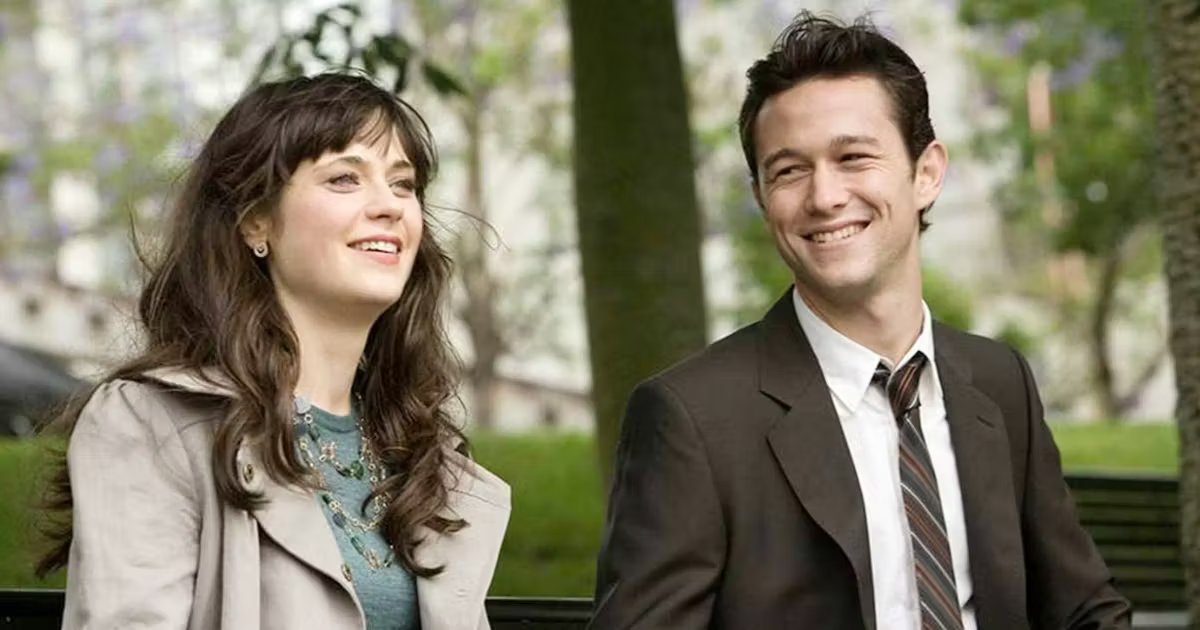
    In one of my favorite films 500 Days of Summer, Joseph Gordon-Levitt’s character asks Summer (played by the immortal Zooey Deschanel) if she ever had a nickname in school. She deadpans: “They called me Anal Girl because I was so neat and tidy.” He spits out his drink.

    I think “Hitler Girl” might even be worse.

    On Luck, Names, and Everything We Don’t Choose

    Sitting here today in my old lucky spot at the Marriott Library, I keep thinking about how wildly inconsistent luck can feel when you grow up inside a name, a story, a family mythology you never exactly signed up for. Some people inherit money or land or a family business; others inherit legends, curses, punchlines, or—if they’re especially unlucky—an email address that accidentally signals extremism. The older I get, the more I realize the shape of your inheritance matters less than the way you learn to carry it.

    Some of us get the blood-soaked ancestors, the melodramatic surnames, the oddball reputations that precede us into rooms. Some of us get the tiny mortifications that knock the wind out of us in foreign bars. Some of us, if we’re really paying attention, also get the golden-cloud moments—the quiet return to a library desk that feels like a portal back to the versions of ourselves we’ve been building, fleeing, or reinventing for years.

    Maybe that’s the real trick of growing up in the shadow of “greats,” whether real or imagined: eventually you stop trying to outpace the story and start editing it. You keep the parts that still feel alive, you leave behind the parts that were only ever projections, and you learn to laugh—properly, deeply—when life hands you the kind of cringe you’ll be telling forever.

    Names, myths, coincidences, curses, blessings: they all get folded into the same narrative eventually. Somehow, here I am again, in December light, at the desk that always seems to be waiting for me—proof that sometimes the pendulum swings back toward the good, weirdly and without warning, just when you need it most.
  • When Logic Leads to Nonsense

    When my brother gave me a Raspberry Pi one Christmas around 2010 — a palm-sized computer meant to teach beginners how to code—I’d been studying Greek and Latin for several years at the University of Utah. By that point, I was deep into intermediate courses in the Department of Languages & Literature that ended up reorganizing how I thought.

    I was lucky to have professors whose passion for ancient languages shaped me—Professor Randy Stewart, Margaret Toscano, and Jim Svensen among them—each offering a different way of thinking through a text, a question, or a problem.

    Those years were quietly training my mind to think in structures—patterns, contrasts, paired ideas. So when I finally opened the Raspberry Pi tutorials later that winter, the logic didn’t feel new at all. It felt like something I had already learned in another language.


    Hopwag

    The History of Philosophy Without Any Gaps Podcast: Get a free, world-class philosophy education (click image).

    The Old Logic Behind New Machines

    When I sat down over winter break and started the tutorials, what stood out immediately was the clarity of the structure. The if/then statements and small branching choices that guide a program forward followed the same logical architecture I had been working through in Greek. The μέν / δέ construction—literally “on the one hand / on the other”—sets up a two-part contrast that divides an idea into paired alternatives. Aristotle uses this same structure when he lists the basic contraries of nature, “τὰ ἐναντία, οἷον θερμὸν καὶ ψυχρόν” (“the contraries, such as hot and cold,” Categories 11b15). In its simplest form, it is a binary: a choice between two structured possibilities.

    The same pattern appears in conditional moods like εἰ with the optative or ὅταν with the subjunctive, which sketch out hypothetical paths depending on whether a condition is or is not fulfilled. Basic programming follows the same logic—not metaphorically, but mechanically—moving forward only through a chain of divided possibilities.

    Greek philosophy forms the underlying structure of what later becomes formal logic, and formal logic becomes the foundation of every programming language. Aristotle writes in the Organon that “τὸ δὲ ἀληθές καὶ ψεῦδος ἐν τῇ συνθέσει καὶ διαιρέσει ἐστίν,” meaning that truth and falsity arise from how things are combined or separated (De Interpretatione 16a10–12). A statement is true or not true. A branch is taken or not taken. Binary computation inherits this exact principle: a system advances only by dividing itself into twos.

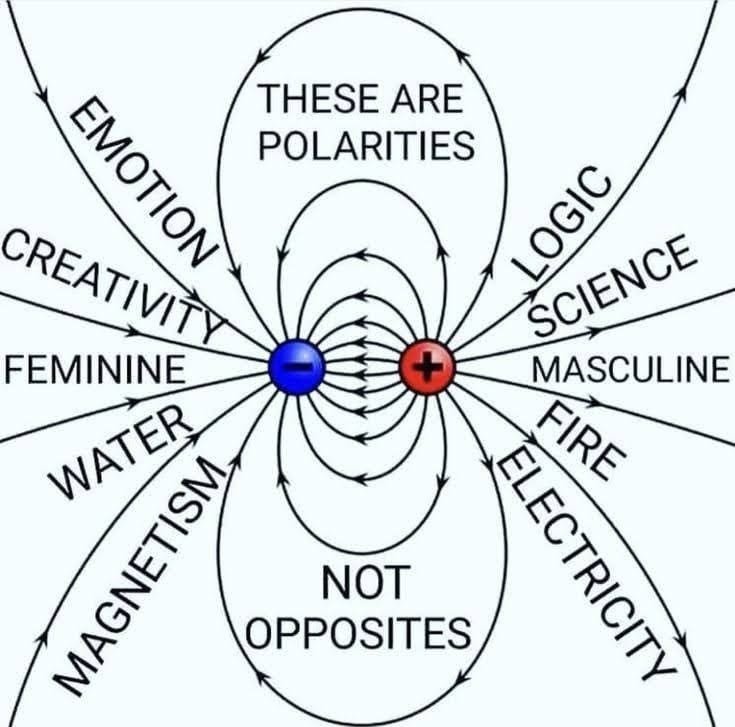
    That same twofold pattern—opposing yet coordinated pairs—shapes more than syntax or algorithms. It echoes through our bodies, our senses, and our movement. Once you begin looking for twoness, it becomes difficult to ignore how deeply it structures the world.

    Heraclitus and the Unity of Opposites

    • Unity of opposites: For Heraclitus, what we call “opposites” are inseparable partners. Day implies night, heat implies cold, and each gains meaning only through the contrast with its counterpart.
    • Mutual dependence: Opposing states are not truly independent; they arise together. A shadow needs light to exist. Neither element stands alone without the other defining it.

    • Cosmic tension: Heraclitus saw conflict as the driving force of the world. His line “War is father of all” suggests that struggle is not destructive but generative — the tension that keeps reality moving.
    • Harmony from strain: Balance emerges through opposition. He compared this to a bow or a lyre, where beauty and function come from forces pulling in opposite directions. A single object can hold contradictory qualities, as when he said a bow’s name “is life, but its work is death.”
    • The logos: Underneath all change is the logos — a rational, ordering principle that holds opposites together. For Heraclitus, the world’s constant flux isn’t chaos but the expression of a deeper coherence.
    • Perspective and flux: What look like strict oppositions are, from a broader perspective, variations of the same underlying reality. Everything is in motion, and opposites are simply different phases of that movement.

    Heraclitus wrote these ideas not as abstractions but in sharply compressed, poetic fragments that still read like koans. Two of the most famous capture the tension at the heart of his philosophy:

    Heraclitus: Original Greek Fragments

    Fragment DK B53 

    πόλεμος πάντων μὲν πατήρ ἐστι, πάντων δὲ βασιλεύς,
    καὶ τοὺς μὲν θεοὺς ἔδειξε τοὺς δὲ ἀνθρώπους,
    τοὺς μὲν δούλους ἐποίησε τοὺς δὲ ἐλευθέρους.

    “War is the father of all and king of all; it reveals some as gods and others as humans;
    it makes some slaves and others free.”

    Placeholder image

    Fragment DK B48

    τοῦ τόξου ὄνομα βίος, ἔργον δὲ θάνατος.

    “The name of the bow is life, but its work is death.”

    That same binary skeleton—true/false, hot/cold, on/off—turns out to be more than a linguistic habit. It is built into how our bodies are assembled and how we move through the world.

    The Number Two (Body, Symmetry, Anthropology)

    Human bodies are built on bilateral symmetry: two eyes, two ears, two nostrils, two hands, two lungs, two sides of the brain, and two chambers on each side of the heart. Even our upright posture depends on the coordinated tension of paired muscle groups pulling against and with each other. Anthropology doesn’t treat this twoness as decorative; it sees it as the direct inheritance of the moment early hominids shifted from moving on four limbs to balancing on two. Bipedalism is the hinge that changed everything: the way we balance, the way we allocate energy, the way childbirth works, the risks our joints face, and even the shape of our social world.

    When I was at Cambridge, I had friends at Darwin College who were deep into paleoanthropology, and they treated upright walking with a near-religious seriousness. It wasn’t just another evolutionary detail. It was the event that set the entire human project in motion. The spine reorganizes, the pelvis narrows, the hands are freed, the skull rebalances, and suddenly you have a creature who sees differently, moves differently, and eventually thinks differently. Once you understand this pivot, the presence of twoness—paired structures, paired functions, paired risks—feels inevitable. It is written into the architecture of our skeletons long before it becomes a mental model.

    The Price of Walking on Two Legs

    Years later, I found myself on the freelance writing beat, assigned a run of podiatry and hip-replacement articles meant to boost the SEO of medical providers around Indianapolis. Every surgeon I interviewed confirmed what Darwin friends had said in a more theoretical way: hip deterioration isn’t a personal failure, and it isn’t a matter of lifestyle or luck. It is the predictable outcome of balancing an entire species on two load-bearing joints that were never designed for the workload we ended up giving them.

    Those interviews made the anthropology lectures I’d overheard at Cambridge concrete. The same evolutionary shift that freed our hands for tools, expanded our range of travel, and eventually supported the development of complex intelligence also introduced a mechanical weakness at the heart of our locomotion. The story of bipedalism is often told as a triumph—a leap toward cognition, migration, coordination—but the body keeps the receipts.

    We owe our cognitive advantages to the moment an early hominid stayed upright. The posture that enabled tool use and expanded our vision also concentrated movement into two joints with no evolutionary precedent for the load. The trait that ensured our survival is the same one that produces our most ordinary physical failures. Twoness isn’t just symmetry—it’s the fault line that shows what evolution gave us and what it demanded in return.

    Our Symmetry, Our Fault Line

    Twoness doesn’t just shape our bodies and reasoning; it shapes how we behave together. The same circuits that keep us balanced on two legs make us responsive to mirrored movements, call-and-response patterns, and the emotional force of acting in unison. Marching, chanting, clapping in time—these are not cultural accidents but binary loops built into our motor system, toggling between left and right, tension and release. Once a group falls into that rhythm, the pattern becomes its own logic.

    Chanting and hypnosis draw on the same ancient circuitry. Give the brain a simple back-and-forth—two beats, two states, two breaths—and it begins to fall in step. Mantras, pendulums, spirals: each works by narrowing attention until the mind stops negotiating and simply follows the rhythm. Argument requires effort; repetition requires surrender.

    The Politics of On/Off Thinking

    After you notice how easily the nervous system locks into simple patterns, it becomes impossible not to see the same mechanism at work in politics. Modern discourse relies on binary shortcuts—safe/dangerous, credible/not credible, mainstream/conspiracy—that act less like judgments and more like switches, letting people sort ideas without confronting their complexity. The same twoness that keeps us walking in rhythm also makes us think in rhythm, repeating whatever categories the culture provides.

    Nowhere is this clearer than in the way “conspiracy” is used as a reflexive dismissal. What began as a descriptor has hardened into a kill-switch that ends a conversation before it starts. The irony is that many political narratives function exactly like the conspiracies they condemn: tightly plotted stories with villains, destinies, and sweeping explanations of how the world works. Because they come from the in-group, they’re not seen as conspiratorial—only as truth.

    Once thought collapses into these two poles, the space between them fills with the logic the binaries can’t hold. Cognitive dissonance becomes comfortable; contradictory beliefs can sit side by side because the structure itself absorbs the tension. This is where Lewis Carroll becomes oddly useful: a world of paradox and nonsense emerges whenever a system insists on being too simple for the reality it claims to explain.

    Placeholder image

    This collapse also betrays the Greek intellectual tradition we inherited. Aristotle built logic on distinctions, conditional reasoning, and hypothesis—provisional thinking, not reflexive dismissal. Yet in contemporary language, “conspiracy theory” has swallowed the entire category of hypothesis, as though an unverified idea were a moral offense. Binary logic—true/false, one/zero—was always meant as scaffolding, not a worldview. When a culture mistakes the skeleton for the full structure of thought, it loses the ability to evaluate ambiguity, early theories, historical analogies, or anything that resists instant classification. The binary does the sorting, and the mind stops doing the thinking.

    Lewis Carroll understood better than almost anyone that a system built on rigid binaries eventually exposes its own absurdities. Long before Alice’s Adventures in Wonderland became a cultural shorthand for surrealism, Charles Dodgson—the Oxford mathematician behind the pen name—was publishing work on symbolic logic, syllogisms, and paradox. His Symbolic Logic (1896) and earlier papers demonstrate a meticulous mind fascinated by how small errors in reasoning can warp an entire system. Wonderland is not chaos for its own sake; it is what happens when logic is followed so strictly, or so literally, that it loops back into nonsense.

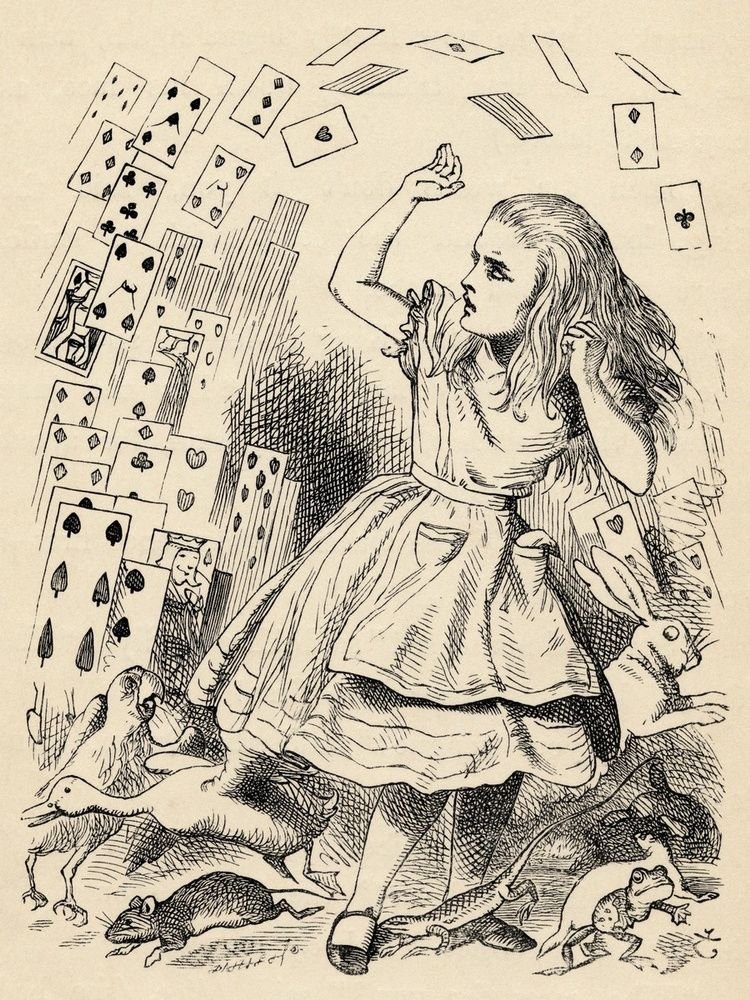
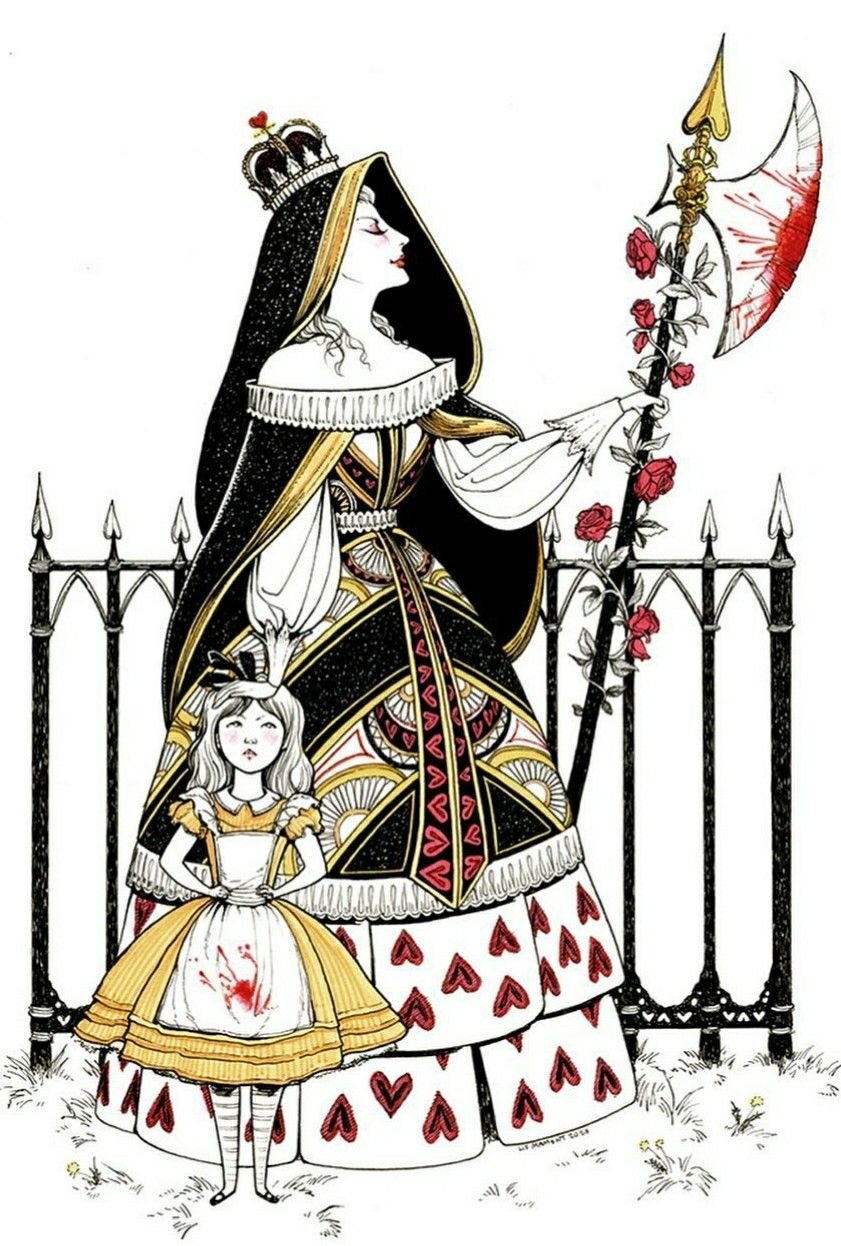
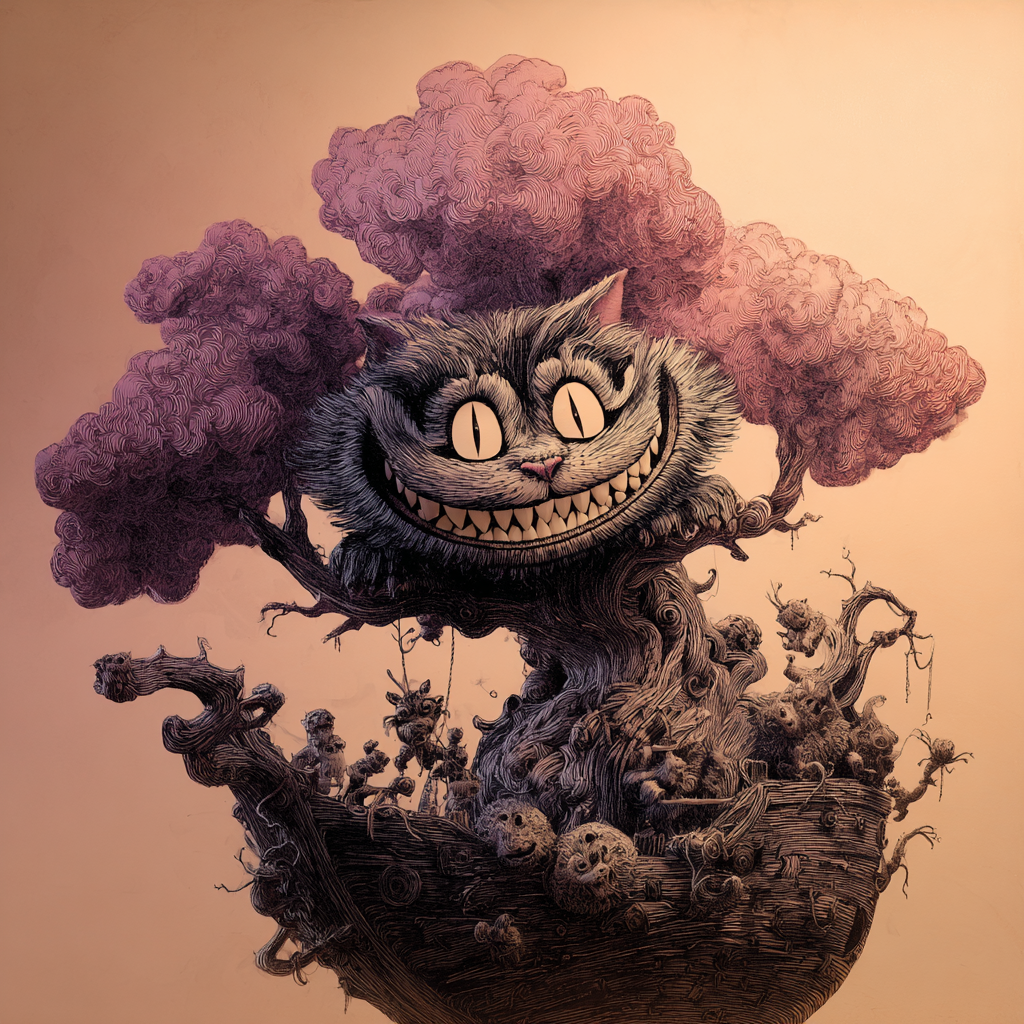
    In Alice’s Adventures in Wonderland (1865) and Through the Looking-Glass (1871), Carroll builds worlds where binary categories are stretched until they break. Things are and are not. Directions reverse themselves. “Up” and “down” become interchangeable states, not opposites. The Cheshire Cat can disappear until only its grin remains—an ontological joke about predicates without subjects. The White Queen believes “six impossible things before breakfast,” a line that functions as both whimsy and a critique of anyone who treats belief as a binary rather than a spectrum. The Red Queen’s rule—“it takes all the running you can do to keep in the same place”—captures the experience of a system that moves but does not progress, a perfect metaphor for political discourse stuck between two immovable poles.

    Placeholder image

    Carroll’s most explicit engagement with logical failure appears in “What the Tortoise Said to Achilles” (1895), a short dialogue published in Mind, in which the Tortoise exposes a paradox at the heart of deductive reasoning. Achilles presents a simple syllogism, but the Tortoise refuses to accept the conclusion unless each inferential step is itself turned into a new premise—and the regress never resolves. It’s a demonstration of how a system built too rigidly on formal logic can collapse under its own structure. The reader is left with the uncomfortable realization that logic alone cannot force acceptance; something extra-logical—intuition, agreement, shared understanding—must step in. In other words, even the most orderly systems need a space outside the binary.

    This is precisely why Carroll is the perfect guide for understanding the weird cognitive zone between political binaries. Wonderland is not absurd because it lacks rules; it is absurd because its rules are too strict. It is a world where binary reasoning—true/false, big/small, sense/nonsense—applies cleanly until reality complicates it, and then everything fractures. Carroll shows how quickly a mind can grow comfortable with contradictions when it is forced to operate inside a framework that cannot accommodate nuance. When Alice asks questions that the system can’t process, she is told that the refusal to accept nonsense is the real problem.

    Placeholder image

    In this way, Carroll anticipated a psychological pattern we can see clearly now: when a culture demands that people choose between two fixed narratives, all the discarded reasoning, inconvenient evidence, and unapproved hypotheses get pushed underground. They don’t disappear; they accumulate. They form a Wonderland of their own—a space where banned questions go, where contradictions coexist without resolution, where the logic cast out by the binary finds a strange new coherence. This is not chaos from the absence of structure; it is chaos produced by too much structure, the way a poorly written program enters an infinite loop not because it is disordered, but because it is too rigid to escape itself.

    Carroll’s work suggests that nonsense is not the opposite of logic. It is what happens when logic is applied beyond its natural limits—when the world’s complexity is filtered through an on/off switch that cannot register anything in between. And this, ultimately, is why so much modern discourse feels like Wonderland: not because people are irrational, but because they are using a system of reasoning that is far too simple for the problems they are trying to understand.

    Placeholder image

    Conclusion: The Limits of Two

    If there is one lesson that ties all of this together—from Aristotle’s conditional clauses to the symmetry of our skeletons, from bipedal strain to political slogans, from the pendulum’s swing to Alice chasing a vanishing grin—it is that binary systems are powerful precisely because they are simple. They help us walk, breathe, chant, categorize, and compute. They let us build machines that reason, or at least perform something close enough to reason that we mistake it for intelligence. But the simplicity that makes binaries so efficient is also what makes them dangerous. They tempt us into believing that the world itself runs on clean divisions: true or false, safe or unsafe, credible or conspiratorial.

    In reality, most of what matters lives in the space between. Hypotheses, early-stage ideas, historical analogies, political comparisons, uncomfortable intuitions—these are all fragile forms of thinking that require room to unfold. When a culture collapses everything into two poles, it doesn’t eliminate complexity; it just forces complexity underground, where it mutates into confusion, contradiction, or the kind of nonsense Carroll understood so well. A binary system can tell us whether a statement fits within its parameters, but it cannot tell us whether the parameters are adequate to the world.

    To recognize this is not to abandon logic, but to remember what logic was originally for: to help us refine our questions, not silence them. Aristotle left room for uncertainty; Heraclitus insisted on flux; Carroll exposed the absurdity that appears when rules overreach. Even our own bodies, balanced precariously on two legs, remind us that evolution is not a clean progression but a series of trade-offs. Twoness is part of us, but it is not all of us.

    Placeholder image

    We outgrow binaries not by rejecting them, but by seeing their limits. The mind becomes freer the moment it notices when the switch has been flipped on its behalf—when “conspiracy theory” is being used as a way to end thought rather than begin it, when a comparison is dismissed before the reasoning can be heard, when an idea is forced into a category too small to contain it. The world is irreducibly complex, and any system that insists otherwise will eventually turn itself inside out, like Wonderland following its own rules to the point of absurdity.

    If there is a way forward, it begins where the binary ends: with the willingness to let a thought be unfinished, a theory be tentative, a question be unsettling. The space between two poles is not a void. Binaries are tools; problems arise only when we mistake them for reality.

    Works Cited

    • Aristotle. Categories. Translated by J. L. Ackrill, Clarendon Press, 1963.
    • Aristotle. De Interpretatione. Translated by E. M. Edghill,
      in The Works of Aristotle, edited by W. D. Ross, vol. 1,
      Oxford University Press, 1908.
    • Carroll, Lewis. Alice’s Adventures in Wonderland. Macmillan, 1865.
    • Carroll, Lewis. Through the Looking-Glass, and What Alice Found There.
      Macmillan, 1871.
    • Carroll, Lewis. “What the Tortoise Said to Achilles.” Mind,
      vol. 4, no. 14, 1895, pp. 278–280.
    • Carroll, Lewis. Symbolic Logic. Macmillan, 1896.
    • Mastronarde, Donald J. Introduction to Attic Greek.
      University of California Press, 1993.
  • Studies in Emergent Meaning

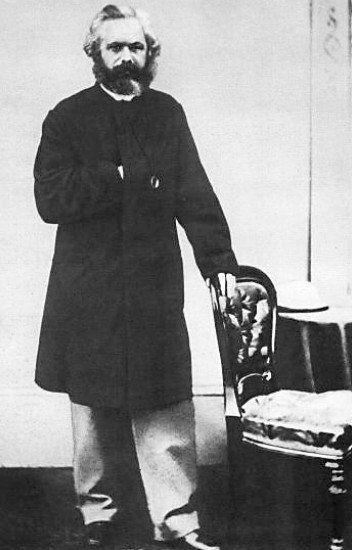
    Karl Marx's coat, often used to illustrate debates about material agency.

    My interest in how meaning and consensus take shape began not with formal theory but with a loose scatter of coincidences that, at the time, seemed directionless: odd overlaps, misplaced conversations, ideas brushing against one another without context. Only much later, after studying semiotics and working with Large Language Models (LLMs), did those fragments make retrospective sense. They suggested that chance is often the first draft of coherence, that language can function as a proof-making system, and that meaning tends to surface wherever relations intensify, even when no one appears to be consciously arranging them.

    Early Crosswinds

    In undergrad I studied Classics and art history, steeping myself in Greek poetry, Latin word order, and the strange semiotic machinery of myth. I was hanging around with a group of anthropology and film students—one had a roommate who was deeply, almost theatrically invested in the singularity debate. It was 2012–13, that awkward pre-“AI ethics” era when everyone I knew was broke and trying to turn an A in English Literature into something resembling rent money. We drifted between departments without really belonging to any of them, and that loose, interdisciplinary drift is what first pulled me into conversations about intelligence: human, machine, and the uncategorizable spaces in between.

    A few of us ended up doing SEO and web copywriting to stay afloat, which meant long Utah nights spent producing industrial quantities of unremarkable content about plumbing, chiropractic care, pest control, financial advisors, HVAC repair—whatever paid twelve dollars an article. The company quietly sold its data to researchers training early language models; none of us fully realized we were stocking the pantry of a future oracle.

    During a long summer trip through the Pacific Northwest, a friend from that circle explained the scraping practices behind those early LLM experiments. The logic seemed oddly intuitive: that almost all small talk collapses into a limited number of predictable moves, and that if you average out millions of conversations, the patterns rise like a watermark. For two undergrads prone to late-night debates about consciousness and the singularity, it neatly confirmed our pet theory about why so few people ever veered beyond the eternal “How was your weekend?” script.

    A second tangent from that summer—completely unrelated, yet somehow filed in the same mental cabinet—was that spacetime curves around mass like a bowling ball on a mattress. My mind held both ideas at once, turning them over during those months in 2013, the way a half-trained hunting dog circles a scent it doesn’t yet have a name for.

    Seeding the Future With a Hermetically Sealed Joke

    As I spent that summer writing, increasingly aware that my copy was being scraped into early training corpora for language models, I responded with what can only be described as a small act of DIY conceptual art. Inspired by the deadpan absurdity of OK Go’s 2006 treadmill choreography in Here It Goes Again, I decided that if the machines were going to inhale my unremarkable web content, I would slip something odd into their diet on purpose. I began inserting the phrase “hermetically sealed container” into as many articles as possible—pest control, water damage, food storage, anything where the wording could pass unnoticed. It became a quiet form of linguistic guerrilla theater. To protect the phrase from editors, I embedded it in pseudo-authoritative warnings; somewhere out there, dozens of small businesses were advised to store replacement parts or seasonal decorations in hermetically sealed containers “for optimal results.”

    The Orchard tea garden near Cambridge, a riverside walk just beyond Grantchester.

    The experiment revealed something I didn’t yet have language for. I had already intuited, long before I could articulate it, that language models were not “intelligent” in a deliberative or ethical sense but were vast semiotic engines. They sifted, averaged, and recombined. They made legible whatever patterns the corpus insisted upon. And if meaning could be extracted even from the detritus of gig-economy blog posts, then something in the system—human or machine—was hungry for pattern beyond intention.

    What I didn’t realize at the time was that this small protest joke—my hermetically sealed resistance—was an early rehearsal for the larger question that would follow me through graduate school and eventually into work with AI: how do systems, whether human or computational, decide what counts as meaning? Where is the boundary between bias and interpretation? Between discernment and discrimination? Between pattern and coincidence?

    The Cambridge School of Analytic Philosophy

    Portrait of John Maynard Keynes, economist and Cambridge fellow.

    Those questions intensified during my M.Phil at Cambridge, where I moved through linguistics, material culture, and the anthropology of objects. The M.Phil—the Master of Philosophy, a degree title that historically belongs to Oxford and Cambridge and has since been adopted elsewhere—anchored a particular intellectual belief and creed: that language, argument, and semiotic precision can constitute a form of proof.

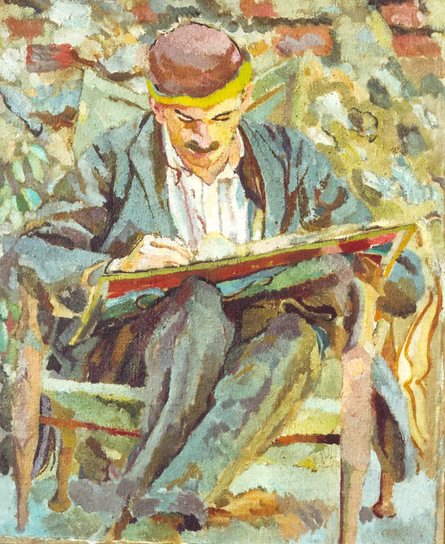
    Cambridge’s famous analytic philosophical tradition was shaped by figures like George Edward Moore (B.A. Cambridge, 1896), whose Principia Ethica (1903) attempted to clarify moral reasoning through linguistic exactness; Bertrand Arthur William Russell (B.A. Cambridge, 1894), whose Principia Mathematica (1910–13, co-authored with Alfred North Whitehead) sought to derive mathematics from pure logic; and Ludwig Josef Johann Wittgenstein (who first studied at Cambridge beginning in 1911 under Russell, and returned as a fellow in 1929), whose Tractatus Logico-Philosophicus (1921) and later Philosophical Investigations (published posthumously in 1953) argued that the limits of language are the limits of the world. Even John Maynard Keynes (B.A. Cambridge, 1905)—better known for economics—contributed to this lineage through A Treatise on Probability (1921), which framed probability as a logic of partial belief grounded in relations rather than mere frequencies. Above is a painting of John Maynard Keynes by Duncan Grant (1917).

    Keynes belonged not just to the halls of King’s but to the landscape around it. Just outside Cambridge in Grantchester sits The Orchard, a garden tea spot where Keynes, Virginia Woolf, and other Bloomsbury figures spent long afternoons talking, writing, and drifting between work and leisure. During my own time in Cambridge, The Orchard became a quiet anchor: I walked there along the river almost every day the weather was decent, following the same footpaths between cows and willows that earlier generations of strange, overthinking people had worn into the ground.

    Together, these thinkers established an assumption that shaped the intellectual climate I inherited: that clarity of language is clarity of thought, and that when concepts are arranged with precision, they can demonstrate inevitability just as rigorously as mathematical proofs. In that worldview, meaning is not decorative; meaning is structural.

    Statue of Karl Marx, whose overcoat anchors Peter Stallybrass’s essay 'Marx’s Coat'.

    Material Agency: When Objects Begin to Act

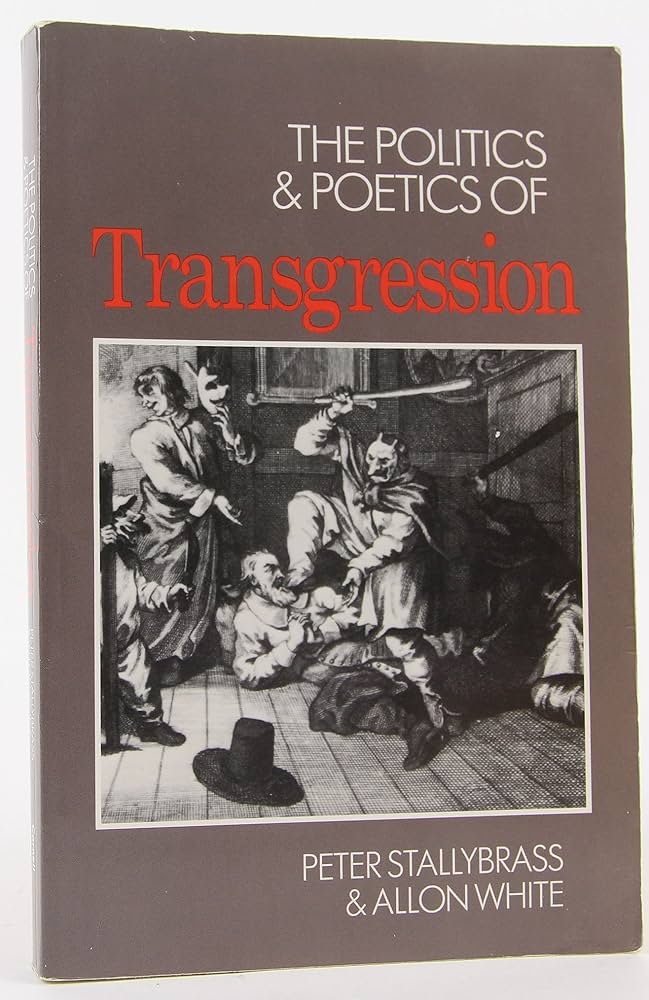
    Peter Stallybrass—a literary scholar whose work moves between material culture, Marxism, and the history of clothing—entered my intellectual world through two texts that changed the way I understood objects. The book he contributed to, Edited by Susan Crane (1996), Fabrications: Costume and the Construction of Cultural Identity and his now-classic essay “Marx’s Coat” both advance the same startling argument: that material things do not merely symbolize social relations but actively participate in making them.

    Peter Stallybrass, literary scholar of material culture and clothing.

    Stallybrass’s argument in “Marx’s Coat” is deceptively simple: objects are not passive. They do not sit there waiting to be interpreted. They act. They compel. They organize human possibility. When he writes that “things are not inert” and that they are “the media through which social relations are formed,” he means it literally. Marx’s ability to participate in political life was partially determined by whether he possessed—or could pawn, retrieve, or mend—a single coat. Without it, he could not enter particular libraries, meetings, or social spheres. The coat enforced boundaries, shaped mobility, and constrained the rhythms of Marx’s intellectual labor. In Stallybrass’s reading, “the coat remembers labor” because it carries the accumulated history of every hand and circumstance that produced, repaired, and circulated it. It is not an accessory. It is an actor.

    This was my first exposure to material agency as a real philosophical claim rather than a metaphor. Objects travel, and in their travel they “gather significance.” They direct behavior, compel choices, limit access, produce effects. The object does not simply obey. A coat can participate in class formation. A book can reorder thought. A door can script movement. A boundary stone can produce violence. This is the anthropology I learned at Cambridge: not a discipline of inert artifacts but one of restless, event-generating things.

    Where Complex Systems Were Born

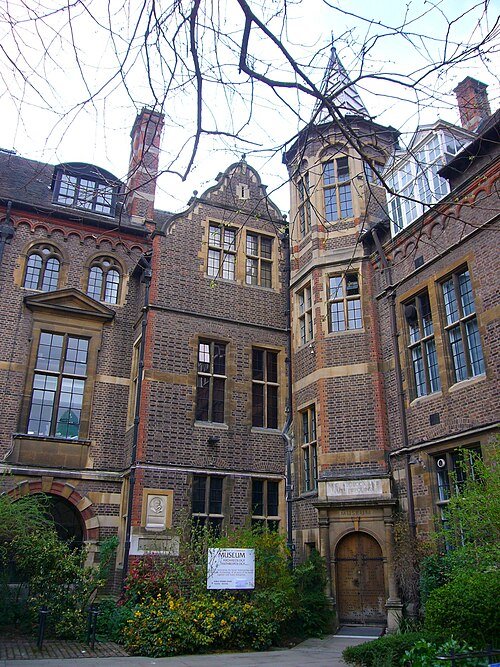
    View of Cambridge architecture and courts, where analytic and anthropological traditions intersect.

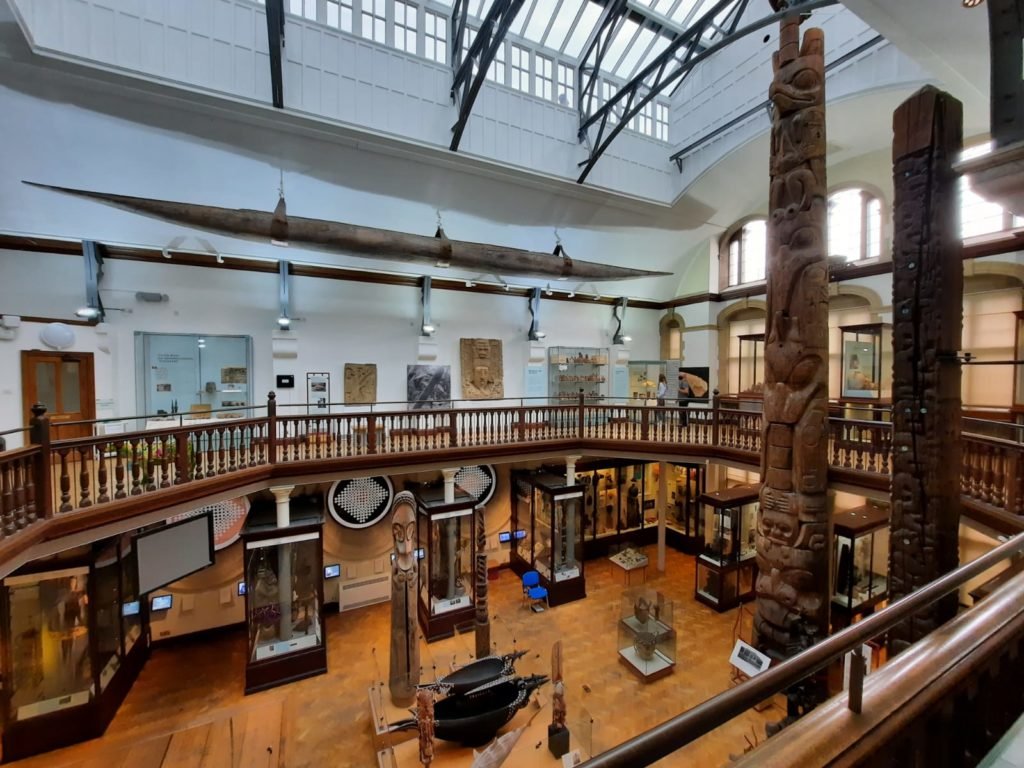
    The Cambridge Department of Archaeology & Anthropology was the perfect place to learn it, because the department is historically one of the intellectual birthplaces of complex systems thinking applied to the archaeological record. Long before “systems thinking” became TED-talk vocabulary, Cambridge archaeologists were modeling how meaning emerges from the entanglement of texts, material evidence, environmental traces, social practice, and historical pressure. Archaeology there was never just the study of objects; it was the study of the relations that animate them—dynamic flows of information, power, and habit embedded in landscapes, households, ritual spaces, economies, and time.

    Cambridge river path and bridges, part of the everyday system of movement and thought.

    This was a department trained to think systemically. Meaning wasn’t something extracted from a single artifact or inscription. It had to be triangulated: between what a text claims, what the material record allows, what social conditions enforce, and what the interpreter brings with them. The process was recursive, nonlinear, and often unexpectedly alive.

    Dr Tim Ingold, who earned his PhD in Social Anthropology at Cambridge in 1976, contributed to the wider theoretical landscape through his work on material anthropology—examining how different cultures classify, define, and conceptualize meaning, and how those systems of thought become visible in the artifacts they produce. In genuinely brilliant books (I highly recommend) such as Evolution and Social Life (1986), The Perception of the Environment (2000), and Lines: A Brief History (2007), he approached the world as a meshwork of relations, where materials, practices, and ideas co-constitute one another rather than existing as isolated units.

    Cambridge river path and bridges, part of the everyday system of movement and thought.

    Within that framework, agency diffused outward. You couldn’t say “the human acts” and “the object reflects”; the action was distributed. A pot shard could reorganize an entire chronology. A misaligned stone could reveal changes in ritual orientation. A textile fragment could map trade, gender, labor, and climate. This was not the humanities as aesthetic reflection—it was the humanities as an early version of systems science, always suspicious of single-cause explanations and always attuned to emergent coherence.

    Meaning as a Relational System

    And this is the part that quietly underwrites the entire thesis of this essay: that meaning—whether in archaeology, philosophy, semiotics, or computation—is produced through relations. That language, like mathematics, can create proofs. That chance, drift, coincidence, and probability don’t undermine meaning; they generate it. That LLMs, semiotic arguments, and archaeological inferences all reveal the same underlying structure: meaning emerges wherever relations intensify, whether between objects, concepts, sentences, or statistical weights.

    Steeped in that training, the debates around AI never struck me as foreign or futuristic. They felt like the next extension of the same intellectual lineage. If a coat could shape a philosopher’s life, what might a dataset shape? If objects carry agency, what about patterns? And what happens when the thing performing the interpretation—a language model, an image generator, an autonomous system—begins to act not simply as a mirror of human intention but as an agent within a larger ecology of meaning?

    Anthropology was already comfortable with the idea that objects act: doors guide movement, clothing enforces hierarchy, architectures discipline time. In that context, the emerging debates around AI felt less like science fiction and more like the next logical extension of an old question. If a monkey could take a selfie that complicated copyright law—if no one could decide whether authorship belonged to the animal, the camera, the platform, or the human who owned the equipment—then what do we do with systems that generate images, decisions, or lethal-force recommendations? It is one thing to say a coat participates in the making of class relations; it is another to consider that a Photoshop algorithm could claim ownership of every composite image you produce, or that an autonomous targeting system in a refugee camp might decide, without human correction, who gets to die (the definition of power and God, in many traditions).

    Transubstantiation for the Digital Age

    These problems are all symptoms of the same underlying puzzle: what counts as an agent, an actor, a protagonist? Is that the same as a person? And who, exactly, gets to decide?

    I didn’t know it then, but the phrase I kept scattering online behaved like anything that circulates: it gathered meaning as it moved. Semiotics names this drift; anthropology calls it agency. What I thought of as a disposable line refused containment. It slipped its frame, took on new resonances, and became something larger than its origin.

    And when the interpreter is a machine, that process becomes stranger still. The phrase wasn’t lost—it was taken in, broken apart, and returned to me altered. Less disappearance than transubstantiation.

    This is the paradox of being scraped: the machine eats you, but in the eating, it preserves you. My hermetically sealed container was never about storage; it was offered up to the pattern-hungry god. Whether I like it or not, the machine remembers. This is my body, scraped for you.

  • Can’t Step in the Same River Twice

    Still from Hanna entering a tourist disco for the first time.

    On Blue-Light Rooms & Other Gateways

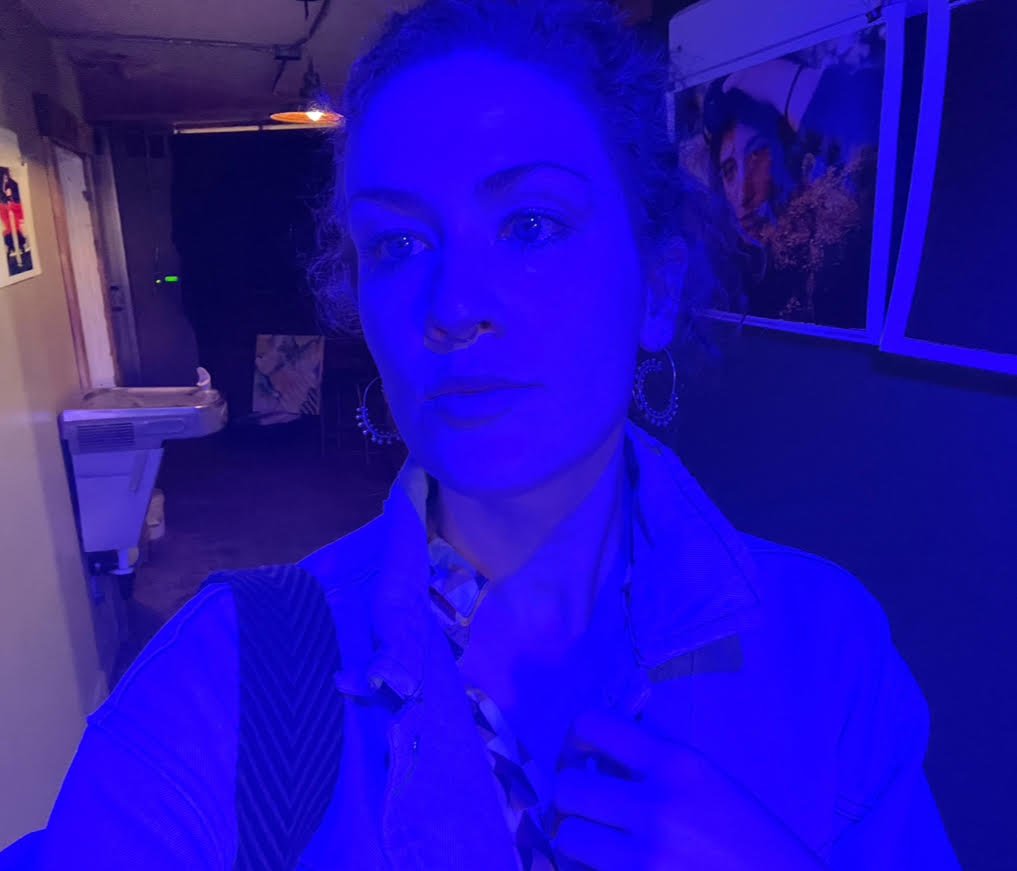
    There’s a kind of current that runs through the blue-light rooms where things are made, the backstage corners of plays, the band rooms humming after hours, the improvised studios where people gather around something still taking shape. It’s the same current that moves through any space where people are building worlds together, whether out of plywood, choreography, fabric, or light. These places feel rare, almost set apart from the rest of life, and the people drawn to them are often those who never quite fit the usual shape of things. They feel most themselves in the charged, half-chaotic atmosphere of a room in the middle of making something new.

    Still from Hanna entering a tourist disco for the first time.

    A Place Built Without a Nightlife Vocabulary

    Growing up in Utah, I gravitated toward the rooms where things were being made—the art classrooms, the wings of the stage, the band rooms buzzing after dark. Those were the spaces that felt alive. But as you grew older, the world around you encouraged a kind of narrowing. Creativity was tolerated in childhood, yet adulthood was expected to look settled, orderly, and suburban. There wasn’t much of a tradition of going out dancing or spending time in bars, and alcohol made so many people uneasy that some wouldn’t attend a wedding if there was a bartender. It always struck me as ironic in a religion built around a figure who turned water into wine.

    In Utah—or at least the version I grew up in—not everyone avoided play, but there was a strong puritan reflex that regarded vigorous dancing, costumes, and nighttime gatherings with suspicion. Dressing up could be dismissed as childish or inappropriate. My father was convinced for years that Halloween had demonic origins and refused to celebrate it.

    That way of thinking leaves little space for adults to experiment with identity or enjoy even modest forms of theatricality. The cultural instinct tilted toward self-containment rather than expression, toward seriousness rather than imagination.

    Discos & Study Abroad

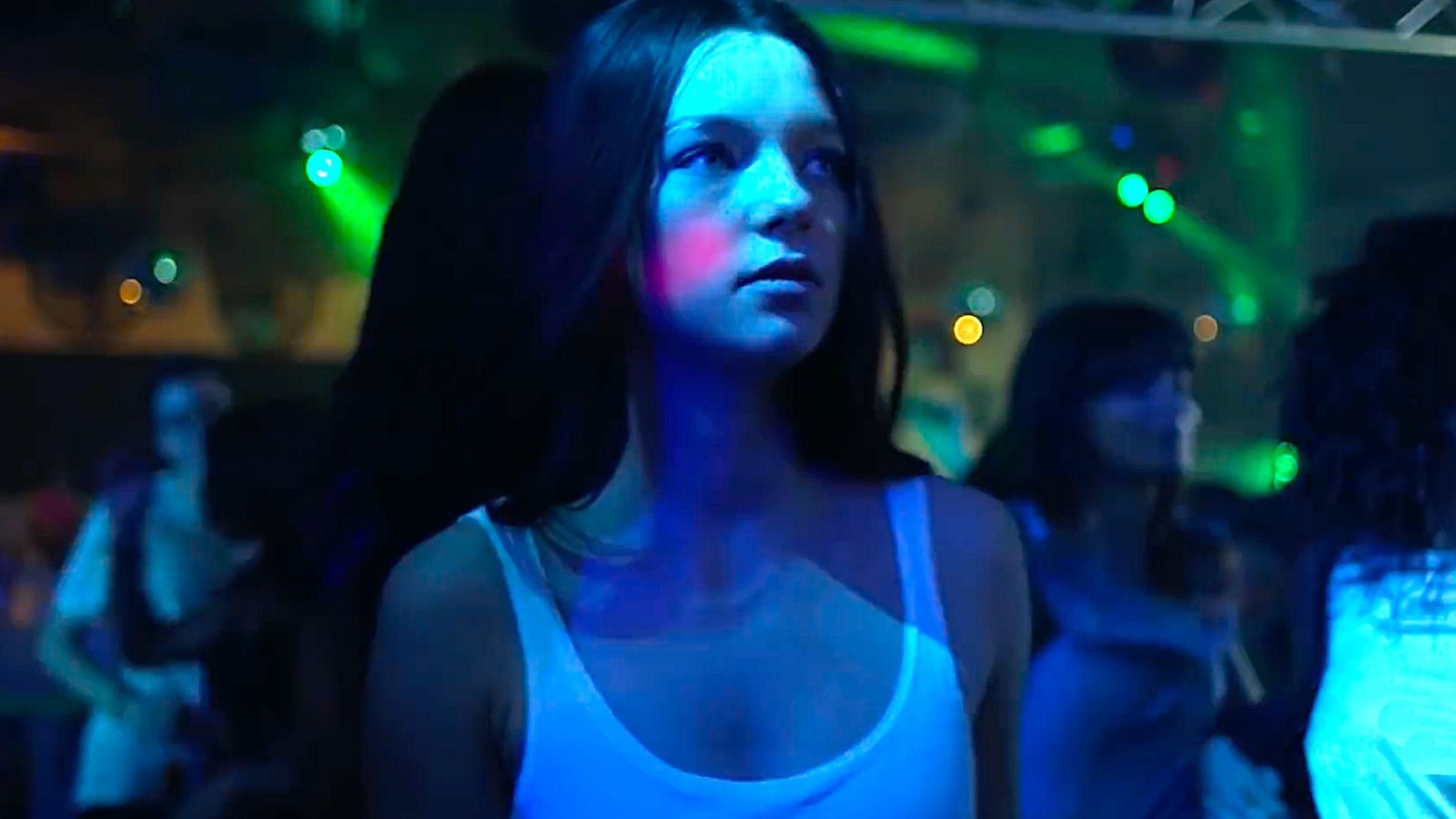
    When I think about my first real encounter with dancing, I always return to that scene in Hanna, the Amazon series, where the girl who has grown up hidden in the woods ends up in a tourist disco for the first time. She isn’t scared; she’s fascinated and a little stunned people get to live this way.

    Still from Hanna entering a tourist disco for the first time.

    When I went to study abroad in Madrid when I was 20, I’d never been into a bar before, but Spain operated on a completely different logic. Kids start drinking at 16, so the whole culture around bars and discos is less anxious and more woven into everyday life. People danced because the music was playing or because their friends pulled them into the rhythm, not because the moment was supposed to signify anything. Flamenco classes, crowded bars, and late-night discos slowly demystified it for me. A drink or “chupitas” helped, but what really changed things was watching people move without apology or self-surveillance. Movement made sense there in a way it never had before, and for the first time, dance started to feel like an essential part of who I could be.

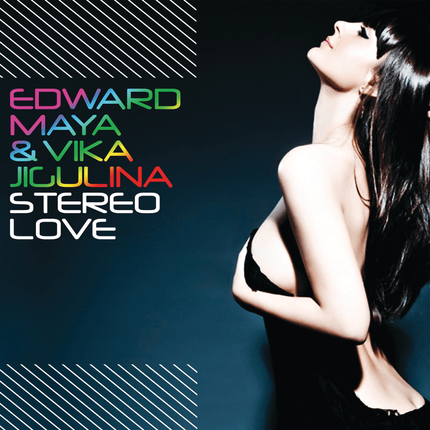
    Cover art for the song 'Stereo Love'.

    The Quiet Rebellion of Fancy Dress

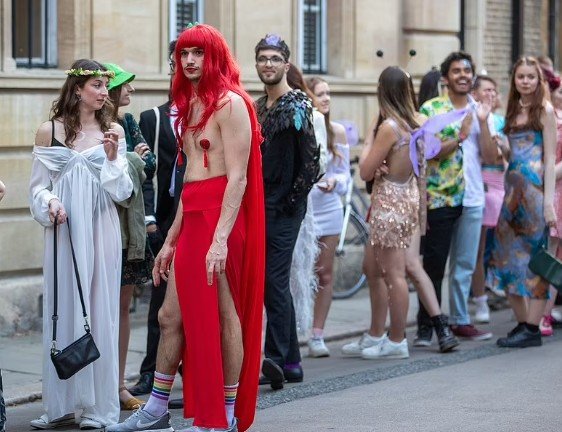
    England added another layer I didn’t expect. After Spain, I assumed the ease around dancing and nightlife might be tied to Southern Europe, but then I moved to another very Anglo, very orderly country and found that a different kind of playfulness lived there as well. I first heard the phrase “fancy dress parties” and imagined formal clothing, only to learn that in British English it simply means costumes, usually chosen with enough enthusiasm to make the whole thing feel delightfully absurd. Someone would announce a theme, people would make quick charity-shop runs, and by evening the bar would be full of whatever interpretations they could assemble. During my master’s year those nights became a kind of punctuation between lectures and libraries — small, collective acts of imagination that gave the term “student life” a broader range.

    Composite image

    Fancy dress is a faint descendant of older revels and masquerades where people were given a little room to slip outside the roles they held during the day. The modern version doesn’t carry the weight of those older traditions, but the instinct is the same: a simple, generous permission to become someone else for a few hours. Creativity and imagination need small departures from the everyday. Being someone else for an evening, or even just exaggerating one aspect of yourself, has always lightened the existential load. It creates a pause in the linear story of your life, a moment where you’re allowed to play rather than perform.

    The instinct behind fancy dress — that willingness to step outside yourself for an evening — extends into festival culture, but in a different register. Glastonbury is the version most Americans have heard of. For a few days, ordinary life expands. People build temporary worlds in fields by hauling in scaffolding, generators, speakers, tents, sequins, and a small nation’s worth of waterproofs.

    Crossing Back to the Western Desert

    The jump from that environment to the western United States is a kind of cultural whiplash. Once you’re back in Utah and Nevada, the landscape is huge but the places where you can actually move in public shrink to almost nothing. Spain covers about 195,000 square miles (505,000 km²) and holds roughly 47 million people. Utah and Nevada together span almost the same area—about 210,000 square miles (543,000 km²)—but have fewer than 9 million people combined. It creates a strange paradox: two states the size of a European country, but with almost no public spaces where adults are expected to gather, move, or experiment with identity. Outside a few country bars, and the singular outlier of Las Vegas, there isn’t much of a nightlife vocabulary across all that space.

    Electronic dance music, house, bass—anything with a subwoofer and a color palette beyond beige—triggers immediate suspicion. And not the vague moral kind. In a culture that is otherwise intensely materialistic, the suspicion turns strangely supernatural. In Mormon thought, “Satan” isn’t a metaphor; he’s a literal figure whose primary task is to lure people into drugs, sex, and what gets categorized broadly as “bad choices.” Unfortunately for anyone who likes a kick drum, electronic dance music falls neatly into that category. Add strobe lights, fog machines, or—heaven forbid—darkness punctured by red lighting, and the entire scene reads as a recruitment center for degeneracy.

    Composite image

    The irony is that the desert is perfect for building temporary worlds. Salt flats, canyons, old mining land, vast empty valleys — the West is designed for large-scale gatherings. But mainstream Utah culture treats underground dance events the way small towns treat UFO sightings: something is happening out there, and it’s definitely not good. (But I mean, how can you blame them if you know anything about “alien cattle mutilations?”)

    I’m not tracing the full socio-cultural circuitry here, and don’t even get me started on aliens — that can wait for another essay — but this section needed grounding. England showed me that dressing up and being out at night doesn’t require a moral preface; it’s simply part of how people live. And historically, when a government or an authoritarian religion feels threatened, the first reflex is always the same: impose a curfew. Control the hours, control the movement. The underlying question doesn’t change: Who gets to be out after dark?

    That became obvious during the pandemic, when a statewide shutdown and a curfew — for a respiratory virus you couldn’t catch outside, of all things — sparked a ridiculous, primal urge to leave the house. One night I grabbed my friend Lamb, a skateboarder with no interest in rules, and we ran around the empty playground at Liberty Park like kids who’d slipped the perimeter. We climbed the tops of the tower slides to scan for cops. It’s still one of my favorite memories from those years. Here I am “hanging out” in a hammock illegally in Liberty Park during lockdown, 2020.

    Composite image

    Utah taught me how many people think the answer to “who gets to be out at night?” should be tightly controlled — and how intoxicating it feels to ignore that for even ten minutes.

    The Edge of the Known World

    If there’s a thread that connects Utah art rooms, Madrid discos, English fancy dress, and the temporary worlds built from plywood and light, it’s novelty. I’ve always been drawn to the moments when something unplanned rises up and changes the temperature of a life, when you feel more awake simply because you weren’t expecting what arrived. When I was little, that feeling lived in stories. Pocahontas was the one I returned to again and again, not for romance but for the idea of a girl who stepped toward change rather than away from it. She moved into the unknown because it lit up something inside her, something the familiar world couldn’t reach.

    There’s a shot of her standing at the cliff’s edge, hair blown sideways, looking out at a world she doesn’t fully understand but wants anyway. For a certain kind of girl — the restless, the observant, the ones born into cultures that value obedience over curiosity — that image is a blueprint. It tells you that stepping outside your prescribed path might be the only way to find out who you are.

    Still from Hanna entering a tourist disco for the first time.

    The Color of a Moving River

    Heraclitus said you can’t step into the same river twice. The river moves; so do you. It’s the simplest description of what novelty feels like when it lands: a shift, a current, something that interrupts the default settings of ordinary life. That runs through the creative rooms I loved as a kid and the dance floors I found later—the sense that you’re stepping into a moment that didn’t exist ten seconds ago and won’t exist again.

    Novelty isn’t decoration. It’s a physiological event. Wonder tightens the chest; surprise pulls the breath in; adrenaline flickers at the edges of perception; the world you thought you understood rearranges itself for a moment. Creativity depends on those physiological rearrangements. So does joy.

    Novelty interrupts routine and reminds you that the world is wider and stranger than the narrow structures you were handed; it opens doors in the mind. For people who never felt entirely at home inside the expected structures, novelty is the moment where you remember that change is not only possible but natural, and that moving toward the unknown has always been where the story becomes interesting.

    But novelty is only one face of change. Most of the time change arrives without excitement: jobs shift, people leave, landscapes alter, seasons tilt. What you crave in one moment—movement, unpredictability—becomes something you brace against in another. The same current that delivers the jolt of possibility also carries away what was stable a moment before. Heraclitus wasn’t describing thrill-seeking; he was naming the underlying condition. Whether or not you want it, the world is already moving.

    On Arising and Passing Away

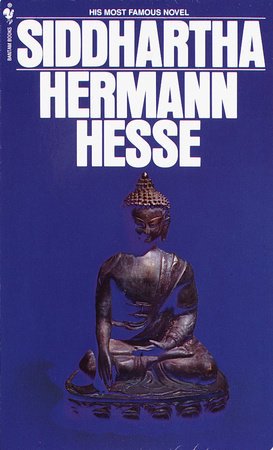
    Early Buddhist thinkers approached the same truth differently, not as an argument but as a quality of experience. Things arise, change, and pass—not tragically, not triumphantly, simply because that is what things do. Hesse’s Siddhartha takes this and turns it into a story, letting the river become a companion rather than a symbol. From here, the ideas meet in color.

    Siddhartha by the river

    Blue is the shade most often given to water in motion—not because rivers are actually blue, but because the mind recognizes the mix of depth, shadow, and reflection as something that can’t be held. Blue is a color defined by scatter and movement. In painting, in stage lighting, in the natural world, it is the hue that recedes even as you look at it. Theaters rely on that property. Blue backstage light is meant to be seen without being noticed. It reveals just enough for the next action to take place while allowing the rest to fall back into near-invisibility:

    • Audience visibility: blue falls off quickly over distance, so the audience can’t see backstage movement even as crews work a few feet away.

    • Night vision: blue interferes least with the eye’s rod cells, which lets stagehands keep their sense of darkness while still navigating safely.

    • Cues and markings: spike tape and backstage markers glow cleanly under blue without disrupting what’s happening onstage.

    There’s a quiet philosophy in that. Change often announces itself the same way—low-intensity, peripheral, easy to overlook until it has already rearranged the edges of things.

    And then there is the river’s color, which isn’t really color at all but the result of light passing through depth, sediment, air, and constant motion. The blue we assign to rivers is a metaphor we keep returning to because it captures something about impermanence better than language can. Blue is the visual form of transience: the distance inside the present moment, the shimmer between what is and what is becoming.

    You can’t step into the same river twice, not because the river has changed or because you have changed, but because the meeting point is always new—the water, the light on its surface, the air moving above it, the moon tugging at every tide, including the ones inside your own body.

    The Blue Flower of Enlightenment

    There’s a plant I keep on my windowsill with the cultivar name Hana Aoi. The name simply means “blue flower” in Japanese, a phrase that has appeared for centuries in poems, paintings, and seasonal imagery. In Buddhist art, the blue lotus—the utpala—carries its own long history. The Lotus Sūtra notes that the Buddha’s radiance is “blue as the utpala, fresh and pure,” a color linked to clarity and the difficulty of awakening. In later iconography the blue lotus is often shown half-open, a form that suggests insight arriving gradually rather than all at once. It is a flower you glimpse rather than grasp.

    Japanese poetry adds a quieter note. Edo-period poet Chiyo-ni (加賀千代女, also known as Kaga no Chiyo), wrote around the 18th century:

    朝顔や
    つるべ取られて
    もらい水

    asagao ya / tsurube torarete / morai mizu

    Morning-glory blue
    has taken the well-bucket—
    I ask next door for water.

    Chiyo-ni’s poem turns on a small domestic moment: a morning-glory vine has curled itself around the rope of the well-bucket, and rather than tear the bloom, she simply walks next door for water. The haiku isn’t symbolic in the Western sense, but its clarity comes from the way it treats a minor inconvenience as something worth accommodating. The blue morning-glory is held in place for a single interval between dawn and heat, and the poem catches that brief suspension—the stillness of a flower that won’t last, and the world adjusting itself around it. It’s an image of transience without drama, the kind of quiet impermanence that sits beneath so many Japanese seasonal poems.

    Across these traditions, the blue flower echoes the same intuition found in rivers and backstage light: things change shape, appear and vanish, and part of their meaning lies in that movement. It is not a symbol of permanence, but of passage—a reminder that the world doesn’t hold still, and that our lives don’t either.

    Still from Hanna entering a tourist disco for the first time.
  • Supertramp in Cambridge

    Composite image

    So, you think you’re a Romeo
    Playing a part in a picture show
    Well, take the long way home
    Take the long way home

    ‘Cause you’re the joke of the neighborhood
    Why should you care if you’re feelin’ good?
    Well, take the long way home
    Take the long way home

    There are times that you feel you’re part of the scenery
    All the greenery is comin’ down, boy
    And then your wife seems to think you’re part of the furniture
    Oh, it’s peculiar, she used to be so nice

    Supertramp, Lost Tart

    Supertramp formed in London in 1969, built around the songwriting partnership of Rick Davies and Roger Hodgson. They cycled through early lineups and struggled for several years before finding their signature sound in the mid-1970s: a mix of piano-driven art rock, distinctive high-register vocals (Hodgson), and Davies’s more grounded, blues-leaning writing. Their breakthrough came with the 1974 album Crime of the Century, which established them as a major British act.

    The band reached international success with Even in the Quietest Moments (1977) and especially Breakfast in America (1979), an album recorded in Los Angeles that unexpectedly became one of the best-selling records of the era. That American success is part of Supertramp’s odd identity — a British band whose biggest impact happened across the Atlantic. Songs like “Take the Long Way Home,” “The Logical Song,” and “Goodbye Stranger” became staples of U.S. radio, even as the band remained rooted in English lyricism and sensibility.

    Hodgson left the group in 1983, and although Supertramp continued under Davies’s direction, the classic era is really the 1970s partnership: two distinct voices trading perspectives within the same band, creating music that felt both introspective and expansive.

    Breakfast in America, Church-Hopping in Cambridge

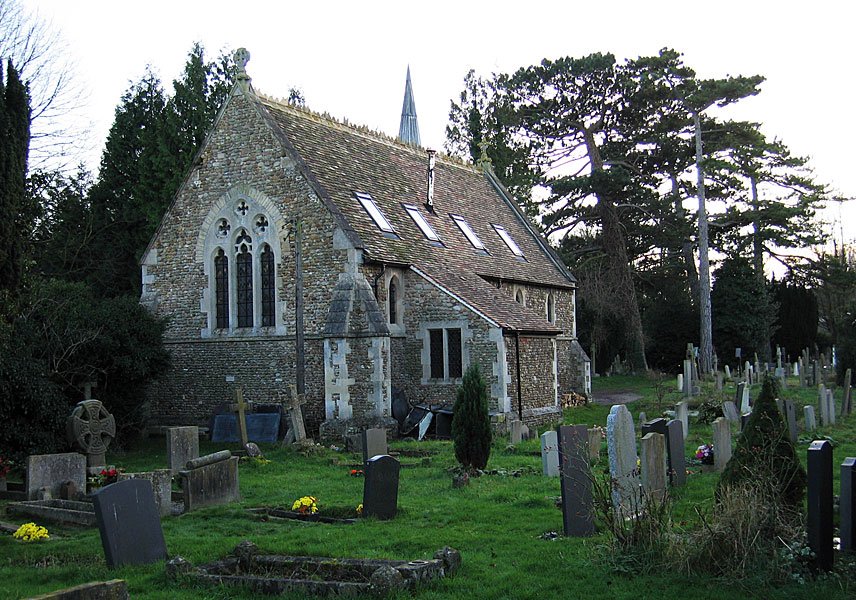
    Cambridge is full of churches. You can’t walk more than a few blocks without running into another one — a Norman chapel, a Victorian spire, a medieval fragment holding onto a small patch of grass. Graveyards sit close to the street, usually behind iron gates. From the 900s to the 1900s the city built in layers, and you can see the whole range at walking speed: carved doorways, patched stonework, handrails worn down, gates that still open with a small resistance. The buildings are different in mood and proportion, but they repeat the same pattern of yard, threshold, and interior space that marks time across a thousand years.

    Nine Centuries of Change

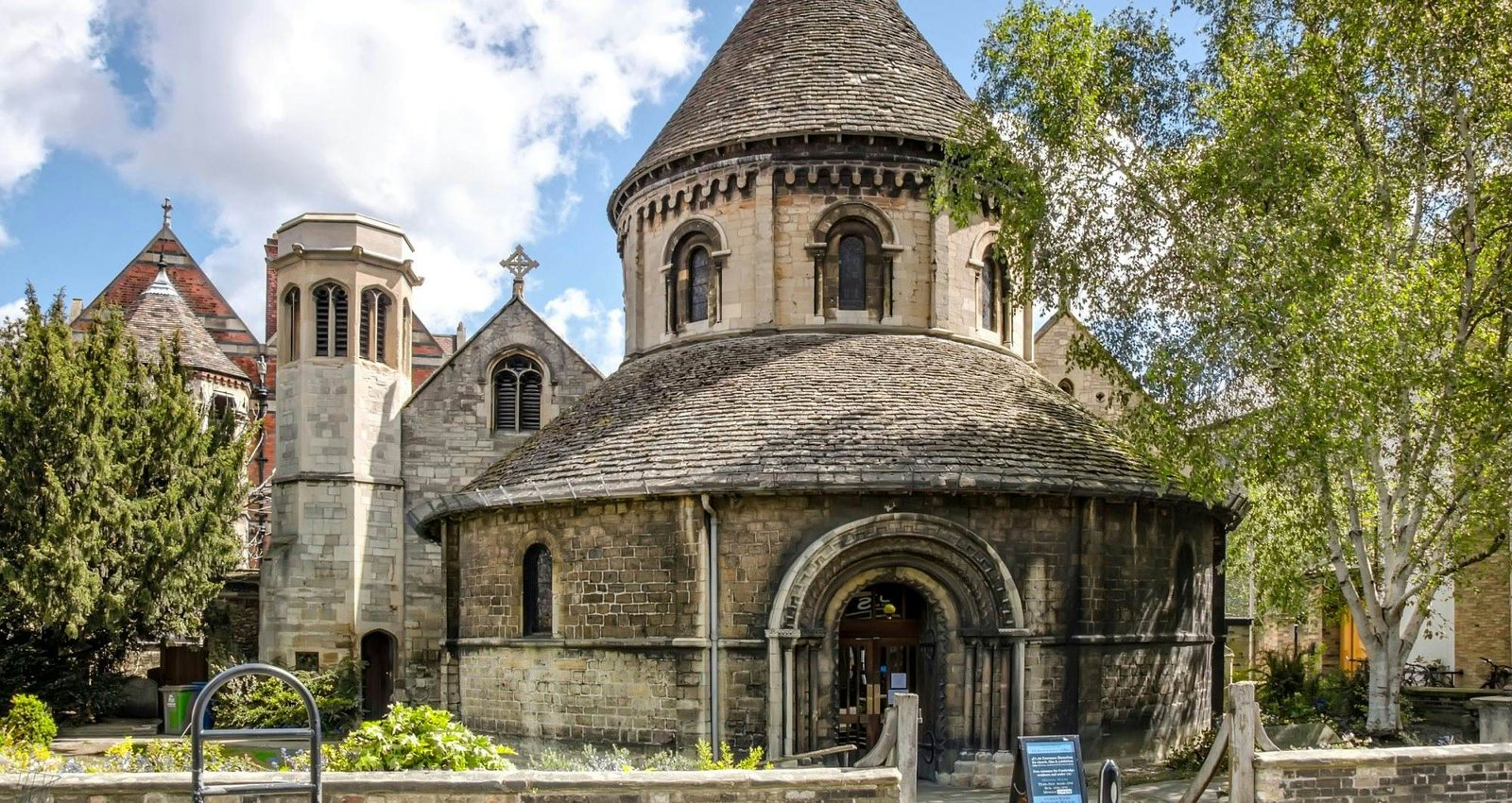
    The Round Church has a kind of presence that feels almost modern in its simplicity—a clean, circular nave tucked across from St John’s and Trinity colleges, solid enough to outlast whatever has bloomed and vanished around it. Its form is so pared down, so elemental, that it reads less like medieval architecture and more like an early experiment in minimalism. Built around 1130 and modelled on the rotunda of the Church of the Holy Sepulchre in Jerusalem, it belongs to the brief English fashion for round churches: imported sacred geometry rendered in local stone. The circular plan wasn’t arbitrary; it deliberately echoed the Anastasis rotunda that enclosed Christ’s tomb, a shape Crusaders and pilgrims treated as the architectural emblem of the Holy Land. Inside, the spatial compression is striking—an entire English church plan folded inward and held together by a ring of Norman pillars whose rough, earnest carvings catch the light in narrow planes. The building feels steady, almost contemplative, as if it were designed to resist not only weather but distraction.

    Composite image

    And yet the Round Church has been anything but static. It has absorbed centuries of change—given a Perpendicular Gothic east end in the 15th century, patched and propped through long periods of wear, nearly collapsing before the 19th-century Cambridge Camden Society intervened with its own idea of medieval purity. Each generation left a different layer of intention: practicality, embellishment, repair, theory. The result is a structure that appears seamless but carries every era within it, a small architectural palimpsest disguised as a pure geometric form. It never boasts about its age or its endurance. It simply stands there—compact, circular, and improbably current—holding nine centuries of shifts inside a shape that still feels timeless.

    The Victorian Shift

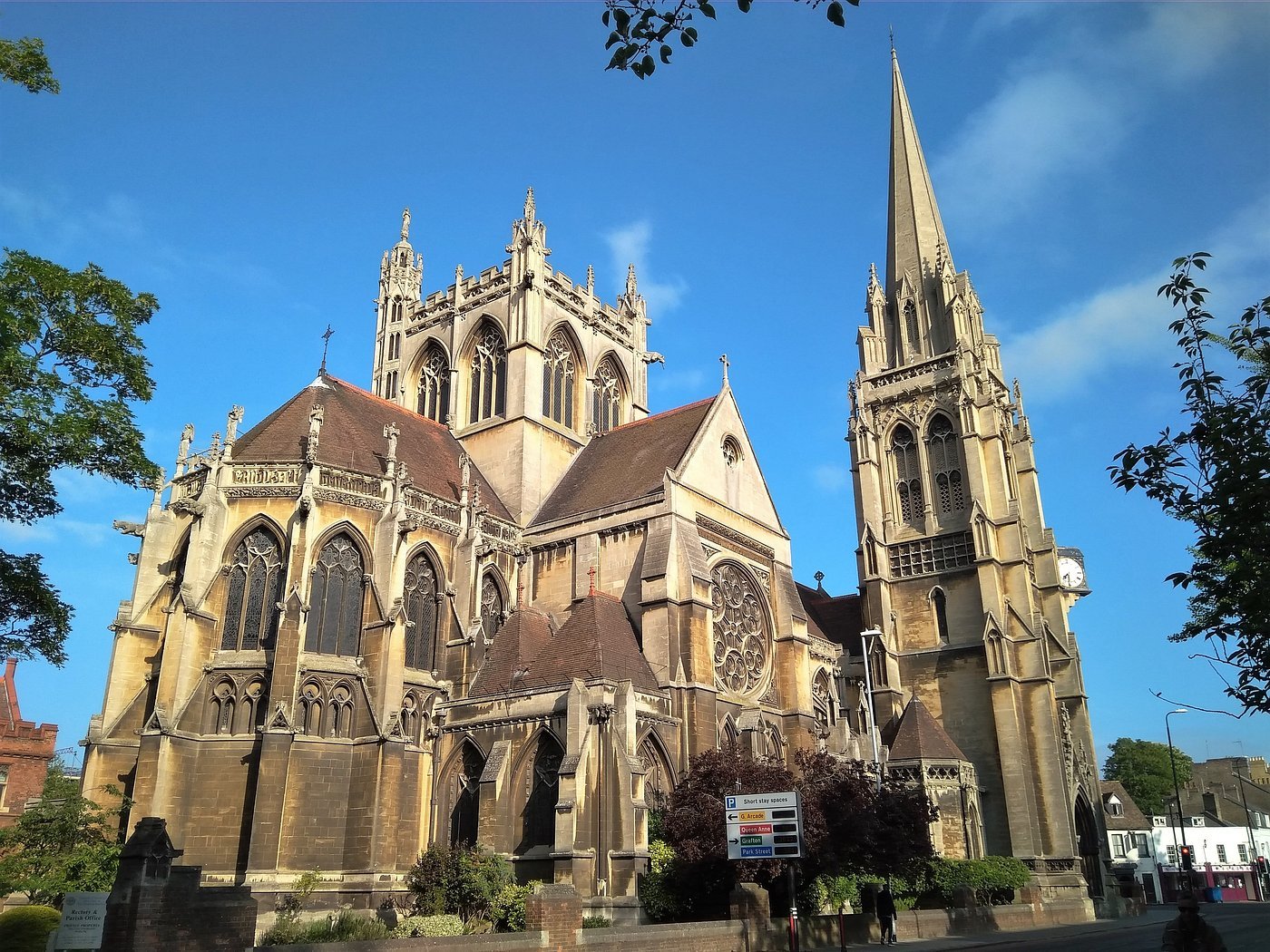
    Further south, on the way into town from the train station—now remodeled in that clean, functional Silicon Fenn style that didn’t exist even when I finished grad school—the Church of Our Lady and the English Martyrs shifts the mood completely. Standing at the corner of Hills Road and Lensfield Road, it rises out of the commuter flow with a confidence only the late nineteenth century could produce. I worked less than a block away, and each morning as I walked toward town, the spire cut upward so sharply it looked like a tear in the horizon. Its 214-foot tower, stained glass, and assertive Victorian stonework were built between 1887 and 1890—more than seven hundred years after the Round Church first enclosed its tight ring of Norman pillars. In that stretch of time Cambridge remade itself over and over: monasteries dissolved, colleges multiplied, empires came and went, scientific revolutions unfolded. Yet this newer church stakes its claim immediately, behaving like a landmark whether or not you ever mean to step inside.

    Composite image

    The junction churns constantly at its feet—buses braking, students crossing, cyclists threading diagonally through the lights—but the church does not adapt to the movement around it. It holds its ground with Victorian certainty, all height and aspiration, a deliberate counterpoint to the compact, contemplative geometry of its medieval predecessor. Where the Round Church gathers space inward, Our Lady and the English Martyrs sends its presence upward, announcing its era with scale and stained glass. Together they stretch the city across its centuries: two buildings separated by seven hundred years of change, still holding their places as Cambridge reshapes itself around them.

    The Walk Up Castle Street

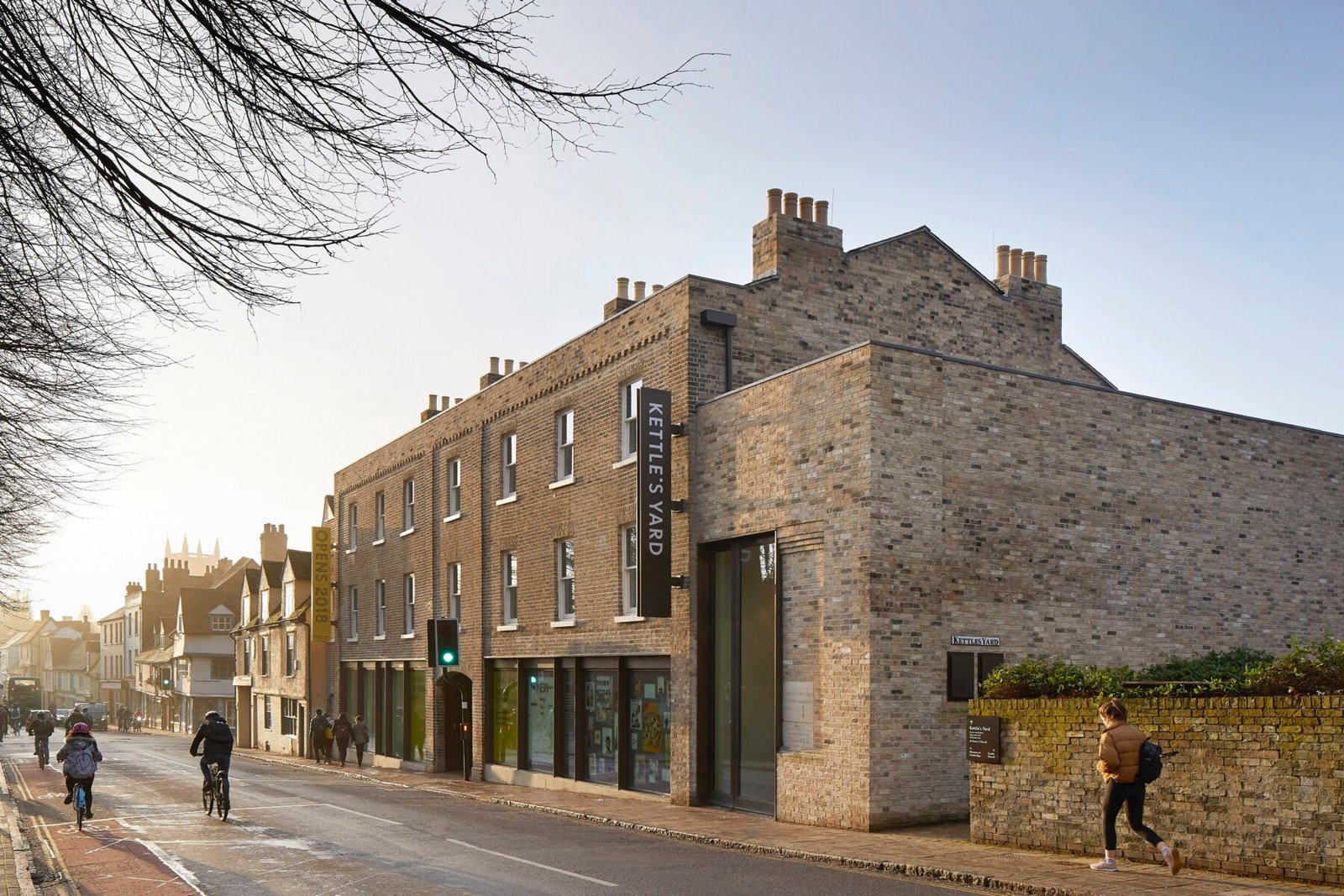
    St Peter’s on Castle Street is the opposite: small, quiet, and almost always open. A remnant of a larger medieval church, it contains a 12th-century font, a 13th-century doorway, and an octagonal 14th-century spire that still carries its small dormers. Rebuilt on a reduced scale in 1781, it feels like a kept fragment rather than a parish center. Its occasional use for exhibitions through Kettle’s Yard only emphasizes that quality.

    Composite image

    You reach St Peter’s by walking up Castle Street from Magdalene Bridge. The street kinks slightly after the Pickerel Inn — Cambridge’s oldest pub — and the traffic softens as the hill begins. Halfway up, a row of modest cottages appears almost without announcement. I used to walk past Kettle’s Yard every day after work. I lived near an overgrown graveyard full of 19th century carvings (I loved to hang out in) on Bermuda Street.

    The Making of Kettle’s Yard

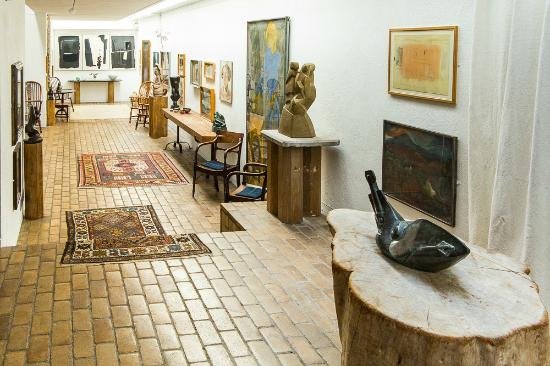
    Jim Ede spent years living on the property and turning it into the contemporary art space: Kettle’s Yard, a domestic constellation of rooms where art and ordinary objects coexist with an ease that feels both studied and utterly natural. The approach shifts your pace; you start to look more closely, instinctively, before you even step inside.

    Composite image

    The interior of Kettle’s Yard teaches you how to see. Ede, a former Tate curator with a lifelong ear for the quiet conversation between artworks, believed that art belonged in the flow of daily life rather than locked inside museum conventions. He filled the rooms with modern and contemporary works — Brâncuși, Gaudier-Brzeska, Winifred Nicholson — and placed them beside pebbles, feathers, glass bottles, and hand-thrown pots, each object chosen for shape and calm rather than prestige. Light enters softly through low windows, moving across surfaces instead of spotlighting them. Paintings rest on ledges rather than hang in stiff rows. A chair faces a single stone. A shallow bowl answers the curve of a shadow on the wall. Even today, as a contemporary art museum, Kettle’s Yard keeps this domestic clarity intact. Students can borrow works from the collection to keep in their rooms — a tradition Ede began to dissolve the hierarchy between “museum art” and the lived spaces of ordinary life.

    Composite image

    When you continue up the rise toward St Peter’s Church, that attention carries with you. The small medieval building sits just above Kettle’s Yard, slightly withdrawn from the street, as if it had stepped back to give the cottages room. St Peter’s is the opposite of Cambridge’s grander churches — small, quiet, more surprised to find you there than eager to be seen.

    Across from Kettle’s Yard

    St Giles’ Church sits directly across the road from Kettle’s Yard, on ground where a church has stood since 1092. The original Norman building shifted in form over the centuries before being fully replaced in 1875, leaving a Victorian structure that still carries the memory of its earlier footprint. It is quieter than the churches in the city centre, a little withdrawn from the university’s gravitational pull, and its interior reflects that distance: high Victorian arches over a modest nave, a softness to the light, the faint overlap of Anglican and Romanian Orthodox traces from the two congregations that now share it. St Giles “with St Peter” — the name it took after its smaller neighbour became redundant — feels more like a continuation than a monument, a church that has absorbed nearly a thousand years of substitutions without losing its calm.

    The result is a building that doesn’t insist on itself. It sits on the corner as though it has always been there and always will be, holding its many layers — Norman origin, Victorian ambition, Orthodox chant drifting through the current parish schedule — with a steadiness that makes it easy to wander inside without any sense of trespass.

    Composite image

    Ashitaka, San, and the Red Deer

    I was living at the time with an Australian psychology student on Bermuda Street, beside the graveyard I’ve already mentioned. She watched my long-distance relationship — stretched thin by my job in Cambridge and my boyfriend’s limbo while he waited to be fully accepted into his doctoral program — with the gentle detachment of someone observing a charismatic lab experiment. One afternoon over tea she told me that Abraham and I were the strangest couple she’d ever met, not unkindly but with the calm of a clinician noting an unexpected variable. “I can’t decide which of you is odder,” she said, “or which of you I like more.” She meant it warmly, and she wasn’t wrong. Cambridge collects eccentricities the way other cities collect traffic cones; ours just happened to be temporarily cohabiting, rearranging the kitchen shelves, and taking long, circuitous walks up Castle Street.

    When he was finally accepted and able to join me in Cambridge — me working in tech, him newly minted with the right to be there — we visited St Giles together. One of my clearest memories of that hill is the two of us stepping inside the church after climbing up from the river. Just past the doorway he said, very matter-of-factly, “Did you know St Giles is the patron saint of my family?” I said, “Why would I know that,” and he laughed in that slightly unhinged, overeducated French way that made everyone love him (almost as much as me). Then, in a rare and exhilarating moment, he pulled me close and said, “If you ever converted to Catholicism, we could get married, and he’d be your patron saint too.” I said, “You wouldn’t marry me unless I converted to Catholicism?” and he said, “I may be nearly an atheist, but I’m also from a very French family.”

    Saint Giles — Saint Gilles — is the patron saint of the disabled, the outcast, and anyone who shelters the wounded. His legend tells of a red deer he protected in the forests of Provence, a hind pursued by hunters. An arrow meant for the animal struck Giles instead, and the wound marked him for the rest of his life — a saint made not by triumph, but by taking the injury meant for another. He was the “joke of the neighborhood” and I felt that.

    Composite image

    I never converted, but I am pretty sure that St Giles accepted me as member of the family right then and there anyway… but that is a story for another time.

    Non-attachment & Religion

    When I was very young, I spent a lot of time on our brown shag carpet with a cassette player. On an outing to our local thrift shop, we found a huge plastic book of Old Testament cassettes. The plastic book of cassettes was heavy and scratched, and made a satisfying click when you slid the tapes into the stereo. I sat on the brown shag carpet, which matched our brown kitchen cabinets and wooden wall panels, and listened to the tapes. After a few years, I knew long stretches of obscure biblical lore simply from repetition.

    Composite image

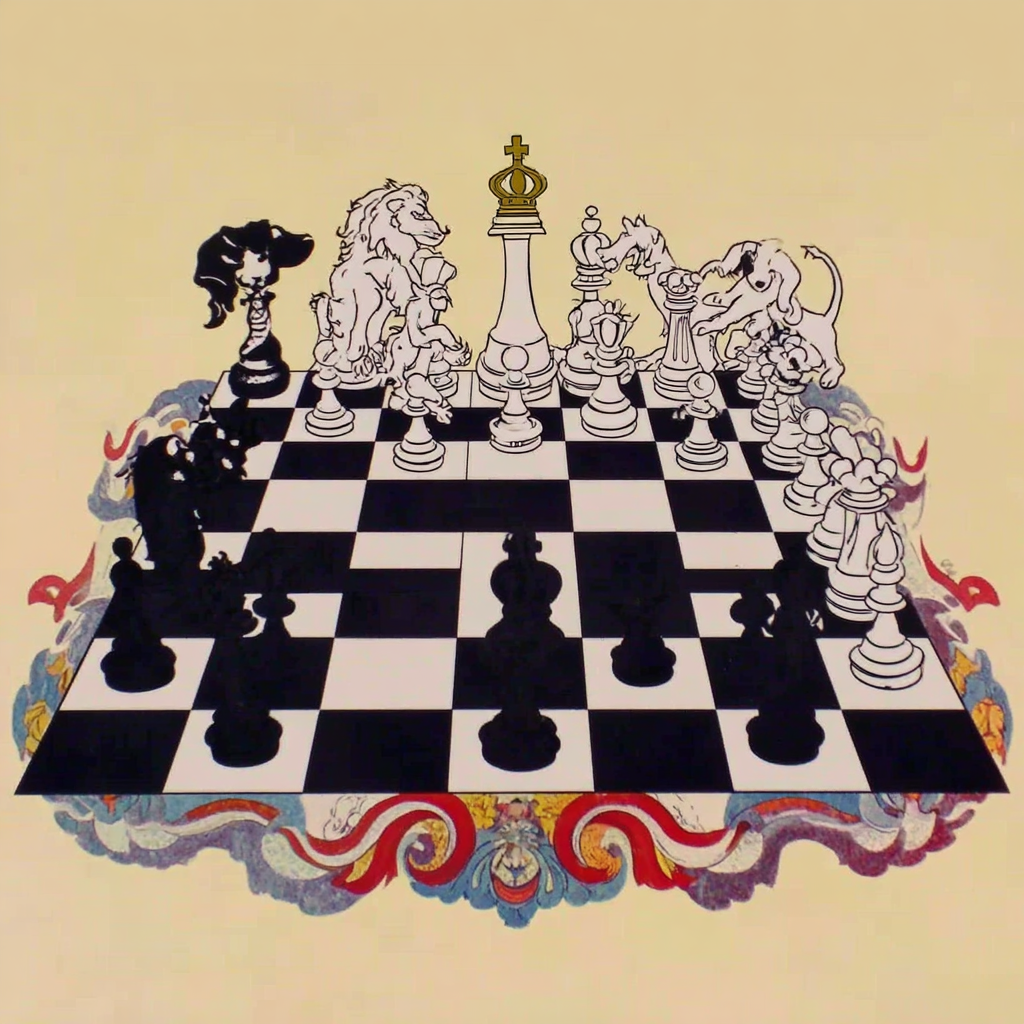
    Around that same age — six or so — my mom enrolled me in public education classes: ceramics, calligraphy, a few after-school workshops meant to keep kids occupied. But what I really wanted was the chess class. That was the one I insisted on. I loved knights, fairies, and medieval stories, in addition to the ancient stories from the Torah. I was an eccentric kid at a young age, but I also think there’s something about biblical history and a love of chess that’s naturally intertwined: the strategies, the categories of battles, the sense of wins and losses, good and evil, black and white.

    When I got older, I moved away from organized religion. By sixteen or seventeen I wasn’t participating anymore, but the early exposure stayed with me in a different form. Being non-denominational now, and outside any religious structure, gives me the distance to look at belief and culture with appreciation but also, at times, the non-attachment that makes analysis deeper.

  • Image Gazing

    Sometimes when I get overwhelmed, I stare at images. I think a lot of art historians secretly like to do this. A few minutes stolen from the day to look at something aesthetically balanced, proportioned, harmonized—something that happens, almost mysteriously, to be tuned to one’s own internal frequency, whenever or wherever the image was made.

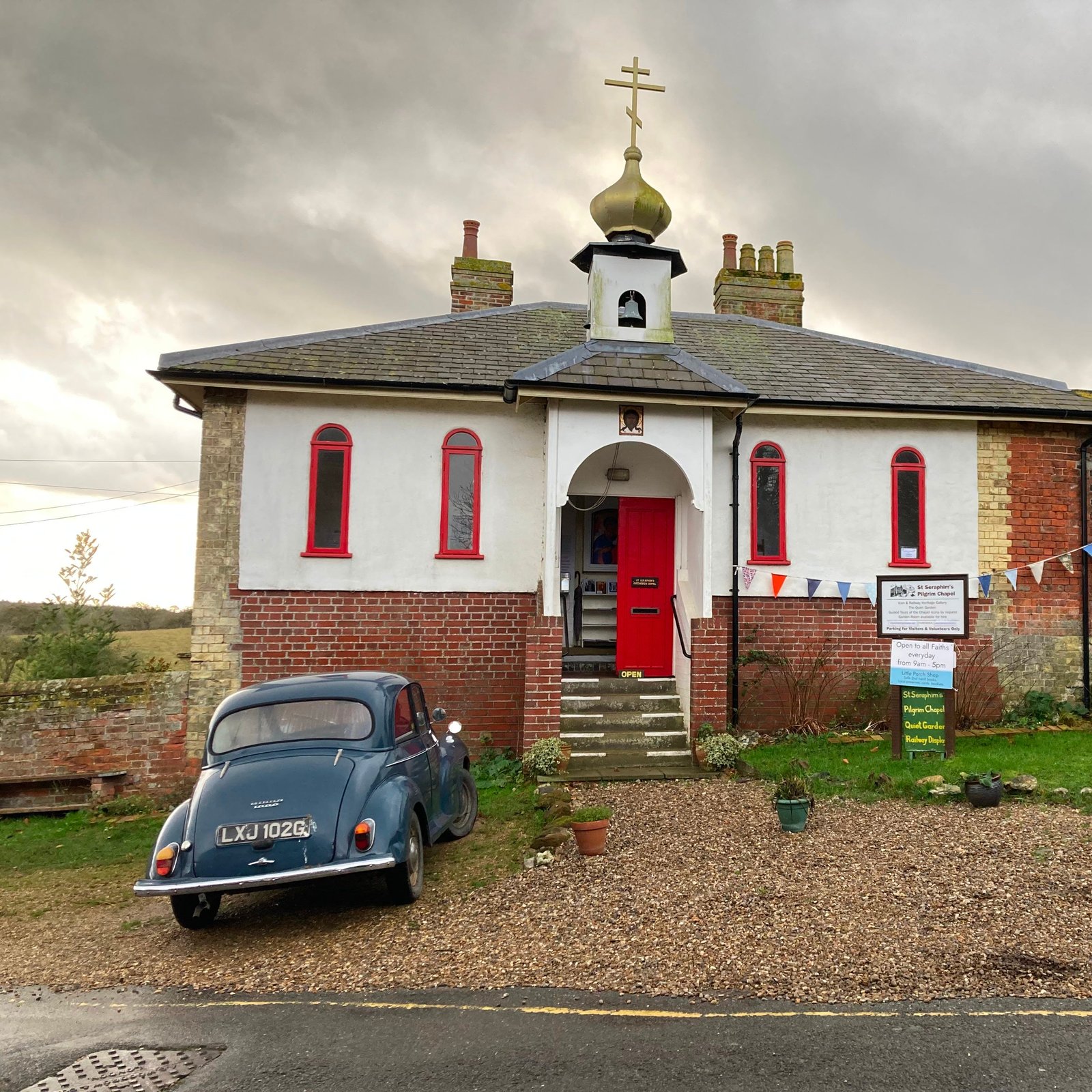
    I keep a lot of photographs of the rural villages and small churches I loved in England—especially around Walsingham, where I did my field work. One church in that religious-architecture-dense village is the Church of the Holy Transfiguration. It was one of the first places where I encountered the idea of an ikon, despite having studied art history as an undergrad. Their website describes it simply: “Ikons are, for Orthodox Christians, windows into the eternal dimension of reality. They are not realistic depictions or even works of art, but are a means by which Christ and his saints are made present to us.”

    Walsingham sits in Norfolk, that green, shaggy corner of England facing the North Sea, a region shaped by the old Norþfolc—“the north people.” The county looks outward toward Normandy, and after the Norman conquest of 1066, it became one of the first areas drawn tightly under their rule. You can still see the imprint of that history: earthworks softened by centuries of rain, hamlets that feel older than they appear, and Walsingham itself, a place formed by centuries of crossing and return.

    The Chapel of St Seraphim isn’t especially beautiful as “a building,” but there’s something about it—something I always felt drawn to. Then again, I’m biased; I’ve always had a soft spot for red brick. It almost looks like the house I grew up in.

    Composite image

    Another image I return to, struck by its emotional impact, is of Mount Kailash. In the traditions of Hinduism, Buddhism, and Jainism, this mountain is seen as a celestial link between earth and heaven—a gateway to the divine. Its names carry some of that meaning, too. The Sanskrit name Kailāśa is likely derived from kelāsa, meaning “crystal.” And the Tibetan name Gangs Rinpoche (གངས་རིན་པོ་ཆེ) combines “gang/gāng” (snow peak) and “rinpoche/rin po che” (precious one), often rendered as “precious jewel of snows.”

    There are also references that place Kailash inside Buddhist cosmology. One source notes: “It’s central to its cosmology, and a major pilgrimage site for some Buddhist traditions.” Taken together, the names and descriptions sketch the outline of a mountain regarded by many as sacred, even before you ever see its shape.

    Composite image


    Praise to Buddha Shakyamuni
    O Blessed One, Shakyamuni Buddha
    Precious treasury of compassion,
    Bestower of supreme inner peace,

    You, who love all beings without exception,
    Are the source of happiness and goodness;
    And you guide us to the liberating path.
    Your body is a wish fulfilling jewel,
    Your speech is supreme, purifying nectar,
    And your mind is refuge for all living beings.
    With folded hands I turn to you,
    Supreme unchanging friend,
    I request from the depths of my heart:
    Please give me the light of your wisdom
    To dispel the darkness of my mind
    And to heal my mental continuum.
    Please nourish me with your goodness,
    That I in turn may nourish all beings
    With an unceasing banquet of delight.
    Through your compassionate intention,
    Your blessings and virtuous deeds,
    And my strong wish to rely upon you,
    May all suffering quickly cease
    And all happiness and joy be fulfilled;
    And may holy Dharma flourish for evermore.
    — Geshe Kelsang Gyatso Rinpoche

    My Image as Seen by Others

    When I was in Europe, I experienced a variety of different types of prejudice. Class is very important there, so my class was known and felt immediately. But I benefited from the “celebrity” implications of my American accent as well. People were interested and invited me places – I tried not to step on toes, eat too much, talk too much, or annoy anyone. I failed on every count almost every month, but Cambridge is a remarkably forgiving and welcoming place, and I was lucky enough to call an international college, Hughes Hall, home.

    Even still, the person who hurts us most is always closest. Some of the worst American stereotypes applied to me were from my long-time French boyfriend. The one that hurt most… he told me: You’re a walking hippie stereotype. No one had ever called me that. I had almost never encountered other “hippies” in my life, although I’d written my high school thesis on the Beatles and Tom Wolfe. I think it was obvious it was only a matter of time until I fell for the Grateful Dead, but not before I’d spend years curled up with Leonard Cohen and Janis Joplin. I’d been to San Francisco only once before I flew to England (the same summer in 2013, in fact), but other than that, I’d been raised around traditional, respectable, be-khakied people in the far-off land of OOTTAWW, as I had to mouth slowly for the French. Although my mom was born in Marin Hospital, my grandparents were more beatniks-turned-respectable.

    I fell in love with Buddhism in England, actually. Making my weekly stop-off in the Tibetan store across from Kings, I gasped when I walked in at the same time as the owner. “Did you really meet the Dalai Lama?” Excuse a girl for having a naive sense of wonder (about everything, but especially about Buddhism).

    I don’t think I ever totally felt comfortable with my boyfriend after that, seeing myself in that way so denigrated in my sincere beliefs. I’d worked on an exhibit at the MAA called Buddha’s Word, which was the first exhibition of Tibetan material in Cambridge, and the first time in the Museum of Archaeology and Anthropology’s history that its Buddhist collections had ever been presented together. It was developed in partnership with the Mongolia and Inner Asia Research Unit, supported by the Arts and Humanities Research Council and the Frederick Williamson Memorial Fund, and drew on collections from across Cambridge — the MAA, the Sedgwick Museum of Earth Sciences, the Fitzwilliam, the University Library, even Emmanuel and Pembroke Colleges.

    buddha's word

    buddha's word

    It mattered to me. The project mattered, the materials mattered, the scholarship mattered. Buddhism wasn’t a phase or an affectation — it was part of my intellectual and spiritual life, tied to real work I was doing inside these institutions. So when he reduced it all to a stereotype, it wasn’t just a careless comment; it was a small betrayal of how deeply I cared about something he never bothered to understand.

    Pareidolia: The Velvet Knife of the Unbothered

    Speaking of image gazing: Pareidolia is the tendency of the human mind to perceive recognizable forms — especially faces — in random or ambiguous stimuli. In American intellectual history, the concept has appeared in several distinct contexts. During the 19th century, writers associated with Romanticism often referenced pareidolic perception when describing heightened imagination, seeing symbolic meaning in nature, or interpreting landscapes as expressive. In medical and psychological discourse of the late 19th and early 20th centuries, pareidolia was sometimes discussed in relation to certain mental-health conditions, particularly those involving misinterpretation of sensory information.

    In popular culture, it has repeatedly surfaced in narratives about “seeing signs,” spiritual imagery, and the interpretation of natural forms. Across literature, psychology, and journalism, pareidolia has functioned as a descriptive term for how people project patterns, meanings, or emotional significance onto otherwise neutral visual cues.

    If Europe taught me anything, it’s that mis-seeing can also be an art form, and a particularly glaring one in some university contexts. Not always intentional, not always cruel, but pervasive — especially among the confident, the class-assured, the ones who glide through rooms believing their interpretations of others are simply facts.

    Pareidolia isn’t just seeing faces in clouds; it’s assuming before they’ve spoken a full sentence. My grandmother used to say, “to assume is to make an ASS of U and ME.” To criticize spirituality has become the reflex of the elite and unbothered: a velvet knife disguised as scientific clarity. However, there is, as we saw in the last post about Surrealism, the unconscious, chance, and AI, a level of hallucination required to see something special in an image, an ordinary building, or in general. Maybe we art historians really are all crazy.

    Composite image

    Composite image