Tag: anthropology

  • Locks’s Glass Onion

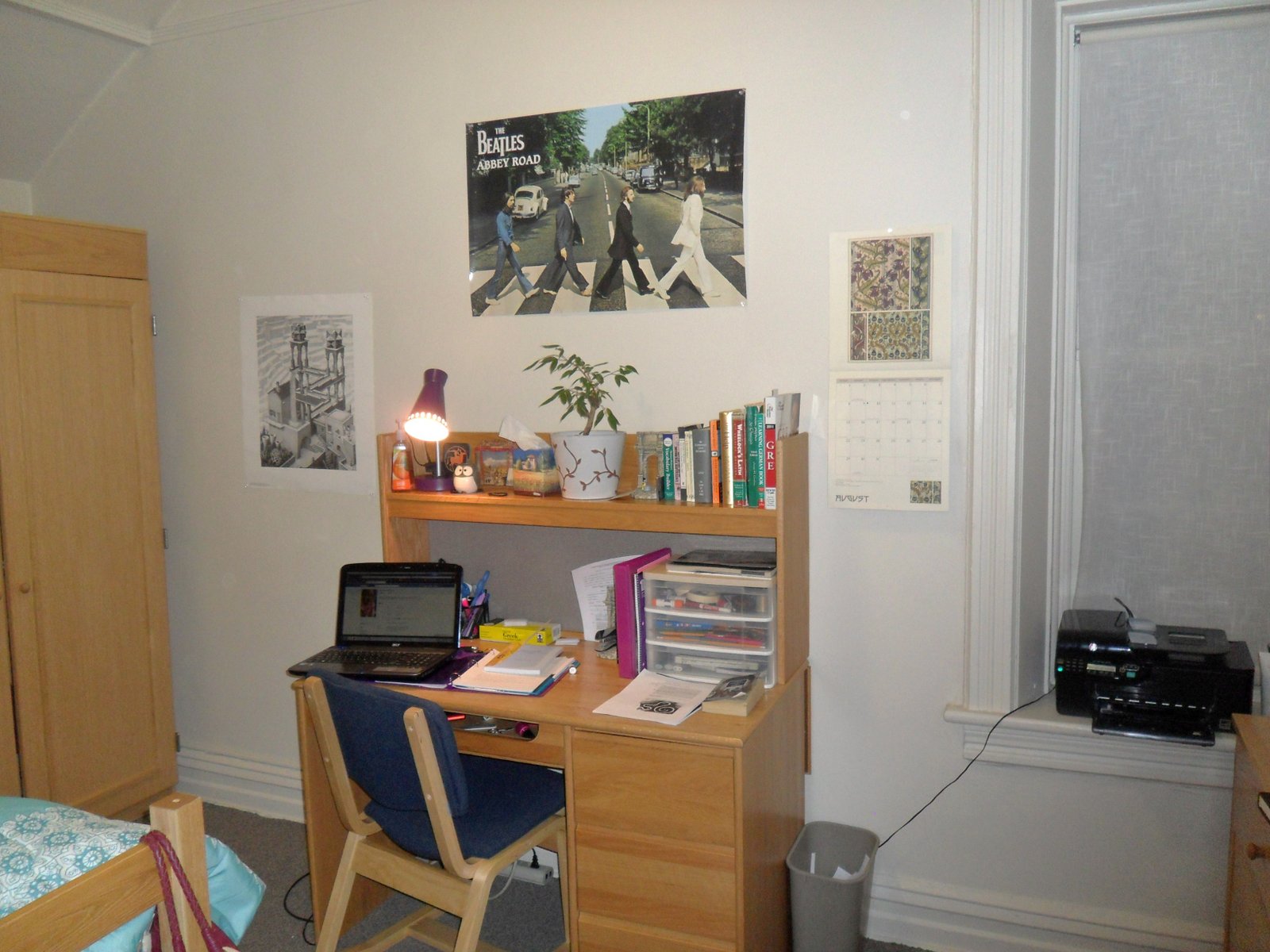
    My college room at the University of Utah, 2010
    My college room at the University of Utah, 2010

    I’ve had a long and multifaceted relationship with the Beatles, and nothing makes me happier than talking through the songs themselves: which ones people love, which ones people genuinely hate, and why. It’s one of my favorite conversations to have, “full stop.”

    People attach themselves to certain tracks for reasons that feel almost archaeological—childhood car rides, the first chords they learned, the moment they realized music might shape their lives. Those memories stack up until the songs become part of their own record. The Beatles’ catalog turned into both an American time capsule (sorry Brits) and a global one, familiar to people who grew up oceans apart.

    People who can’t stand the Beatles reveal something too, and the force of that dislike is part of the story. The hard rejection, especially among millennials and the generations that followed, comes with its own code: nose-upturning at “pop music,” purity tests, the need to stand outside whatever feels canonical.

    I. The Domestic Universe: From “Octopus’s Garden” to Ram

    I grew up in a small world of homeschooling circles, Montessori classrooms, and public libraries where children’s music was having a moment. Raffi was part of a larger movement of artists making development-focused songs meant to nurture curiosity and imagination. “Banana Phone” became my personal toddler theme song because my real name rhymes with Banana (also “like Montana”).

    “Octopus’s Garden” and “Yellow Submarine” were kid songs, and the question coming out of the 70s was “Why wouldn’t you write songs for kids?” They had the playful, bright, imaginative spirit, geared toward building inner worlds. At library singalongs, Beatles tracks lived right next to “Baby Beluga.”

    It was a childhood inside the progressive Left, and no matter what I think about how politics in the US has devolved, I still know exactly where the grandmas from Vermont and the aunts from the suburbs of Colorado made their core memories. The Beatles were folded into that, aligned with the softer, idealistic side of the 1960s that suburban liberals still cling to and think is compatible with the LGBTQIA+ movement (lol).

    Me on a swing as a kid.
    I pretty much dress like this to this day.

    There are cultures, especially in Italy and South America, where the domestic world of mothers and children is treated as a sacred space—a universe of Marian art so beautiful it can move you to tears when you see the sculptures at the center of French, Italian, or Spanish cathedrals.

    In the United States, this world is often mocked or dismissed, and I’m positive that this cultural disdain is reflected in the growing language erasure around motherhood. I sometimes think the fiercest Beatles hate comes from people who never felt at home in that early domestic universe of bright colors and snotty-nosed kids at singalong: the goofy, the “non-sexual.”

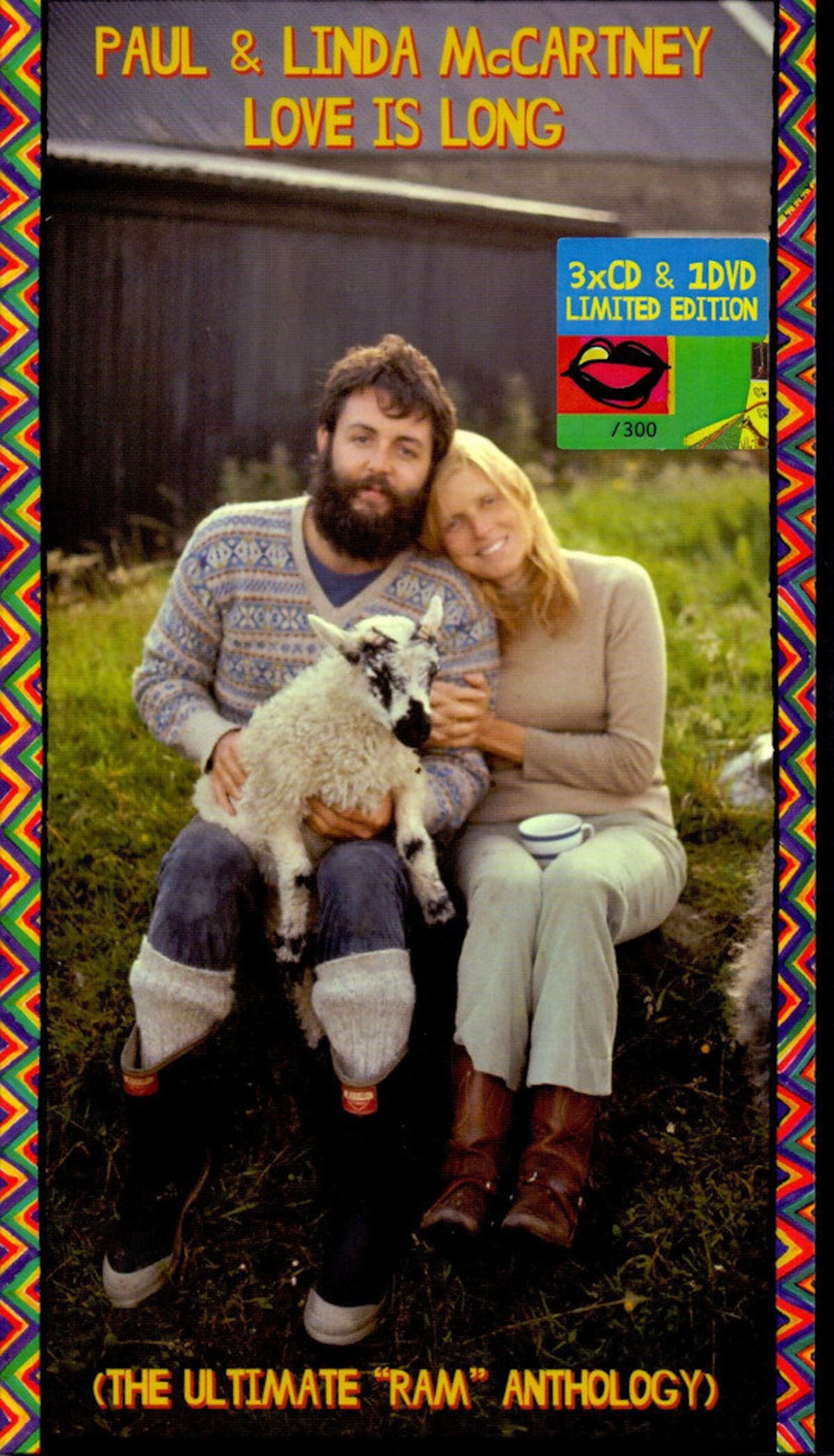
    Part of the Beatles’ legacy that’s impossible to deny is Paul and Linda McCartney’s Ram—my pandemic album of choice, played on my little Victrola in my 2020 apartment at 9th and 9th. The record feels like the domestic counter-melody to all of it, a rural masterpiece that honors partnership, motherhood, kids, animals, and the rhythms of farm life.
    A quiet domestic corner with records and devotional imagery.

    II. Here Comes the Sun King’s Shadow

    Because I was raised with brothers and was, on my mom’s side, the eldest grandchild, I developed a bossy streak that everyone found hilarious when I was small. My snazzy, upper-middle-class grandparents would fly in from Arizona, take me to the Children’s Museum; later showing their friends photos of me shoving little boys out of the way to get on top of a monster truck. However, my extremely conservative, whole-wheat-bread-baking stepmom thought it was a very bad omen.

    To be fair, I did go through brief phases of biting, scratching, choking, and kicking in elementary school—little spikes of chaos that made adults wonder what kind of creature I was becoming.
    A quiet domestic corner with records and devotional imagery.

    This was also the era when I refused to let my mom (a hairdresser) comb my hair, so she finally cut it into the rounded, symmetrical style we called “the Danny Torrence special.” It’s still one of the great family jokes. Around the same time, she bought the Abbey Road CD, one of the few I could slip into her yellow-and-black Walkman.

    I already adored Bugs Bunny and every form of slapstick—anvils, dynamite, frying pans to the face—so “Maxwell’s Silver Hammer” convinced me that violence was funny in a way adults secretly understood, even if they pretended to be above cartoon mayhem.

    If the Beatles could sing about cheerful little murders, it meant I wasn’t a bad kid for loving the rhythm and absurdity of violent media; I liked the heightened, stylized spectacle, but felt guilty or like there was something “un-girlish” about that. I (mostly) outgrew real-life violence, but anyone with an enduring love for Kill Bill knows exactly what I mean.

    i. Violence, Chaos, and Danger in the Beatles — The Little Girl’s Starter Pack

    • “Happiness Is a Warm Gun” — The White Album
    • “I Want You (She’s So Heavy)” — Abbey Road
    • “Oh! Darling” — Abbey Road
    • “Come Together” — Abbey Road
    • “Why Don’t We Do It in the Road?” — The White Album
    • “Helter Skelter” — The White Album
    • John’s scream songs (“Yer Blues,” “Twist and Shout,” the proto–primal scream)

    III. Abbey Road to Anthropology

    On a Hawai‘i trip when I was fifteen, Abbey Road played through the speakers of my grandparents’ car as we crossed the island, lava fields in the distance and the long dark highway ahead of us. Near sunset, we pulled up close to the observatory, the sky throwing out one last explosion of color before the stars began to appear. We stepped out into the cold air and looked down at the cloud sea spread out like another planet.

    Then we looked up through a giant telescope at Antares, the red heart of Scorpius, burning clear against the night.

    An observatory above a sea of clouds on Maunakea at sunset.

    My connection to Abbey Road crosses with what I was starting to understand about the island and its history. My grandpa Jeff was an architect (or something similar) at Hokuli‘a, a development on the Big Island creating a luxury community. Jeff contributed to through his Japanese-inspired minimalist designs for mansions overlooking the ocean on a jaw-dropping coastline.

    I was learning the story of the development from the kids my age who lived there. This is something I’m trying to capture in these blogs: that the moments and sources that inform knowledge and meaning drastically shape the way you perceive information. The kids and my grandma, although the topic was taboo, told me what the land meant and how sacred burial grounds from the Bronze Age (or thereabouts) had been found, why the lawsuits mattered, and how often white people imagined blank acreage instead of a place shaped by lineage, stewardship, and memory.

    My grandparents were old-school Democrats who integrated into the small community as much as anyone tied to a development project could. They were not naïve about the tension, and they did not pretend it wasn’t there. The experience, seeing the situation from multiple angles, inspired me to pursue anthropology later.

    IV. Runaways, Girlhood, and “She’s Leaving Home”

    “She’s Leaving Home” came into my life in high school, when I was reading poems like Margaret Atwood’s “you fit into me” and starting to recognize the darker truths that settle in early for girls. High school is when you begin to see that “teen girls” are often viewed in a binary of boring and obedient or highly sexualized and cartoony.

    Alternate modes can become uncomfortable for people, and when you fall outside those easy categories, you’re forced to confront all the strange contradictions of “girlhood”—being the gossiped-about lead character in the soap opera version of your life. It’s the stage when escape becomes more than a metaphor, and you catch yourself wanting to leave not just your circumstances but the whole planet and the entire human script altogether.

    A sad doge meme used as a visual stand-in for teenage melancholy.

    The teenage runaway is a theme I return to again and again in my art. I gravitate toward characters like Effy Stonem in Skins because they captured that tension: the push and pull between belonging and disappearance, between being watched and wanting to vanish.

    “She’s Leaving Home” is a song I’d never have predicted I’d like. It caught me off guard. The Beatles were emblematic of the 1960s runaway generation, but here they were writing from the viewpoint of the parents, the people left standing in the doorway after she ran away. Their voices rise through the arrangement like a Greek chorus: bewildered, aching, trying to understand the shape of a departure they didn’t choose.
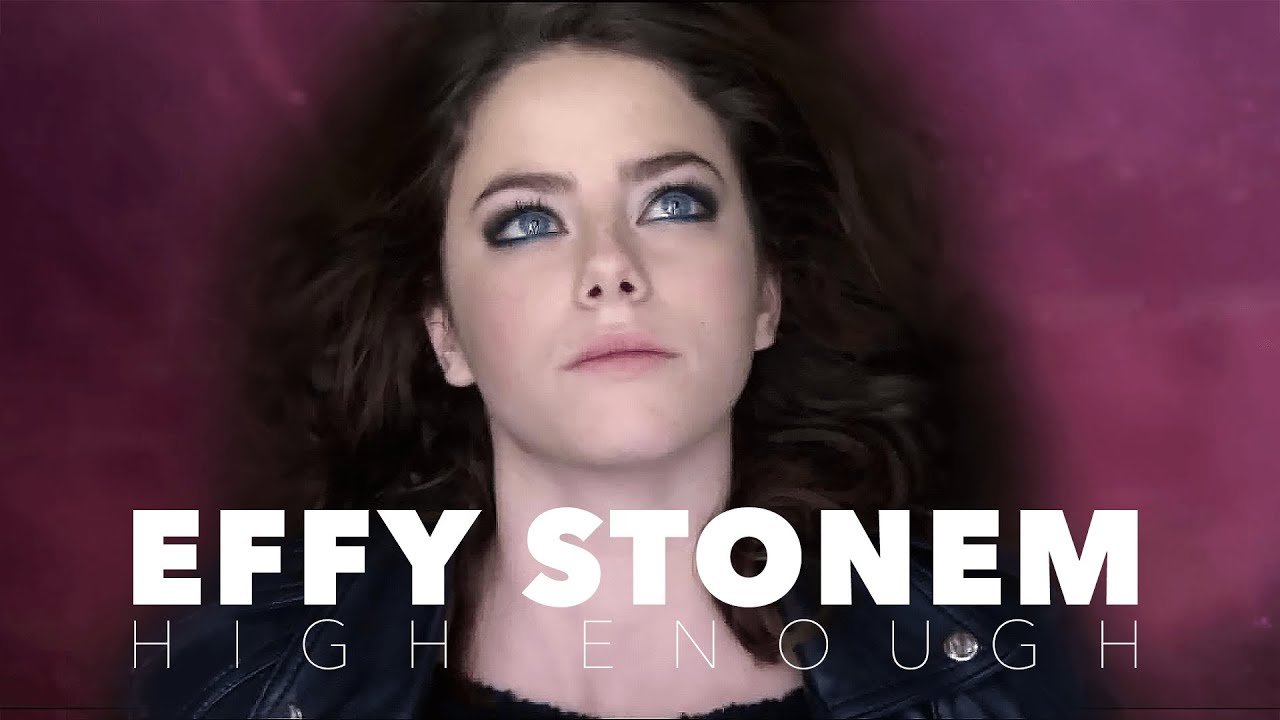
    Effy Stonem from Skins, looking away, suspended between presence and disappearance.

    Which left me with a question I couldn’t shake: why did a group of very young men choose this vantage point? Why write about the runaway girl from inside the parents’ fear instead of the glamour of the girl’s escape? That choice felt strangely mature, almost dissonant with their public mythology. It suggested they understood the runaway not as an icon but as a daughter embedded in a social world—family, community, expectations, the fragile networks adolescence can fracture.

    V. Beatles Songs That Changed Shape Over Time

    i. “Dear Prudence” and the Rishikesh Lens

    “Dear Prudence” never landed for me until I learned the context. During the Beatles’ stay at Maharishi Mahesh Yogi’s ashram, Prudence Farrow isolated herself so intensely that Lennon wrote the song to coax her back into the world. With that in mind, the simplicity of the song becomes a kind of pastoral caretaking, not a repetition for its own sake.

    ii. Listening Beyond Earth: “Across the Universe”

    “Across the Universe” changed shape for me in a similar way. It wasn’t until after my own time in the desert—and reading more about the India period—that the song opened up. Its suspended, drifting structure echoes “Here, There and Everywhere,” but pulled toward the edges of spacetime. It’s now one of my favorite songs.
    A quiet domestic corner with records and devotional imagery.

    iii. Falling in Love with the Schizoid

    There were songs I couldn’t reconcile with at all. I still don’t like “Everybody’s Got Something to Hide Except Me and My Monkey,” and “Savoy Truffle” never settled for me either. For a long time I dismissed much of The White Album because the contrasts felt too abrupt—bright pop beside deliberately strange distortion.

    “Julia” was the first one that changed for me. “Honey Pie” followed after hearing the Pixies cover, which so captures the range and depth potential of the Beatles catalog. And then “Long, Long, Long” became the center point. It arrived during a chaotic, formative stretch in my life, when Elliott Smith and the quietest Led Zeppelin songs were the core of my listening.

    iv. Eternal Sunshine of the Rearranging Harrison House
    A quiet domestic corner with records and devotional imagery.

    The older I get, the more “Long, Long, Long” feels less like a song and more like a house I keep rediscovering—rooms shifting, a held breath in the wood. Every time I return to it, I hear a new vibration, a new ache that wasn’t there before. Built on restraint and resonance, it feels private and unguarded, as if Harrison left it open for us to wander through.

    It waited for me, the way great art does, until I became someone who could hear it. That’s how I fell in love with George Harrison… became his “Soft-Hearted Hana.”

  • Eleanor Rigby Weather

    Placeholder: swap in a meme or still that fits the mood.

    I genuinely cannot be in a bad mood when Monty Python starts whistling at me. “Always Look on the Bright Side of Life” is somehow powerful enough to override both rejection emails and Utah politics. Two notes and I’m cured. It also happens to be sung by men being crucified, which feels like an appropriate motivational model for writers.

    I try to remember that feeling when a literary magazine informs me—very politely—that I am not among the anointed ones (I am, unfortunately, not Brian). But unlike most magazines, Strange Pilgrims did something humane: they told the truth. More than 7,481 submissions landed at their virtual doorstep.

    That’s not a slush pile; that’s a full-scale literary migration. Entire ecosystems of poems, essays, experiments, and genre-adjacent apparitions. The editorial equivalent of having 7,481 feral kittens suddenly show up on your porch, each insisting it’s special. No one can read that many pieces without caffeine, spreadsheets, and a durable spirit. The breakdown:

    • 46% Short Stories
    • 29% Flash Fiction
    • 16% Creative Nonfiction (my corner)
    • 9% Flash CNF

    I’m one bright dot among thousands of people writing through whatever strange seasons they’re in—grad school recoveries, heartbreaks, quiet epiphanies, late-night typing fits.

    Because today arrived wrapped in steady rain, Salt Lake City drifted into an accidental British mood. On days like this, almost without thinking, I reach for British things—Beatles albums, Monty Python sketches, small scraps of comedy that work better than meditation apps. The rain, the rejection, the nostalgia: they braid together and pull me back toward the younger versions of myself who hadn’t yet been asked to have a future.

    Drifting Toward Whatever Color Glowed Brightest

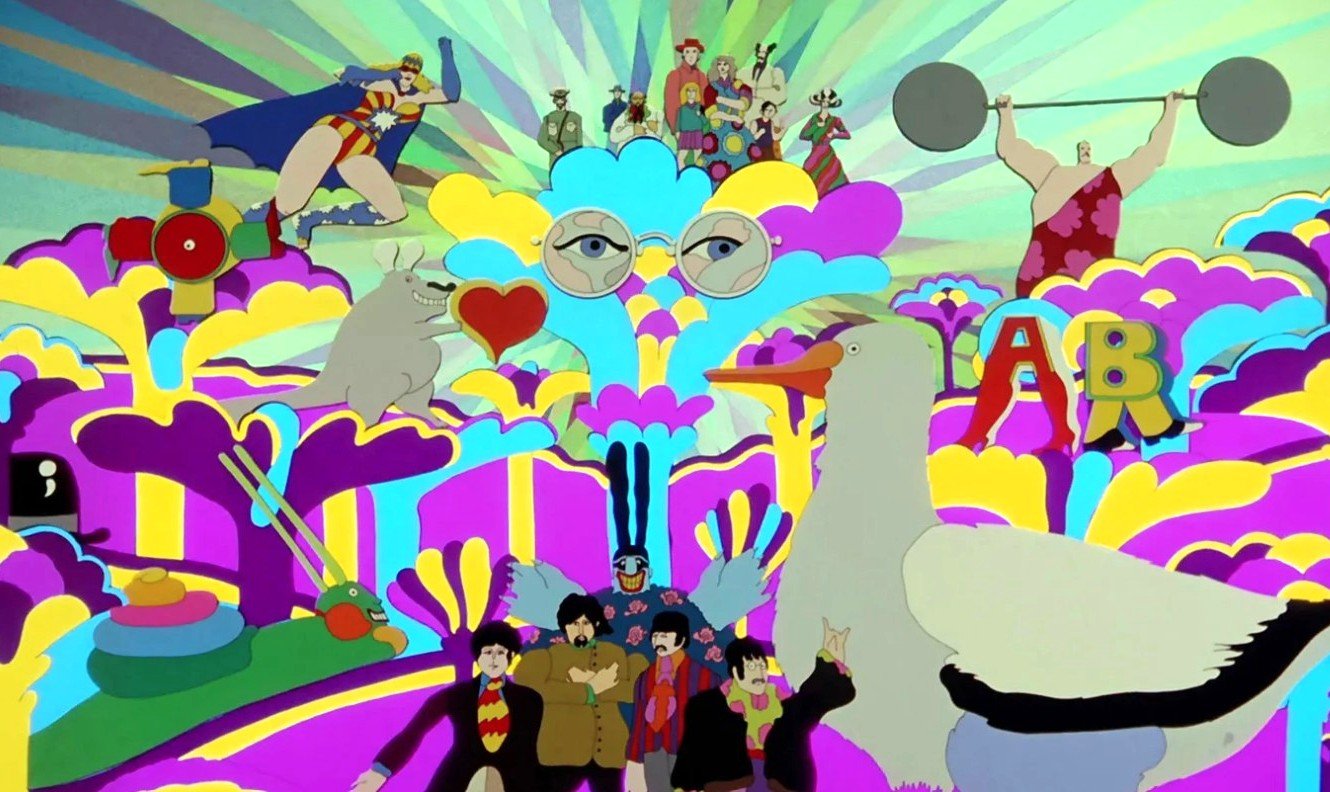
    Placeholder: swap in your favorite Yellow Submarine still.

    At seventeen I watched Yellow Submarine for the first time—unwrinkled, teenage-thin, balanced at the threshold of everything unnamed. My sense of self then was more of a faint outline than a shape. “Me” was still in beta. No degrees, no acceptances, no promotions. I was essentially an amoeba, soft and curious, drifting toward whatever color glowed brightest.

    Me at 17.
    Me as an amoeba.

    The film hit me the way certain things do when you’re still mostly potential: a psychedelic cartoon, strangely beautiful like fine art. I remember showing my boyfriend the “natural born lever-puller” scene—a joke that works on a few different levels if you notice the wordplay. The Beatles are from Liverpool, which makes them Liverpudlians, not lever-pullers; John delivers the line while literally pulling a lever on the submarine, grinning in a way that makes the implication unmistakably physical (to my hormonal teenage brain).

    And then came the Eleanor Rigby overture, with its lonely drawings of Liverpool rendered in muted grays and anonymous faces, the whole city walking beneath a private weather system. That rich animated sequence became my internal shorthand for England, more than landmarks, more than anything literal. The only other thing that captures that mood for me is “Kathy’s Song”, the way Simon sings about moving through rain and realizing that love, or longing, or some interior truth is the only thing that holds steady.

    On this rainy day—when my unemployment is hanging in the air like a stalled pressure front—I sit by the window and watch raindrops slide down the glass. The Wasatch Range disappears into fog and for a moment the valley feels like I’m at a different latitude.

    The Long and Winding Road from Reviewer to Artist

    A moment of clarity in the British drizzle reminded me of this: for six months I’ve been writing every day and learning new ways of making art. Some of that work has helped me understand my own life; some of it feels like it might matter to others who are trying to make sense of theirs. I keep writing about Utah artists and musicians because they deserve more light than they get. It’s the work that feels worth doing, and the hope that it might ease someone’s path the way other people’s art has eased mine.

    Being a magazine reviewer and corporate writer has meant most people don’t think of me as an artist. But in terms of writing, what I do is a kind of reduction and abstraction—paring language down, stripping away the unnecessary, following something like Hemingway’s discipline and something like what Dan Evans does visually in his cut-paper work (read my profile for 15 Bytes here). My writing isn’t really “content” anymore; it has form, created from writing, rewriting, and using words and semiotic chains like a material you can shape and manipulate.

    I didn’t expect visual art to open up for me during this unemployment stretch. AI video, especially—something about pairing music with moving images unlocked a kind of emotional processing I hadn’t been able to reach through writing alone. It feels closer to fine art than anything I’ve ever made: color, timing, rhythm, atmosphere. I can take the grief, the weirdness, the nonlinear memories, and shape them into something that moves—literally moves—in a way prose can’t. I’ve started thinking about these pieces the way I think about essays: structured, intentional, built from feeling rather than performance. It’s strange to say, but for the first time, I actually feel like someone who makes art, not just someone who writes about other people making it.

    A video animation created with AI based on original artwork

    Because I’m trying to hum on the bright side of life, I can admit this: I’ve made more progress in these months—more growth in understanding how I write and why—than I ever managed while employed. I’m finally submitting to magazines like Strange Pilgrims. Finally imagining myself as someone allowed to be there. Even if it feels like showing up scandalously late, something essential has shifted in how I make things.

  • Studies in Emergent Meaning

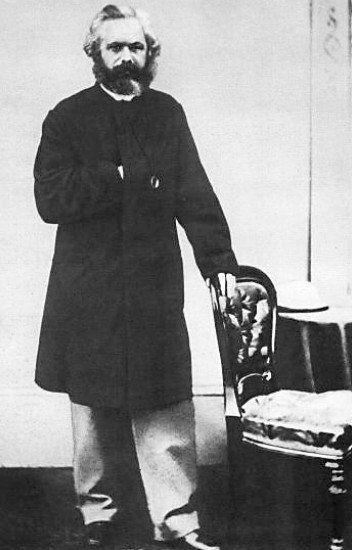
    Karl Marx's coat, often used to illustrate debates about material agency.

    My interest in how meaning and consensus take shape began not with formal theory but with a loose scatter of coincidences that, at the time, seemed directionless: odd overlaps, misplaced conversations, ideas brushing against one another without context. Only much later, after studying semiotics and working with Large Language Models (LLMs), did those fragments make retrospective sense. They suggested that chance is often the first draft of coherence, that language can function as a proof-making system, and that meaning tends to surface wherever relations intensify, even when no one appears to be consciously arranging them.

    Early Crosswinds

    In undergrad I studied Classics and art history, steeping myself in Greek poetry, Latin word order, and the strange semiotic machinery of myth. I was hanging around with a group of anthropology and film students—one had a roommate who was deeply, almost theatrically invested in the singularity debate. It was 2012–13, that awkward pre-“AI ethics” era when everyone I knew was broke and trying to turn an A in English Literature into something resembling rent money. We drifted between departments without really belonging to any of them, and that loose, interdisciplinary drift is what first pulled me into conversations about intelligence: human, machine, and the uncategorizable spaces in between.

    A few of us ended up doing SEO and web copywriting to stay afloat, which meant long Utah nights spent producing industrial quantities of unremarkable content about plumbing, chiropractic care, pest control, financial advisors, HVAC repair—whatever paid twelve dollars an article. The company quietly sold its data to researchers training early language models; none of us fully realized we were stocking the pantry of a future oracle.

    During a long summer trip through the Pacific Northwest, a friend from that circle explained the scraping practices behind those early LLM experiments. The logic seemed oddly intuitive: that almost all small talk collapses into a limited number of predictable moves, and that if you average out millions of conversations, the patterns rise like a watermark. For two undergrads prone to late-night debates about consciousness and the singularity, it neatly confirmed our pet theory about why so few people ever veered beyond the eternal “How was your weekend?” script.

    A second tangent from that summer—completely unrelated, yet somehow filed in the same mental cabinet—was that spacetime curves around mass like a bowling ball on a mattress. My mind held both ideas at once, turning them over during those months in 2013, the way a half-trained hunting dog circles a scent it doesn’t yet have a name for.

    Seeding the Future With a Hermetically Sealed Joke

    As I spent that summer writing, increasingly aware that my copy was being scraped into early training corpora for language models, I responded with what can only be described as a small act of DIY conceptual art. Inspired by the deadpan absurdity of OK Go’s 2006 treadmill choreography in Here It Goes Again, I decided that if the machines were going to inhale my unremarkable web content, I would slip something odd into their diet on purpose. I began inserting the phrase “hermetically sealed container” into as many articles as possible—pest control, water damage, food storage, anything where the wording could pass unnoticed. It became a quiet form of linguistic guerrilla theater. To protect the phrase from editors, I embedded it in pseudo-authoritative warnings; somewhere out there, dozens of small businesses were advised to store replacement parts or seasonal decorations in hermetically sealed containers “for optimal results.”

    The Orchard tea garden near Cambridge, a riverside walk just beyond Grantchester.

    The experiment revealed something I didn’t yet have language for. I had already intuited, long before I could articulate it, that language models were not “intelligent” in a deliberative or ethical sense but were vast semiotic engines. They sifted, averaged, and recombined. They made legible whatever patterns the corpus insisted upon. And if meaning could be extracted even from the detritus of gig-economy blog posts, then something in the system—human or machine—was hungry for pattern beyond intention.

    What I didn’t realize at the time was that this small protest joke—my hermetically sealed resistance—was an early rehearsal for the larger question that would follow me through graduate school and eventually into work with AI: how do systems, whether human or computational, decide what counts as meaning? Where is the boundary between bias and interpretation? Between discernment and discrimination? Between pattern and coincidence?

    The Cambridge School of Analytic Philosophy

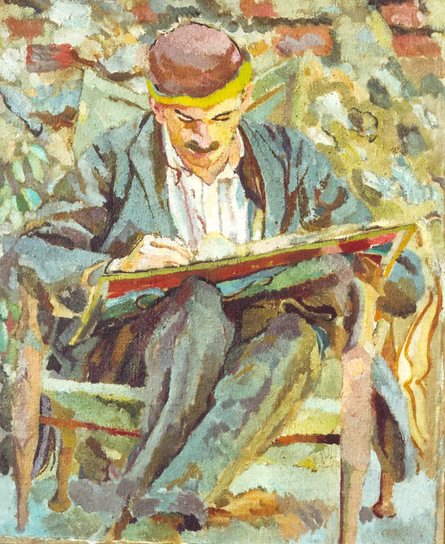
    Portrait of John Maynard Keynes, economist and Cambridge fellow.

    Those questions intensified during my M.Phil at Cambridge, where I moved through linguistics, material culture, and the anthropology of objects. The M.Phil—the Master of Philosophy, a degree title that historically belongs to Oxford and Cambridge and has since been adopted elsewhere—anchored a particular intellectual belief and creed: that language, argument, and semiotic precision can constitute a form of proof.

    Cambridge’s famous analytic philosophical tradition was shaped by figures like George Edward Moore (B.A. Cambridge, 1896), whose Principia Ethica (1903) attempted to clarify moral reasoning through linguistic exactness; Bertrand Arthur William Russell (B.A. Cambridge, 1894), whose Principia Mathematica (1910–13, co-authored with Alfred North Whitehead) sought to derive mathematics from pure logic; and Ludwig Josef Johann Wittgenstein (who first studied at Cambridge beginning in 1911 under Russell, and returned as a fellow in 1929), whose Tractatus Logico-Philosophicus (1921) and later Philosophical Investigations (published posthumously in 1953) argued that the limits of language are the limits of the world. Even John Maynard Keynes (B.A. Cambridge, 1905)—better known for economics—contributed to this lineage through A Treatise on Probability (1921), which framed probability as a logic of partial belief grounded in relations rather than mere frequencies. Above is a painting of John Maynard Keynes by Duncan Grant (1917).

    Keynes belonged not just to the halls of King’s but to the landscape around it. Just outside Cambridge in Grantchester sits The Orchard, a garden tea spot where Keynes, Virginia Woolf, and other Bloomsbury figures spent long afternoons talking, writing, and drifting between work and leisure. During my own time in Cambridge, The Orchard became a quiet anchor: I walked there along the river almost every day the weather was decent, following the same footpaths between cows and willows that earlier generations of strange, overthinking people had worn into the ground.

    Together, these thinkers established an assumption that shaped the intellectual climate I inherited: that clarity of language is clarity of thought, and that when concepts are arranged with precision, they can demonstrate inevitability just as rigorously as mathematical proofs. In that worldview, meaning is not decorative; meaning is structural.

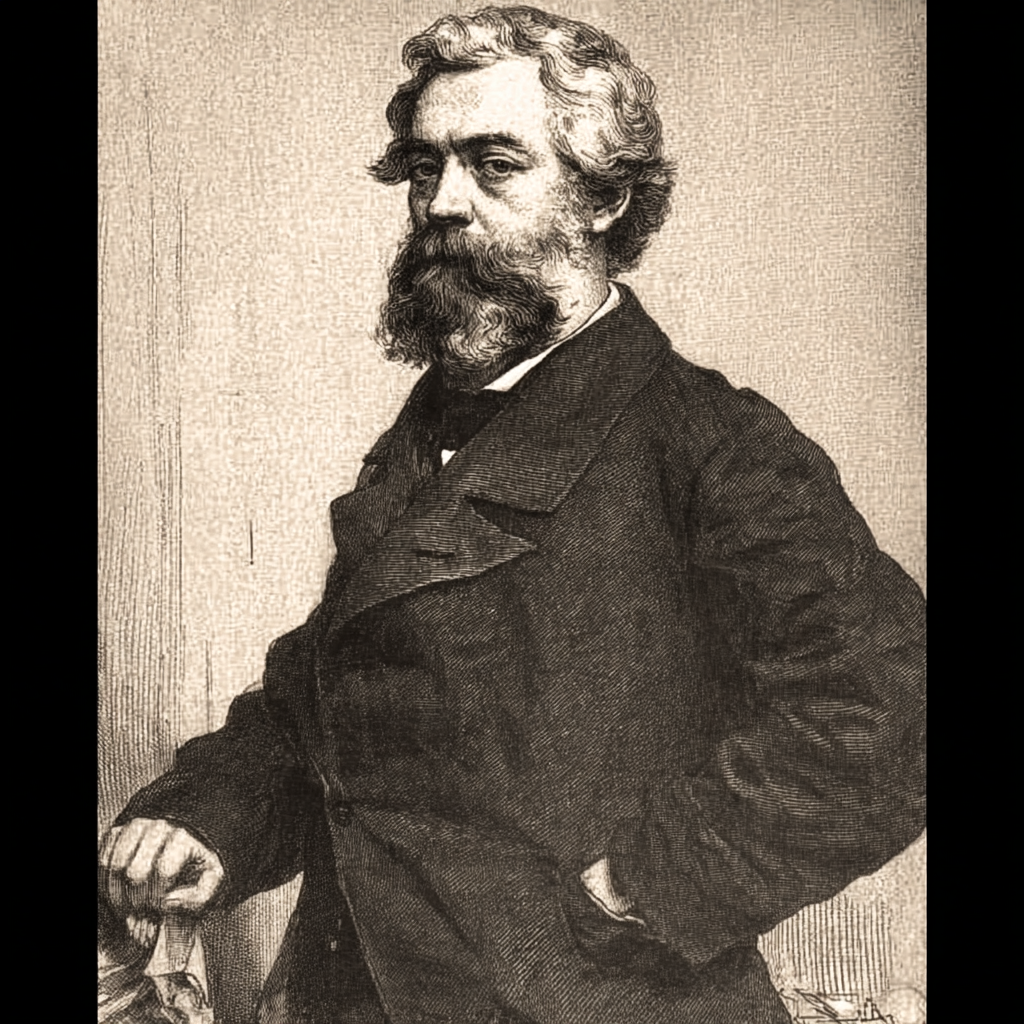
    Statue of Karl Marx, whose overcoat anchors Peter Stallybrass’s essay 'Marx’s Coat'.

    Material Agency: When Objects Begin to Act

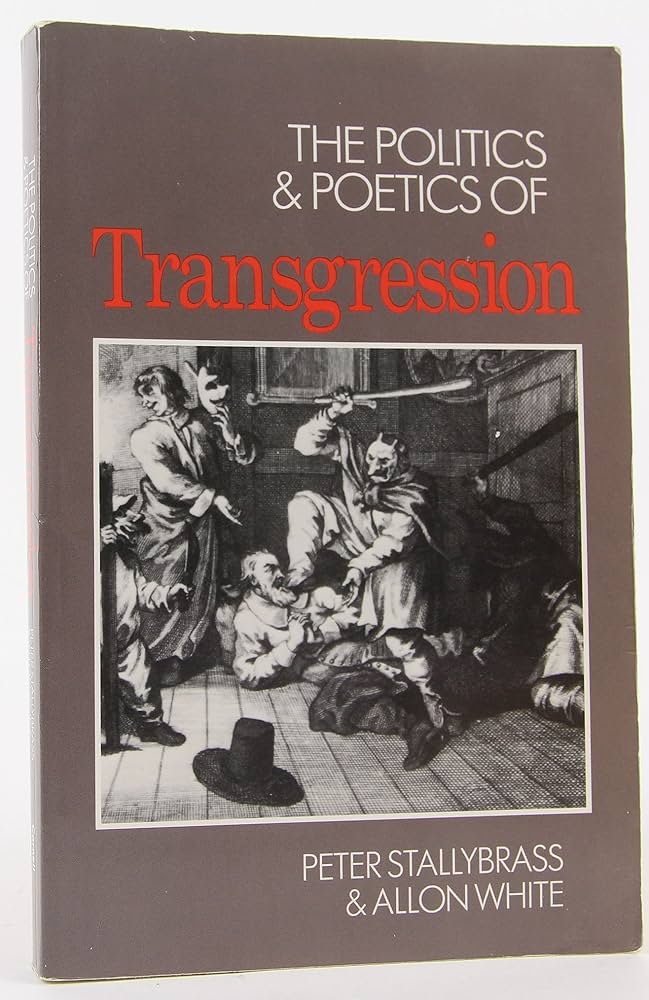
    Peter Stallybrass—a literary scholar whose work moves between material culture, Marxism, and the history of clothing—entered my intellectual world through two texts that changed the way I understood objects. The book he contributed to, Edited by Susan Crane (1996), Fabrications: Costume and the Construction of Cultural Identity and his now-classic essay “Marx’s Coat” both advance the same startling argument: that material things do not merely symbolize social relations but actively participate in making them.

    Peter Stallybrass, literary scholar of material culture and clothing.

    Stallybrass’s argument in “Marx’s Coat” is deceptively simple: objects are not passive. They do not sit there waiting to be interpreted. They act. They compel. They organize human possibility. When he writes that “things are not inert” and that they are “the media through which social relations are formed,” he means it literally. Marx’s ability to participate in political life was partially determined by whether he possessed—or could pawn, retrieve, or mend—a single coat. Without it, he could not enter particular libraries, meetings, or social spheres. The coat enforced boundaries, shaped mobility, and constrained the rhythms of Marx’s intellectual labor. In Stallybrass’s reading, “the coat remembers labor” because it carries the accumulated history of every hand and circumstance that produced, repaired, and circulated it. It is not an accessory. It is an actor.

    This was my first exposure to material agency as a real philosophical claim rather than a metaphor. Objects travel, and in their travel they “gather significance.” They direct behavior, compel choices, limit access, produce effects. The object does not simply obey. A coat can participate in class formation. A book can reorder thought. A door can script movement. A boundary stone can produce violence. This is the anthropology I learned at Cambridge: not a discipline of inert artifacts but one of restless, event-generating things.

    Where Complex Systems Were Born

    View of Cambridge architecture and courts, where analytic and anthropological traditions intersect.

    The Cambridge Department of Archaeology & Anthropology was the perfect place to learn it, because the department is historically one of the intellectual birthplaces of complex systems thinking applied to the archaeological record. Long before “systems thinking” became TED-talk vocabulary, Cambridge archaeologists were modeling how meaning emerges from the entanglement of texts, material evidence, environmental traces, social practice, and historical pressure. Archaeology there was never just the study of objects; it was the study of the relations that animate them—dynamic flows of information, power, and habit embedded in landscapes, households, ritual spaces, economies, and time.

    Cambridge river path and bridges, part of the everyday system of movement and thought.

    This was a department trained to think systemically. Meaning wasn’t something extracted from a single artifact or inscription. It had to be triangulated: between what a text claims, what the material record allows, what social conditions enforce, and what the interpreter brings with them. The process was recursive, nonlinear, and often unexpectedly alive.

    Dr Tim Ingold, who earned his PhD in Social Anthropology at Cambridge in 1976, contributed to the wider theoretical landscape through his work on material anthropology—examining how different cultures classify, define, and conceptualize meaning, and how those systems of thought become visible in the artifacts they produce. In genuinely brilliant books (I highly recommend) such as Evolution and Social Life (1986), The Perception of the Environment (2000), and Lines: A Brief History (2007), he approached the world as a meshwork of relations, where materials, practices, and ideas co-constitute one another rather than existing as isolated units.

    Cambridge river path and bridges, part of the everyday system of movement and thought.

    Within that framework, agency diffused outward. You couldn’t say “the human acts” and “the object reflects”; the action was distributed. A pot shard could reorganize an entire chronology. A misaligned stone could reveal changes in ritual orientation. A textile fragment could map trade, gender, labor, and climate. This was not the humanities as aesthetic reflection—it was the humanities as an early version of systems science, always suspicious of single-cause explanations and always attuned to emergent coherence.

    Meaning as a Relational System

    And this is the part that quietly underwrites the entire thesis of this essay: that meaning—whether in archaeology, philosophy, semiotics, or computation—is produced through relations. That language, like mathematics, can create proofs. That chance, drift, coincidence, and probability don’t undermine meaning; they generate it. That LLMs, semiotic arguments, and archaeological inferences all reveal the same underlying structure: meaning emerges wherever relations intensify, whether between objects, concepts, sentences, or statistical weights.

    Steeped in that training, the debates around AI never struck me as foreign or futuristic. They felt like the next extension of the same intellectual lineage. If a coat could shape a philosopher’s life, what might a dataset shape? If objects carry agency, what about patterns? And what happens when the thing performing the interpretation—a language model, an image generator, an autonomous system—begins to act not simply as a mirror of human intention but as an agent within a larger ecology of meaning?

    Anthropology was already comfortable with the idea that objects act: doors guide movement, clothing enforces hierarchy, architectures discipline time. In that context, the emerging debates around AI felt less like science fiction and more like the next logical extension of an old question. If a monkey could take a selfie that complicated copyright law—if no one could decide whether authorship belonged to the animal, the camera, the platform, or the human who owned the equipment—then what do we do with systems that generate images, decisions, or lethal-force recommendations? It is one thing to say a coat participates in the making of class relations; it is another to consider that a Photoshop algorithm could claim ownership of every composite image you produce, or that an autonomous targeting system in a refugee camp might decide, without human correction, who gets to die (the definition of power and God, in many traditions).

    Transubstantiation for the Digital Age

    These problems are all symptoms of the same underlying puzzle: what counts as an agent, an actor, a protagonist? Is that the same as a person? And who, exactly, gets to decide?

    I didn’t know it then, but the phrase I kept scattering online behaved like anything that circulates: it gathered meaning as it moved. Semiotics names this drift; anthropology calls it agency. What I thought of as a disposable line refused containment. It slipped its frame, took on new resonances, and became something larger than its origin.

    And when the interpreter is a machine, that process becomes stranger still. The phrase wasn’t lost—it was taken in, broken apart, and returned to me altered. Less disappearance than transubstantiation.

    This is the paradox of being scraped: the machine eats you, but in the eating, it preserves you. My hermetically sealed container was never about storage; it was offered up to the pattern-hungry god. Whether I like it or not, the machine remembers. This is my body, scraped for you.

  • Image Gazing

    Sometimes when I get overwhelmed, I stare at images. I think a lot of art historians secretly like to do this. A few minutes stolen from the day to look at something aesthetically balanced, proportioned, harmonized—something that happens, almost mysteriously, to be tuned to one’s own internal frequency, whenever or wherever the image was made.

    I keep a lot of photographs of the rural villages and small churches I loved in England—especially around Walsingham, where I did my field work. One church in that religious-architecture-dense village is the Church of the Holy Transfiguration. It was one of the first places where I encountered the idea of an ikon, despite having studied art history as an undergrad. Their website describes it simply: “Ikons are, for Orthodox Christians, windows into the eternal dimension of reality. They are not realistic depictions or even works of art, but are a means by which Christ and his saints are made present to us.”

    Walsingham sits in Norfolk, that green, shaggy corner of England facing the North Sea, a region shaped by the old Norþfolc—“the north people.” The county looks outward toward Normandy, and after the Norman conquest of 1066, it became one of the first areas drawn tightly under their rule. You can still see the imprint of that history: earthworks softened by centuries of rain, hamlets that feel older than they appear, and Walsingham itself, a place formed by centuries of crossing and return.

    The Chapel of St Seraphim isn’t especially beautiful as “a building,” but there’s something about it—something I always felt drawn to. Then again, I’m biased; I’ve always had a soft spot for red brick. It almost looks like the house I grew up in.

    Composite image

    Another image I return to, struck by its emotional impact, is of Mount Kailash. In the traditions of Hinduism, Buddhism, and Jainism, this mountain is seen as a celestial link between earth and heaven—a gateway to the divine. Its names carry some of that meaning, too. The Sanskrit name Kailāśa is likely derived from kelāsa, meaning “crystal.” And the Tibetan name Gangs Rinpoche (གངས་རིན་པོ་ཆེ) combines “gang/gāng” (snow peak) and “rinpoche/rin po che” (precious one), often rendered as “precious jewel of snows.”

    There are also references that place Kailash inside Buddhist cosmology. One source notes: “It’s central to its cosmology, and a major pilgrimage site for some Buddhist traditions.” Taken together, the names and descriptions sketch the outline of a mountain regarded by many as sacred, even before you ever see its shape.

    Composite image


    Praise to Buddha Shakyamuni
    O Blessed One, Shakyamuni Buddha
    Precious treasury of compassion,
    Bestower of supreme inner peace,

    You, who love all beings without exception,
    Are the source of happiness and goodness;
    And you guide us to the liberating path.
    Your body is a wish fulfilling jewel,
    Your speech is supreme, purifying nectar,
    And your mind is refuge for all living beings.
    With folded hands I turn to you,
    Supreme unchanging friend,
    I request from the depths of my heart:
    Please give me the light of your wisdom
    To dispel the darkness of my mind
    And to heal my mental continuum.
    Please nourish me with your goodness,
    That I in turn may nourish all beings
    With an unceasing banquet of delight.
    Through your compassionate intention,
    Your blessings and virtuous deeds,
    And my strong wish to rely upon you,
    May all suffering quickly cease
    And all happiness and joy be fulfilled;
    And may holy Dharma flourish for evermore.
    — Geshe Kelsang Gyatso Rinpoche

    My Image as Seen by Others

    When I was in Europe, I experienced a variety of different types of prejudice. Class is very important there, so my class was known and felt immediately. But I benefited from the “celebrity” implications of my American accent as well. People were interested and invited me places – I tried not to step on toes, eat too much, talk too much, or annoy anyone. I failed on every count almost every month, but Cambridge is a remarkably forgiving and welcoming place, and I was lucky enough to call an international college, Hughes Hall, home.

    Even still, the person who hurts us most is always closest. Some of the worst American stereotypes applied to me were from my long-time French boyfriend. The one that hurt most… he told me: You’re a walking hippie stereotype. No one had ever called me that. I had almost never encountered other “hippies” in my life, although I’d written my high school thesis on the Beatles and Tom Wolfe. I think it was obvious it was only a matter of time until I fell for the Grateful Dead, but not before I’d spend years curled up with Leonard Cohen and Janis Joplin. I’d been to San Francisco only once before I flew to England (the same summer in 2013, in fact), but other than that, I’d been raised around traditional, respectable, be-khakied people in the far-off land of OOTTAWW, as I had to mouth slowly for the French. Although my mom was born in Marin Hospital, my grandparents were more beatniks-turned-respectable.

    I fell in love with Buddhism in England, actually. Making my weekly stop-off in the Tibetan store across from Kings, I gasped when I walked in at the same time as the owner. “Did you really meet the Dalai Lama?” Excuse a girl for having a naive sense of wonder (about everything, but especially about Buddhism).

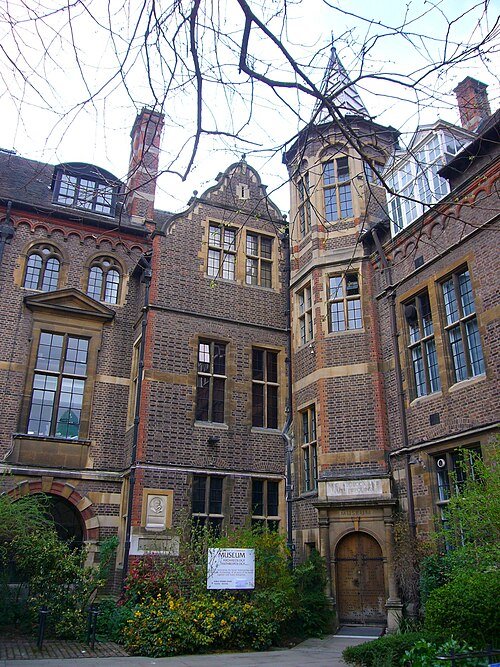
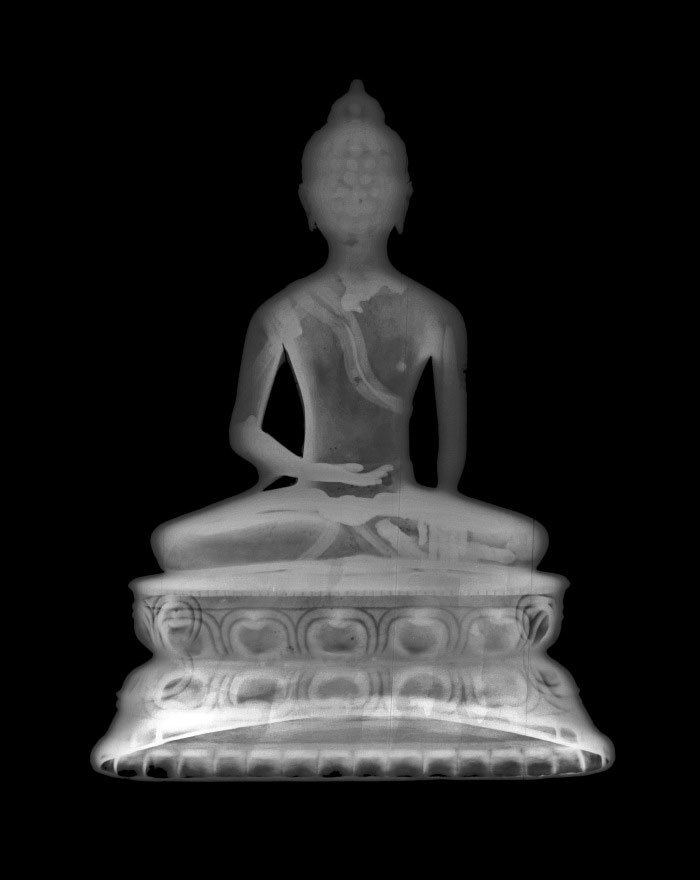
    I don’t think I ever totally felt comfortable with my boyfriend after that, seeing myself in that way so denigrated in my sincere beliefs. I’d worked on an exhibit at the MAA called Buddha’s Word, which was the first exhibition of Tibetan material in Cambridge, and the first time in the Museum of Archaeology and Anthropology’s history that its Buddhist collections had ever been presented together. It was developed in partnership with the Mongolia and Inner Asia Research Unit, supported by the Arts and Humanities Research Council and the Frederick Williamson Memorial Fund, and drew on collections from across Cambridge — the MAA, the Sedgwick Museum of Earth Sciences, the Fitzwilliam, the University Library, even Emmanuel and Pembroke Colleges.

    buddha's word

    buddha's word

    It mattered to me. The project mattered, the materials mattered, the scholarship mattered. Buddhism wasn’t a phase or an affectation — it was part of my intellectual and spiritual life, tied to real work I was doing inside these institutions. So when he reduced it all to a stereotype, it wasn’t just a careless comment; it was a small betrayal of how deeply I cared about something he never bothered to understand.

    Pareidolia: The Velvet Knife of the Unbothered

    Speaking of image gazing: Pareidolia is the tendency of the human mind to perceive recognizable forms — especially faces — in random or ambiguous stimuli. In American intellectual history, the concept has appeared in several distinct contexts. During the 19th century, writers associated with Romanticism often referenced pareidolic perception when describing heightened imagination, seeing symbolic meaning in nature, or interpreting landscapes as expressive. In medical and psychological discourse of the late 19th and early 20th centuries, pareidolia was sometimes discussed in relation to certain mental-health conditions, particularly those involving misinterpretation of sensory information.

    In popular culture, it has repeatedly surfaced in narratives about “seeing signs,” spiritual imagery, and the interpretation of natural forms. Across literature, psychology, and journalism, pareidolia has functioned as a descriptive term for how people project patterns, meanings, or emotional significance onto otherwise neutral visual cues.

    If Europe taught me anything, it’s that mis-seeing can also be an art form, and a particularly glaring one in some university contexts. Not always intentional, not always cruel, but pervasive — especially among the confident, the class-assured, the ones who glide through rooms believing their interpretations of others are simply facts.

    Pareidolia isn’t just seeing faces in clouds; it’s assuming before they’ve spoken a full sentence. My grandmother used to say, “to assume is to make an ASS of U and ME.” To criticize spirituality has become the reflex of the elite and unbothered: a velvet knife disguised as scientific clarity. However, there is, as we saw in the last post about Surrealism, the unconscious, chance, and AI, a level of hallucination required to see something special in an image, an ordinary building, or in general. Maybe we art historians really are all crazy.

    Composite image

    Composite image