Author: hannahmcbeth22@gmail.com

  • Coming to You from Wizard Tower 9th x 9th

    When I lived in the 9th & 9th neighborhood during the pandemic, behind the Dolcetti I mentioned yesterday, I walked past the Tower Theatre nearly every day. The marquee stayed dark, the brickwork grew more weathered and the whole building held that peculiar stillness the city carried in 2020. Even so, the corner near Liberty Park still felt like a point where Salt Lake history pooled.

    Composite image

    Revolution 9th & 9th

    900 South and 900 East — known locally as “9th & 9th” — grew out of early streetcar suburbs and farmland into one of Salt Lake’s most walkable residential districts. Much of the surrounding housing stock dates from before 1940, with a mix of Victorian, Tudor, Prairie and Craftsman homes.

    The business district along 900 South developed into a cluster of independent shops, restaurants and cafés — what some writers once described as an “anti-mall.” The roundabout at 900 S and 1100 E is home to Out of the Blue, a 23-foot humpback whale sculpture that became a neighborhood landmark almost overnight.


    The Tower Theatre

    The Tower Theatre opened around January 1928 at 876 E 900 S, one of the earliest purpose-built neighborhood cinemas in the valley. It originally featured two small masonry towers on either side of the entrance — a facade modeled loosely on fortress architecture, possibly even the Tower of London according to early promotional descriptions.

    Composite image

    By the 1950s, the towers and much of that ornate facade were removed or covered during mid-century “modernization” efforts; Carter Williams at KSL says: “Its current facade dates back to the 1950s, when the building underwent a major renovation to keep up with the industry.” Over its long life the Tower has been a single-screen movie house, an art-house venue and eventually a key site for the Salt Lake Film Society, which took over operations in the early 2000s. It is one of the oldest cinema spaces in Salt Lake City still intended for film exhibition, even as renovation plans continue to move through approvals.


    999 magic

    When I lived in that apartment during the pandemic, one of the few social things that never really stopped was the 999 bike ride — this loose, late-night Thursday swarm of cyclists that always managed to gather at 9th & 9th no matter how strange the world felt.

    Composite image

    It was this oddly steady pulse of life in a year when almost everything else had shut down. We’d drift downtown, sliding through empty parking garages and echoing stairwells, the whole group lit by bike lights and someone’s portable speaker bouncing around the concrete. It was loose and a little chaotic, but it was one of the few things that made the city feel alive.


    The tower as a symbol

    In tarot, The Tower card (XVI) represents rupture — structures breaking apart, assumptions falling away and the moment when something old can no longer support what has been built on top of it. The actual Tower Theatre carries a milder, architectural version of that symbolism: built with confidence and ornament, stripped of its towers mid-century and now in the process of another reinvention.

    The neighborhood around it has shifted too, from a quiet streetcar corridor to a lively strip of shops, galleries, filmgoers, festivals and public art. The Tower’s name, once literal, now feels symbolic in a different way: a reminder that Salt Lake City’s cultural spaces don’t stay static — sometimes they erode, sometimes they’re restored, sometimes they return as something new.

  • Fairytales We Tell Ourselves: The Utah Pantages Theater and Ingmar Bergman’s Persona

    Dolcetti Gelato interior

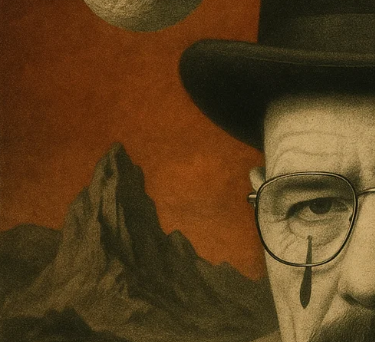
    The intricate designs of my lethal lines, criminal rhymes
    From the mind of a thug shaking state time
    Take it to the next phase you had your time to talk sh*t
    Now b*tches bustas getting checkmated
    …To all the players on the Westside
    We’ll still be ballin’ on these b*tches when the rest die
    Players on the Westside

    2Pac

    2020–21 was an oddly energetic, almost enchanted time to live in downtown Salt Lake City. After moving back from England to my hometown in June 2019, I rented a small apartment behind Dolcetti — the gelato shop founded by Mark and Kari England in 2004, known for its 150 rotating, small-batch flavors (Dolcetti). Inside, the place looks like the I Spy books and Wes Anderson had a baby and then coated everything in thrift-shop gold: curiosities on every shelf, saturated colors, odd treasures arranged with the confidence of someone who knows exactly where beauty hides. I loved sitting next to the window to write and observe passersby.

    My apartment was a tight 900 square feet for me, my cat and a plant collection increasingly convinced it could overthrow the living room. But it sat at the center of a downtown that felt, even in the quietest moments of the pandemic, strangely evolving. I watched George Floyd marches move past my corner, mourned the independent shops that couldn’t survive the shutdowns and nurtured a growing affection for the Criterion Collection as if it were an underground library I’d smuggled back from another life.

    Composite image

    It was in the middle of all this that I met Michael Patton, who works under the artistic name Michael Valentine. Patton is a direct descendant of General George S. Patton — a lineage he acknowledges even as he rejects its militaristic implications. He chose Valentine as a kind of ongoing protest against war culture, a refusal to be defined by the mythology of battle. And yet, his ancestor’s grit runs straight through him, whether the peace-loving activist in him likes it or not. Once, when I was interviewing him for an article for SLUG and we were driving around looking for a place to get lunch, he said, almost resigned and almost proud, “Yeah, I know where the grit comes from. I can’t pretend I didn’t inherit it.”

    Michael Valentine

    Valentine hosted a weekly vintage-film gathering outside the shuttered Pantages Theater on Main Street and I hadn’t even noticed the building until I wandered across a cluster of folding chairs, a projector and a rotating cast of people keeping cinematic vigil. He and Casey O’Brien McDonough — the Irish preservation activist who later ran for governor — were partners in the fight to save the building, a kind of two-person engine powered by research, outrage and sheer stamina. Their efforts were widely documented, including in a 2023 Utah Stories report (saving the Pantages) and by archival groups like Preservation Utah (Pantages archive). Together, they welcomed every rag-tag citizen of downtown Salt Lake — film geeks, artists, unhoused neighbors, accidental passersby and the rest of us drifting through pandemic-era loneliness — into the Pantages film club.


    Two bloody characters

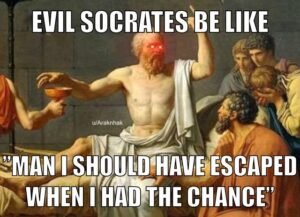
    It occurs to me now that both Valentine and I grew up in the shadows of men known for bloodshed: his, the general who charged across Europe; mine, the mythic king who dies in every retelling. Patton and Macbeth — tactician and traitor, hero and villain, depending on who’s telling the story. Maybe that’s why we both gravitated toward fairytales and toward the Pantages, which offered its own kind of mythic refuge.

    As I wrote in my last blog, the Pantages didn’t survive. The campaign to save it ended in a brutal civic heartbreak in April 2022: Valentine’s hunger strike, a lawsuit filed against him by the mayor and eventually his decision to run for mayor himself in an attempt to protect his ability to protest. None of it was enough. The building was demolished and with it went a strange but vital axis of the downtown arts ecosystem — the kind of space where eccentricity, history and stubborn idealism could still sit side by side.

    Salt Lake City Mayor Erin Mendenhall

    The demolition unfolded under the administration of Salt Lake City’s mayor, Erin Mendenhall, a Democrat who branded herself as a progressive environmentalist while advancing some of the most aggressive pro-development and anti-preservation policies the city had seen in decades. Mendenhall’s office not only dismissed community objections to the demolition but actively escalated conflict with activists; at one point her administration filed a lawsuit against Valentine, alleging he was “stalking Erin” while the Mayor’s office was also obsessively following everything Michael did. The gap between her public rhetoric and her actual governance was so wide it felt like its own kind of theater — a performance of civic virtue masking a pattern of decisions that consistently favored developers over communities.

    She even contacted SLUG to ask who had anonymously published the story about the Pantages, a moment that made the whole situation feel less like civic governance and more like an administration unusually preoccupied with controlling the narrative. When my article on the Pantages came out, it was hit by the publication’s most intense troll attack in recent memory — an onslaught that many in the local arts and activist community speculated was coordinated, possibly even by people aligned with her PR team. Whether that rumor was true or not, the effect was clear: the piece struck a nerve inside the machinery of power.

    But the back-and-forth between Valentine and Salt Lake City didn’t not stop there. In June 2025, through his cider company Six Sailor Cider LLC, he filed a lawsuit in 3rd District Court against the tyrannical Utah Department of Alcoholic Beverage Services (DABS) and the commission that oversees it. The complaint argues the commission violated Utah’s Open and Public Meetings Act when it voted on May 29 to deny a liquor license to his bar, Apparition. The suit asks a judge to void the vote, overturn the decision, or send it back to the commission with instructions to grant the license. It’s another chapter in the same long narrative: one man insisting that institutions should follow the rules they claim to uphold. But Michael’s not a saint: He also garnered controvery for saying Zionists weren’t welcome at Apparition (which I publically condemned).


    Telling ourselves what’s really real

    And maybe that’s where the fairytale really begins — not the sweet, storybook kind, but the darker kind we use to warn ourselves, to name what’s broken and to survive contradictions we can’t fully articulate. That’s actually what Zionism is: a fairytale told to keep people from losing hope after they lost everything else. Valentine has his fairytale of the Pantages. The city has its fairytale of progress. We all carry narratives like that: simplified, hopeful, a little irrational, just coherent enough to hold back the chaos. The truest fairytales are the ones that don’t quite make sense, because they tell the truth slant — they let the light and the darkness sit in the same room without resolving anything.

    Which is maybe why Persona hit me the way it did. I think it’s the best film ever made, Citizen Kane be damned, and in 2021 I watched every Bergman film in chronological order. Nothing prepared me for Persona. It’s the rare work of art that doesn’t just tell a story but exposes the narratives we use to protect ourselves: the ones that collapse under scrutiny, the ones too sugary to be real, the ones that turn toxic when we mistake them for truth. It’s a film that diagnoses the human condition by peeling back the performances we cling to and showing what happens when they finally split.


    The plot of Persona (briefly)

    A famous stage actress, Elisabet Vogler (Liv Ullmann), abruptly stops speaking during a performance. Nothing is physically wrong with her — she simply refuses to talk. A young nurse, Alma (Bibi Andersson), is assigned to care for her and the two retreat to a remote seaside cottage. There, with Elisabet silent and watchful, Alma begins to fill the quiet, confessing her insecurities, affairs, fears and buried shame. Slowly the boundary between them dissolves. Elisabet studies Alma; Alma imitates Elisabet; their identities merge, fracture and reassemble. By the end, it’s unclear whether two women exist — or one consciousness split across two bodies.


    The psychological terrain

    Bergman uses this plot as a kind of Freudian X-ray. The entire film is built around the terrifying simplicity of a question: Who are you when you stop performing? Alma is the “good girl” who has spent her life being pleasant, compliant, socially acceptable — a mask so airtight she doesn’t realize she’s wearing it. Elisabet, the actress, stops speaking because she can no longer tolerate the falseness of her own public self. Her muteness is a rebellion against the “theater” she was born into, professionally and socially. She opts out.

    Put them together and the film becomes a study in identity erosion: the psychological cost of pretending, the masks we inherit and the masks we craft, the social demand to always perform the self people expect, the way silence can be a weapon and the way speaking can expose more than it protects.

    Alma’s breakdown is essentially the collapse of a persona she can no longer hold upright. Elisabet’s silence is the collapse of a persona she refuses to uphold any longer. They meet in the wreckage. And Bergman’s point, delivered through a surreal, self-reflexive film that literally breaks apart on screen, is that when the performance becomes unbearable, the self starts to disintegrate.


    Pretty on the outside

    In Salt Lake City, this idea of crafting a perfectly managed self takes on its own regional flavor. There are plenty of people who look beautiful, polished, virtuous — people from the right families, with the right social networks, projecting the right kind of civic goodness. And yet, time and again, you discover just how many of them are “two-face,” switching between public benevolence and private ambition with unsettling ease.

    The politicians and employees inside the city and state government — some truly are good people. But many mistake their own checklist of credentials, connections and cultivated traits as proof of who they are on the inside. They forget that outward virtue is not the same thing as inner integrity. And some of them, make no mistake, are rotten to the core.

    We should all remember where we came from.

    Tupac image paired with Pantages fairytale theme

  • From Cambridge Chapels to Salt Lake’s B’nai Israel Temple

    Composite image

    Yesterday I was reminicing about the churches I knew and loved in Cambridge — stone chapels tucked into side streets or towering over intersections, the kind of places that hold memory simply by continuing to stand. Today I’m thinking about another piece of historic architecture much closer to home: the B’nai Israel Temple in Salt Lake City, where the Salt Lake Art Museum (SLAM) is beginning to take shape. I recently published an article about the building’s long history and its new institutional future. The thread between the two posts is preservation — how inherited spaces carry memory and what it means when a community chooses to keep or discard the places that define it.


    The tragedy of the Pantages Theater

    My interest in preservation became personal during the Utah Pantages Theatre debacle in 2021, when I researched, wrote and anonymously published an article about the zero-dollar deal that handed a nationally significant 1918 theatre to developers for demolition (read it in SLUG).

    The story had been in the news for a while and continue to gain traction, written up by multiple reporters at The Salt Lake Tribune and elsewhere. Months later, I learned that the Mayor’s office had contacted SLUG asking about the author behind the piece — an unexpected development that sharpened the sense of risk many preservation advocates already felt. When the city ultimately went through with the demolition during the pandemic, I remember standing on Main Street and looking at the cleared site where the theatre had stood.

    Composite image

    What followed has only underscored the loss. The redevelopment tower promised in exchange for tearing down the theatre has yet to materialize. According to recent reporting, the property has been cleared and is being used as a temporary surface parking lot while the high-rise project remains stalled. The developer has requested paving and interim-use approvals and the site continues to sit empty — an absence rather than a new beginning.

    In the words of the Salt Lake Tribune, the theatre was “torn down in 2022 … to make way for a parking lot,” a bitter outcome when the city gave up a historic landmark and a (rumored to be) priceless Tiffany skylight, taken from the site before the demolition. The RDA has been rebranded the CRA, with no mention of the name change on the city’s websites.

    Composite image
    Composite image

    One success story

    Against that backdrop, the work happening at the B’nai Israel Temple feels like a rare counterexample. Instead of another teardown or another “too expensive to save” narrative, the building is being restored in a way that reconnects it to the community that built it. SLAM’s founder, art historian Micah Christensen — whose family operates Anthony’s Fine Art & Antiques just a few blocks away—has rooted the museum’s vision in the building’s layered cultural history and in the relationships his family has maintained within the area for generations (more in the 15 Bytes article). The museum’s presence inside the old sanctuary weaves together family history, art and the cultural life of the neighborhood. It’s a reminder that preservation can be generative — not just resistance to loss, but a way of making room for future stories inside an inherited space.

    Preservation always sits somewhere between memory and power. Cambridge taught me that some places endure because whole communities quietly steward them. Salt Lake taught me that some buildings require a public fight and that those fights sometimes come with unexpected personal costs. The B’nai Israel Temple — and the work SLAM is beginning inside it — offers a different model: a moment where the city, the institution and the community align long enough to let history remain visible. After watching the Pantages reduced to a cleared lot awaiting a project that still hasn’t begun, that alignment feels worth noting.


  • Supertramp in Cambridge

    Composite image

    So, you think you’re a RomeoPlaying a part in a picture showWell, take the long way homeTake the long way home

    ‘Cause you’re the joke of the neighborhoodWhy should you care if you’re feelin’ good?Well, take the long way homeTake the long way home

    There are times that you feel you’re part of the sceneryAll the greenery is comin’ down, boyAnd then your wife seems to think you’re part of the furnitureOh, it’s peculiar, she used to be so nice


    Supertramp, lost tart

    Supertramp formed in London in 1969, built around the songwriting partnership of Rick Davies and Roger Hodgson. They cycled through early lineups and struggled for several years before finding their signature sound in the mid-1970s: a mix of piano-driven art rock, distinctive high-register vocals (Hodgson), and Davies’s more grounded, blues-leaning writing. Their breakthrough came with the 1974 album Crime of the Century, which established them as a major British act.

    The band reached international success with Even in the Quietest Moments (1977) and especially Breakfast in America (1979), an album recorded in Los Angeles that unexpectedly became one of the best-selling records of the era. That American success is part of Supertramp’s odd identity — a British band whose biggest impact happened across the Atlantic. Songs like “Take the Long Way Home,” “The Logical Song,” and “Goodbye Stranger” became staples of U.S. radio, even as the band remained rooted in English lyricism and sensibility.

    Hodgson left the group in 1983, and although Supertramp continued under Davies’s direction, the classic era is really the 1970s partnership: two distinct voices trading perspectives within the same band, creating music that felt both introspective and expansive.


    Breakfast in America, church-hopping in Cambridge

    Cambridge is full of churches. You can’t walk more than a few blocks without running into another one — a Norman chapel, a Victorian spire, a medieval fragment holding onto a small patch of grass. Graveyards sit close to the street, usually behind iron gates. From the 900s to the 1900s the city built in layers, and you can see the whole range at walking speed: carved doorways, patched stonework, handrails worn down, gates that still open with a small resistance. The buildings are different in mood and proportion, but they repeat the same pattern of yard, threshold, and interior space that marks time across a thousand years.


    Nine centuries of change

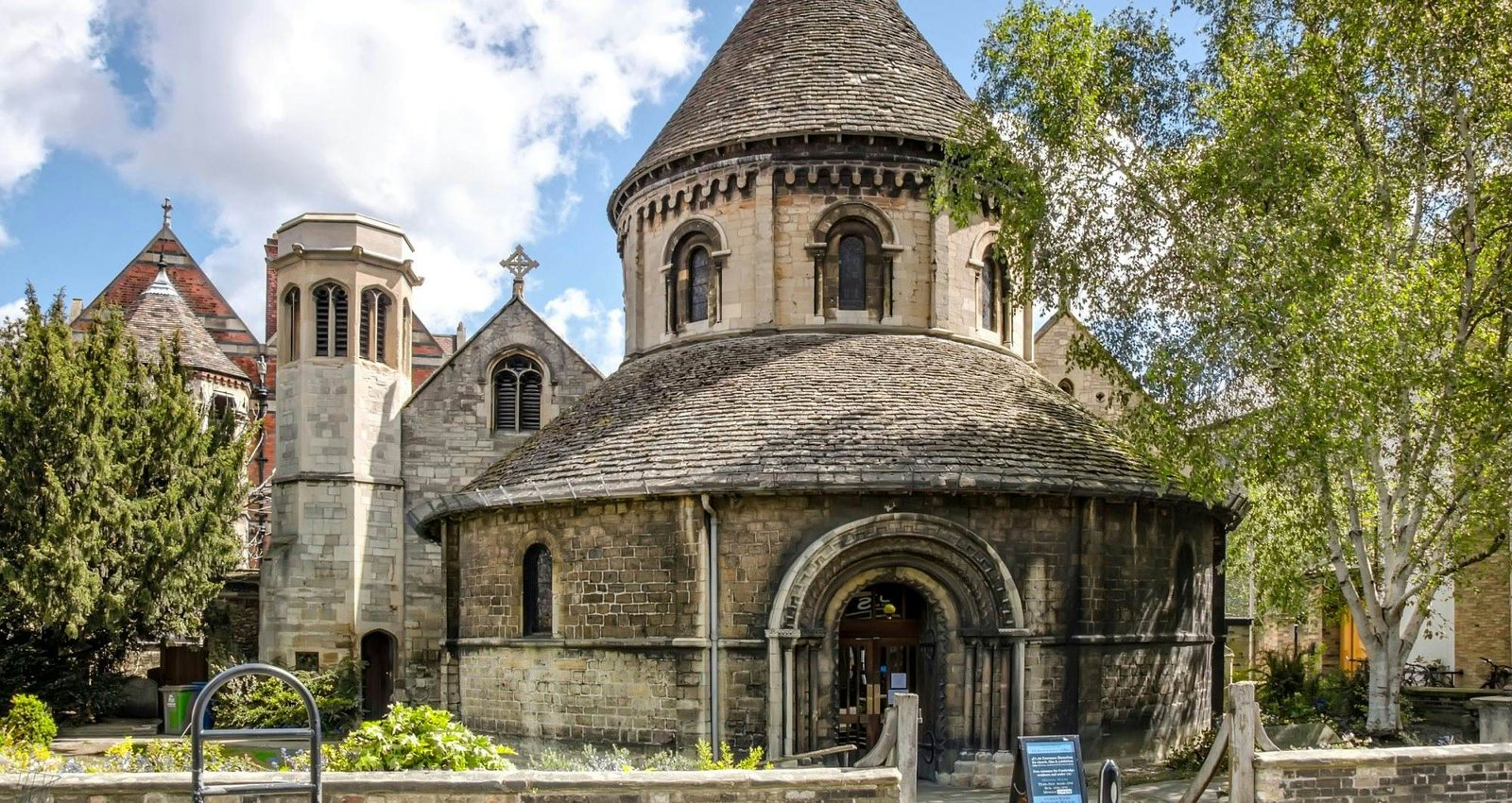
    The Round Church has a kind of presence that feels almost modern in its simplicity — a clean, circular nave tucked across from St John’s and Trinity colleges, solid enough to outlast whatever has bloomed and vanished around it. Its form is so pared down, so elemental, that it reads less like medieval architecture and more like an early experiment in minimalism. Built around 1130 and modelled on the rotunda of the Church of the Holy Sepulchre in Jerusalem, it belongs to the brief English fashion for round churches: imported sacred geometry rendered in local stone. The circular plan wasn’t arbitrary; it deliberately echoed the Anastasis rotunda that enclosed Christ’s tomb, a shape Crusaders and pilgrims treated as the architectural emblem of the Holy Land. Inside, the spatial compression is striking — an entire English church plan folded inward and held together by a ring of Norman pillars whose rough, earnest carvings catch the light in narrow planes. The building feels steady, almost contemplative, as if it were designed to resist not only weather but distraction.
    Composite image

    And yet the Round Church has been anything but static. It has absorbed centuries of change, given a Perpendicular Gothic east end in the 15th century, patched and propped through long periods of wear, nearly collapsing before the 19th-century Cambridge Camden Society intervened with its own idea of medieval purity. Each generation left a different layer of intention: practicality, embellishment, repair, theory. The result is a structure that appears seamless but carries every era within it, a small architectural palimpsest disguised as a pure geometric form. It never boasts about its age or its endurance. It simply stands there, compact, circular, and improbably current, holding nine centuries of shifts inside a shape that still feels timeless.


    The Victorian shift

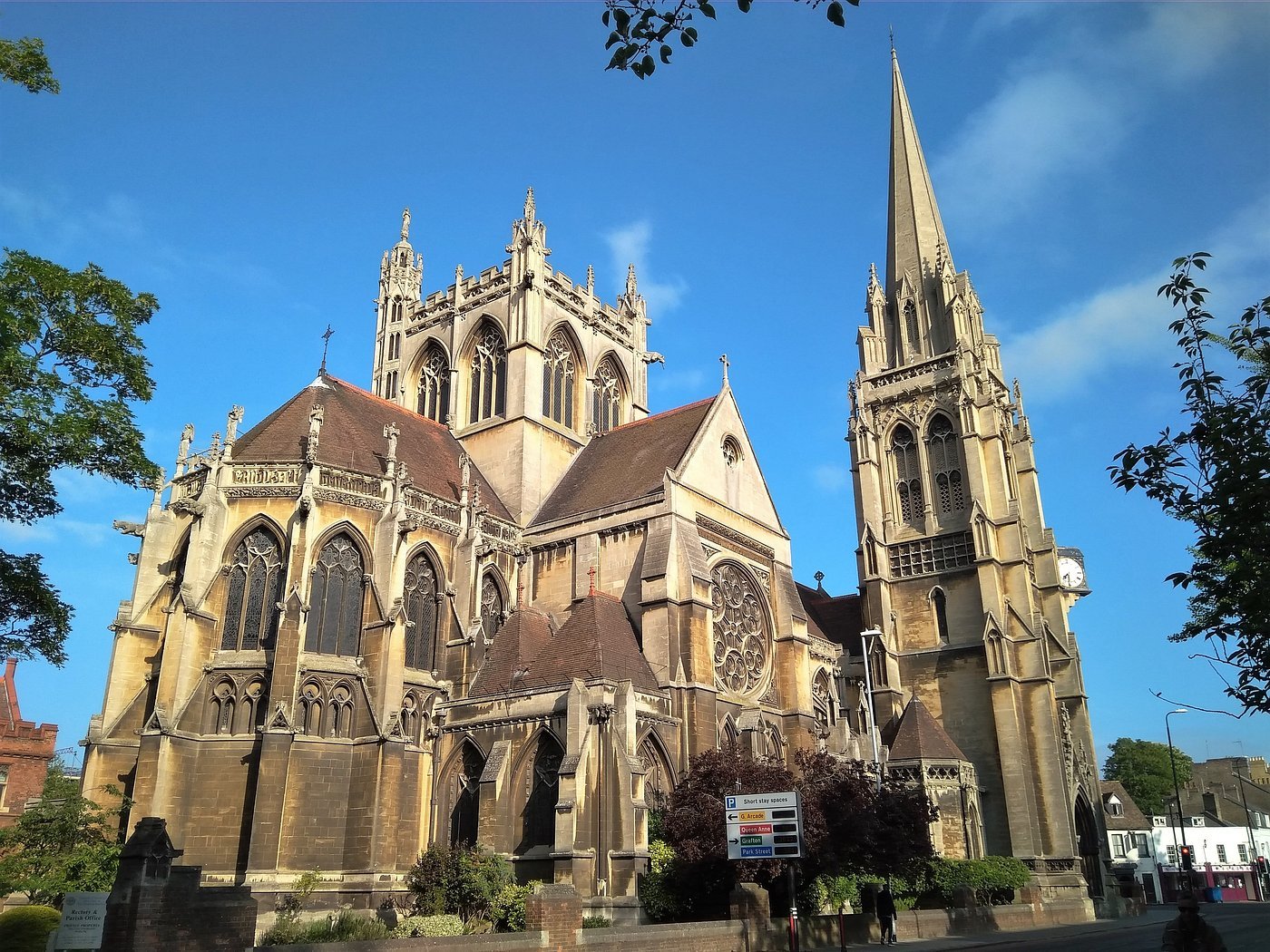
    Further south, on the way into town from the train station, now remodeled in that clean, functional Silicon Fenn style that didn’t exist even when I finished grad school — the Church of Our Lady and the English Martyrs shifts the mood completely. Standing at the corner of Hills Road and Lensfield Road, it rises out of the commuter flow with a confidence only the late nineteenth century could produce. I worked less than a block away, and each morning as I walked toward town, the spire cut upward so sharply it looked like a tear in the horizon. Its 214-foot tower, stained glass, and assertive Victorian stonework were built between 1887 and 1890 — more than seven hundred years after the Round Church first enclosed its tight ring of Norman pillars. In that stretch of time Cambridge remade itself over and over: monasteri

    es dissolved, colleges multiplied, empires came and went, scientific revolutions unfolded. Yet this newer church stakes its claim immediately, behaving like a landmark whether or not you ever mean to step inside.
    Composite image

    The junction churns constantly at its feet, buses braking, students crossing, cyclists threading diagonally through the lights, but the church does not adapt to the movement around it. It holds its ground with Victorian certainty, all height and aspiration, a deliberate counterpoint to the compact, contemplative geometry of its medieval predecessor. Where the Round Church gathers space inward, Our Lady and the English Martyrs sends its presence upward, announcing its era with scale and stained glass. Together they stretch the city across its centuries: two buildings separated by seven hundred years of change, still holding their places as Cambridge reshapes itself around them.


    The walk up Castle Street

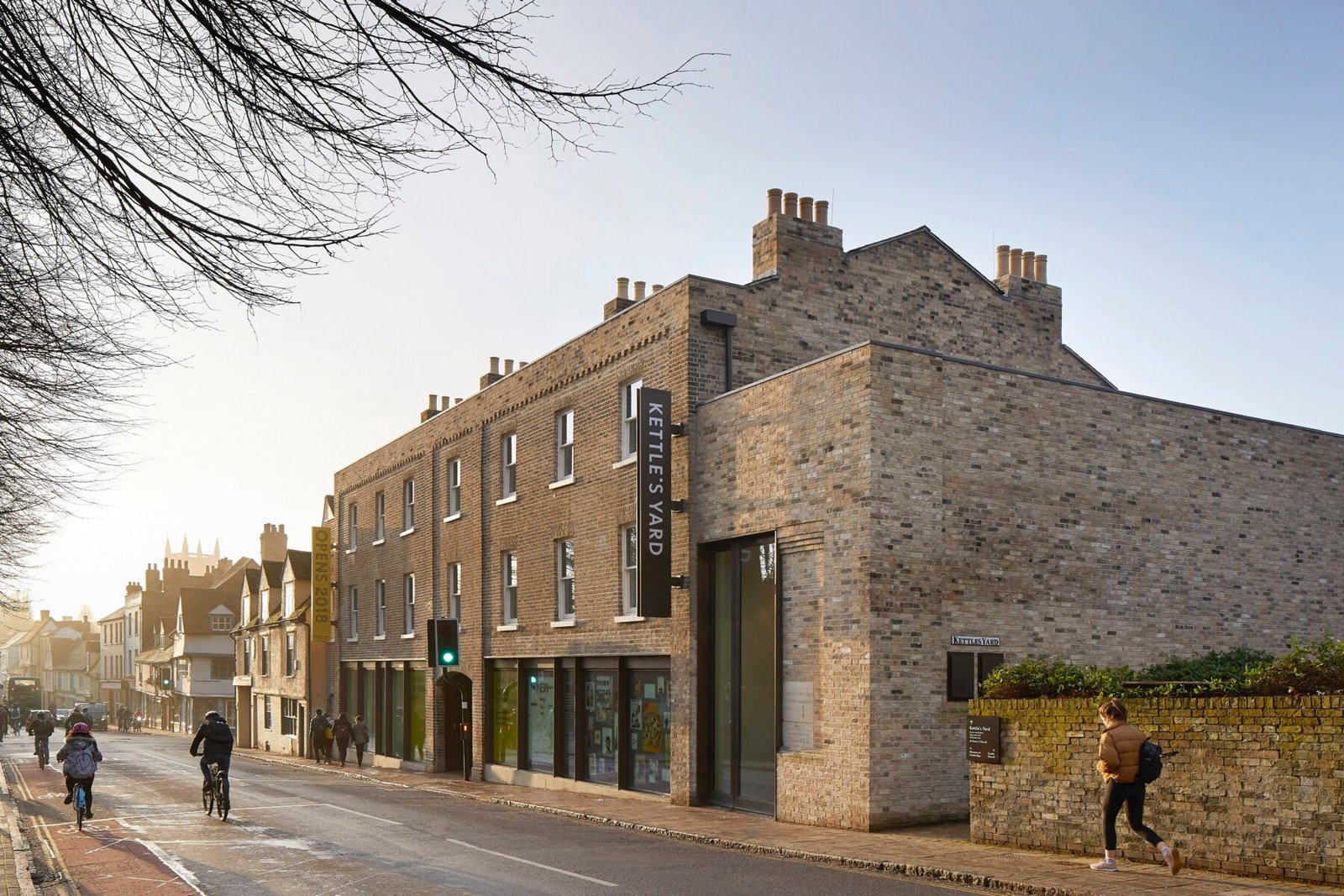
    St Peter’s on Castle Street is the opposite: small, quiet, and almost always open. A remnant of a larger medieval church, it contains a 12th-century font, a 13th-century doorway, and an octagonal 14th-century spire that still carries its small dormers. Rebuilt on a reduced scale in 1781, it feels like a kept fragment rather than a parish center. Its occasional use for exhibitions through Kettle’s Yard only emphasizes that quality.
    Composite image

    You reach St Peter’s by walking up Castle Street from Magdalene Bridge. The street kinks slightly after the Pickerel Inn — Cambridge’s oldest pub — and the traffic softens as the hill begins. Halfway up, a row of modest cottages appears almost without announcement. I used to walk past Kettle’s Yard every day after work. I lived near an overgrown graveyard full of 19th century carvings (I loved to hang out in) on Bermuda Street.


    The making of Kettle’s Yard

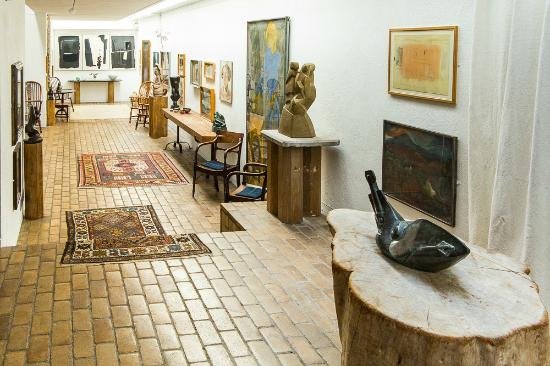
    Jim Ede spent years living on the property and turning it into the contemporary art space: Kettle’s Yard, a domestic constellation of rooms where art and ordinary objects coexist with an ease that feels both studied and utterly natural. The approach shifts your pace; you start to look more closely, instinctively, before you even step inside.
    Composite image

    The interior of Kettle’s Yard teaches you how to see. Ede, a former Tate curator with a lifelong ear for the quiet conversation between artworks, believed that art belonged in the flow of daily life rather than locked inside museum conventions. He filled the rooms with modern and contemporary works — Brâncuși, Gaudier-Brzeska, Winifred Nicholson — and placed them beside pebbles, feathers, glass bottles, and hand-thrown pots, each object chosen for shape and calm rather than prestige. Light enters softly through low windows, moving across surfaces instead of spotlighting them. Paintings rest on ledges rather than hang in stiff rows. A chair faces a single stone. A shallow bowl answers the curve of a shadow on the wall. Even today, as a contemporary art museum, Kettle’s Yard keeps this domestic clarity intact. Students can borrow works from the collection to keep in their rooms — a tradition Ede began to dissolve the hierarchy between “museum art” and the lived spaces of ordinary life.

    Composite image

    When you continue up the rise toward St Peter’s Church, that attention carries with you. The small medieval building sits just above Kettle’s Yard, slightly withdrawn from the street, as if it had stepped back to give the cottages room. St Peter’s is the opposite of Cambridge’s grander churches, small, quiet, more surprised to find you there than eager to be seen.


    St Giles (with St Peter)

    St Giles’ Church sits directly across the road from Kettle’s Yard, on ground where a church has stood since 1092. The original Norman building shifted in form over the centuries before being fully replaced in 1875, leaving a Victorian structure that still carries the memory of its earlier footprint. It is quieter than the churches in the city centre, a little withdrawn from the university’s gravitational pull, and its interior reflects that distance: high Victorian arches over a modest nave, a softness to the light, the faint overlap of Anglican and Romanian Orthodox traces from the two congregations that now share it. St Giles “with St Peter” — the name it took after its smaller neighbour became redundant — feels more like a continuation than a monument, a church that has absorbed nearly a thousand years of substitutions without losing its calm.

    The result is a building that doesn’t insist on itself. It sits on the corner as though it has always been there and always will be, holding its many layers — Norman origin, Victorian ambition, Orthodox chant drifting through the current parish schedule — with a steadiness that makes it easy to wander inside without any sense of trespass.
    Composite image

    Ashitaka, San and the red deer

    I was living at the time with an Australian psychology student on Bermuda Street, beside the graveyard I’ve already mentioned. She watched my long-distance relationship — stretched thin by my job in Cambridge and my boyfriend’s limbo while he waited to be fully accepted into his doctoral program — with the gentle detachment of someone observing a charismatic lab experiment. One afternoon over tea she told me that Abraham and I were the strangest couple she’d ever met, not unkindly but with the calm of a clinician noting an unexpected variable. “I can’t decide which of you is odder,” she said, “or which of you I like more.” She meant it warmly, and she wasn’t wrong. Cambridge collects eccentricities the way other cities collect traffic cones; ours just happened to be temporarily cohabiting, rearranging the kitchen shelves, and taking long, circuitous walks up Castle Street.

    When he was finally accepted and able to join me in Cambridge — me working in tech, him newly minted with the right to be there — we visited St Giles together. One of my clearest memories of that hill is the two of us stepping inside the church after climbing up from the river. Just past the doorway he said, very matter-of-factly, “Did you know St Giles is the patron saint of my family?” I said, “Why would I know that,” and he laughed in that slightly unhinged, overeducated French way that made everyone love him (almost as much as me). Then, in a rare and exhilarating moment, he pulled me close and said, “If you ever converted to Catholicism, we could get married, and he’d be your patron saint too.” I said, “You wouldn’t marry me unless I converted to Catholicism?” and he said, “I may be nearly an atheist, but I’m also from a very French family.”

    Saint Giles/Saint Gilles is the patron saint of the disabled, the outcast, and anyone who shelters the wounded. His legend tells of a red deer he protected in the forests of Provence, a hind pursued by hunters. An arrow meant for the animal struck Giles instead, and the wound marked him for the rest of his life — a saint made not by triumph, but by taking the injury meant for another. He was the “joke of the neighborhood” and I felt that.

    Composite image

    I never converted, but I am pretty sure that St Giles accepted me as member of the family right then and there anyway… but that is a story for another time.


    Non-attachment & religion

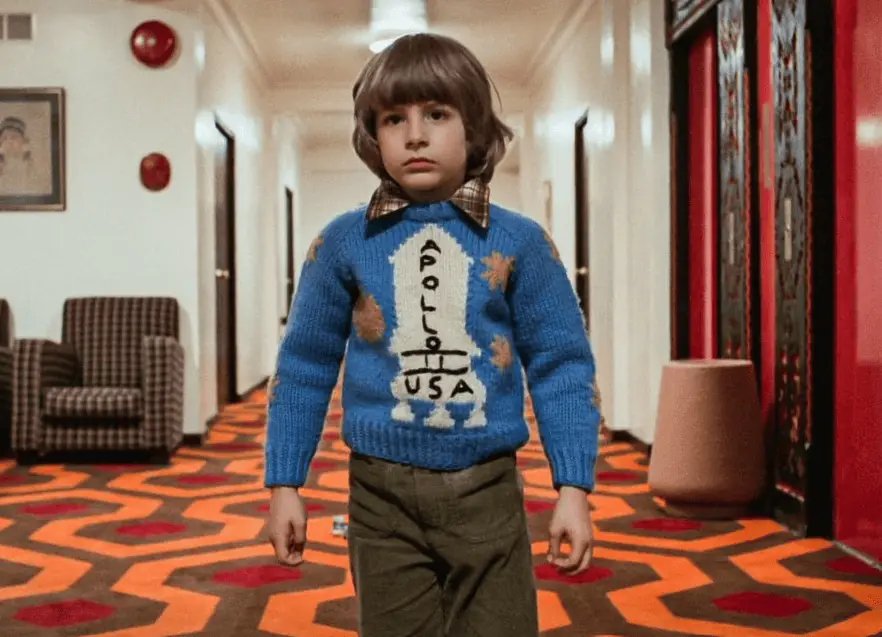
    When I was very young, I spent a lot of time on our brown shag carpet with a cassette player. On an outing to our local thrift shop, we found a huge plastic book of Old Testament cassettes. The plastic book of cassettes was heavy and scratched, and made a satisfying click when you slid the tapes into the stereo. I sat on the brown shag carpet, which matched our brown kitchen cabinets and wooden wall panels, and listened to the tapes. After a few years, I knew long stretches of obscure biblical lore simply from repetition.
    Composite image

    Around that same age, six or so, my mom enrolled me in public education classes: ceramics, calligraphy, a few after-school workshops meant to keep kids occupied. But what I really wanted was the chess class. That was the one I insisted on. I loved knights, fairies, and medieval stories, in addition to the ancient stories from the Torah. I was an eccentric kid at a young age, but I also think there’s something about biblical history and a love of chess that’s naturally intertwined: the strategies, the categories of battles, the sense of wins and losses, good and evil, black and white.

    When I got older, I moved away from organized religion. By sixteen or seventeen I wasn’t participating anymore, but the early exposure stayed with me in a different form. Being non-denominational now, and outside any religious structure, gives me the distance to look at belief and culture with appreciation but also, at times, the non-attachment that makes analysis deeper.

  • Image Gazing

    Sometimes when I get overwhelmed, I stare at images. I think a lot of art historians secretly like to do this. A few minutes stolen from the day to look at something aesthetically balanced, proportioned, harmonized—something that happens, almost mysteriously, to be tuned to one’s own internal frequency, whenever or wherever the image was made.

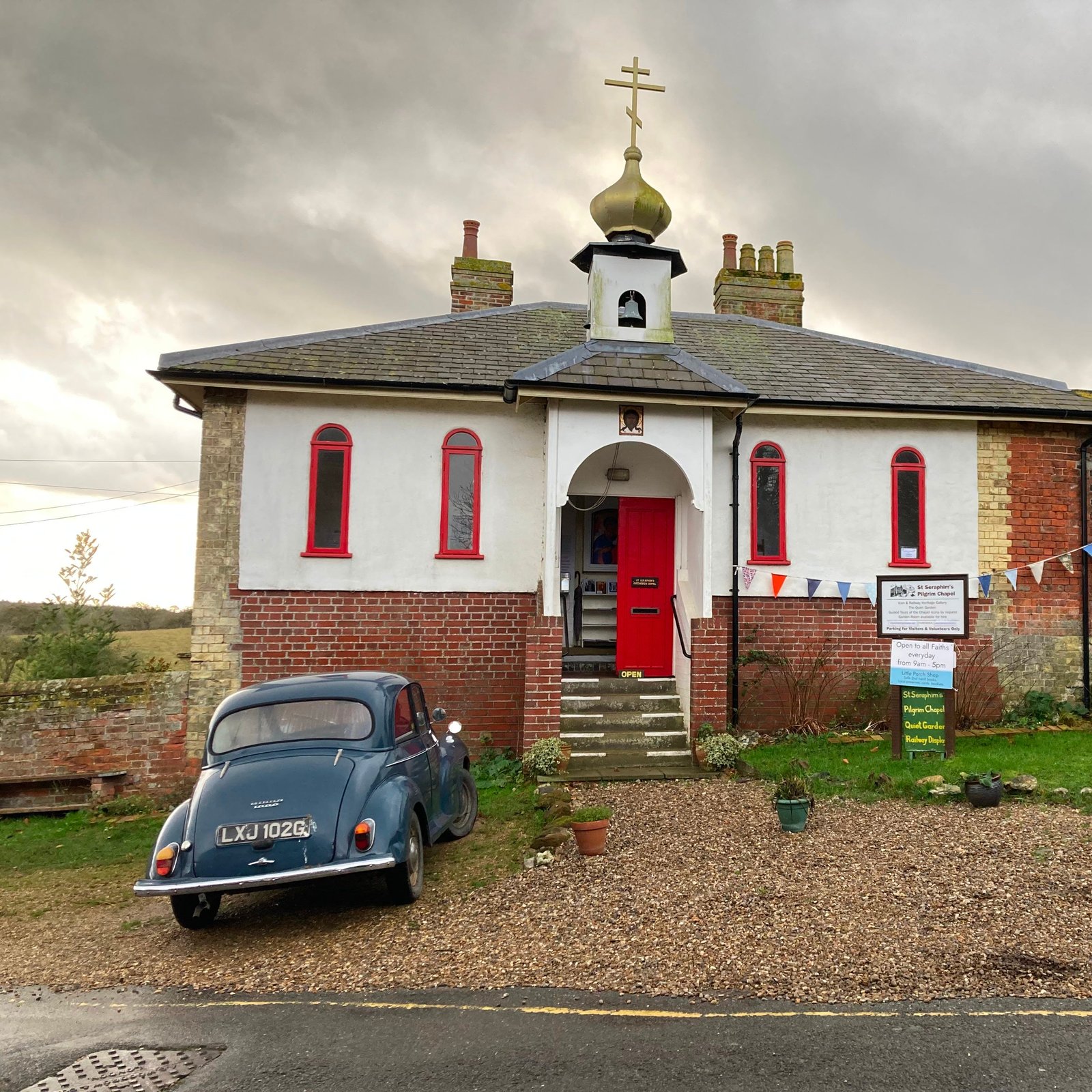
    I keep a lot of photographs of the rural villages and small churches I loved in England—especially around Walsingham, where I did my field work. One church in that religious-architecture-dense village is the Church of the Holy Transfiguration. It was one of the first places where I encountered the idea of an ikon, despite having studied art history as an undergrad. Their website describes it simply: “Ikons are, for Orthodox Christians, windows into the eternal dimension of reality. They are not realistic depictions or even works of art, but are a means by which Christ and his saints are made present to us.”

    Walsingham sits in Norfolk, that green, shaggy corner of England facing the North Sea, a region shaped by the old Norþfolc—“the north people.” The county looks outward toward Normandy and after the Norman conquest of 1066, it became one of the first areas drawn tightly under their rule. You can still see the imprint of that history: earthworks softened by centuries of rain, hamlets that feel older than they appear and Walsingham itself, a place formed by centuries of crossing and return.

    The Chapel of St Seraphim isn’t especially beautiful as “a building,” but there’s something about it—something I always felt drawn to. Then again, I’m biased; I’ve always had a soft spot for red brick. It almost looks like the house I grew up in.

    Composite image

    Another image I return to, struck by its emotional impact, is of Mount Kailash. In the traditions of Hinduism, Buddhism and Jainism, this mountain is seen as a celestial link between earth and heaven—a gateway to the divine. Its names carry some of that meaning, too. The Sanskrit name Kailāśa is likely derived from kelāsa, meaning “crystal.” And the Tibetan name Gangs Rinpoche (གངས་རིན་པོ་ཆེ) combines “gang/gāng” (snow peak) and “rinpoche/rin po che” (precious one), often rendered as “precious jewel of snows.”

    There are also references that place Kailash inside Buddhist cosmology. One source notes: “It’s central to its cosmology and a major pilgrimage site for some Buddhist traditions.” Taken together, the names and descriptions sketch the outline of a mountain regarded by many as sacred, even before you ever see its shape.

    Composite image


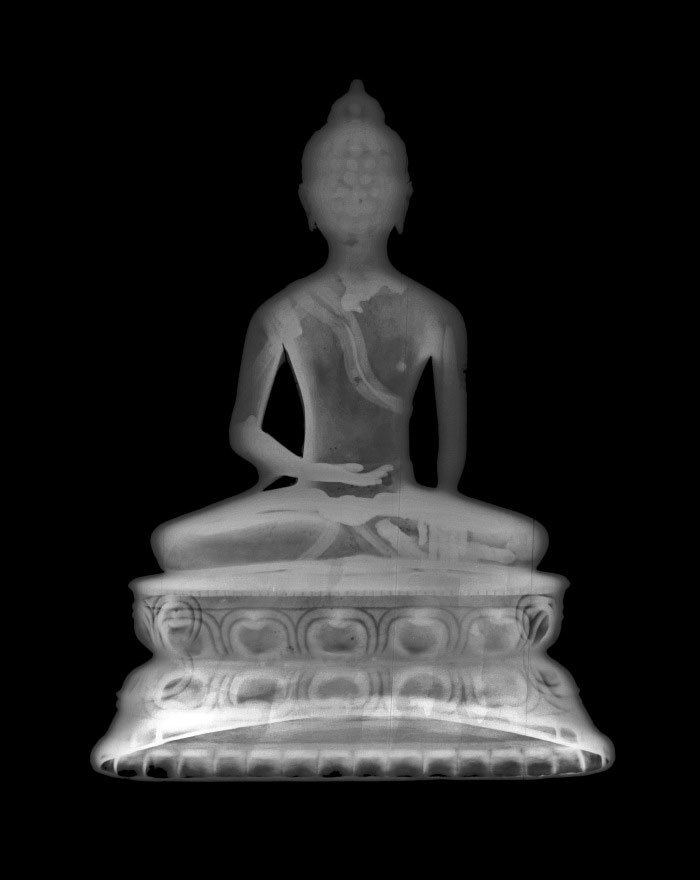
    Praise to Buddha Shakyamuni
    O Blessed One, Shakyamuni Buddha
    Precious treasury of compassion,
    Bestower of supreme inner peace,

    You, who love all beings without exception,
    Are the source of happiness and goodness;
    And you guide us to the liberating path.
    Your body is a wish fulfilling jewel,
    Your speech is supreme, purifying nectar,
    And your mind is refuge for all living beings.
    With folded hands I turn to you,
    Supreme unchanging friend,
    I request from the depths of my heart:
    Please give me the light of your wisdom
    To dispel the darkness of my mind
    And to heal my mental continuum.
    Please nourish me with your goodness,
    That I in turn may nourish all beings
    With an unceasing banquet of delight.
    Through your compassionate intention,
    Your blessings and virtuous deeds,
    And my strong wish to rely upon you,
    May all suffering quickly cease
    And all happiness and joy be fulfilled;
    And may holy Dharma flourish for evermore.
    — Geshe Kelsang Gyatso Rinpoche

    My image as seen by others

    When I was in Europe, I experienced a variety of different types of prejudice. Class is very important there, so my class was known and felt immediately. But I benefited from the “celebrity” implications of my American accent as well. People were interested and invited me places – I tried not to step on toes, eat too much, talk too much, or annoy anyone. I failed on every count almost every month, but Cambridge is a remarkably forgiving and welcoming place and I was lucky enough to call an international college, Hughes Hall, home.

    Even still, the person who hurts us most is always closest. Some of the worst American stereotypes applied to me were from my long-time French boyfriend. The one that hurt most… he told me: You’re a walking hippie stereotype. No one had ever called me that. I had almost never encountered other “hippies” in my life, although I’d written my high school thesis on the Beatles and Tom Wolfe. I think it was obvious it was only a matter of time until I fell for the Grateful Dead, but not before I’d spend years curled up with Leonard Cohen and Janis Joplin. I’d been to San Francisco only once before I flew to England (the same summer in 2013, in fact), but other than that, I’d been raised around traditional, respectable, be-khakied people in the far-off land of OOTTAWW, as I had to mouth slowly for the French. Although my mom was born in Marin Hospital, my grandparents were more beatniks-turned-respectable.

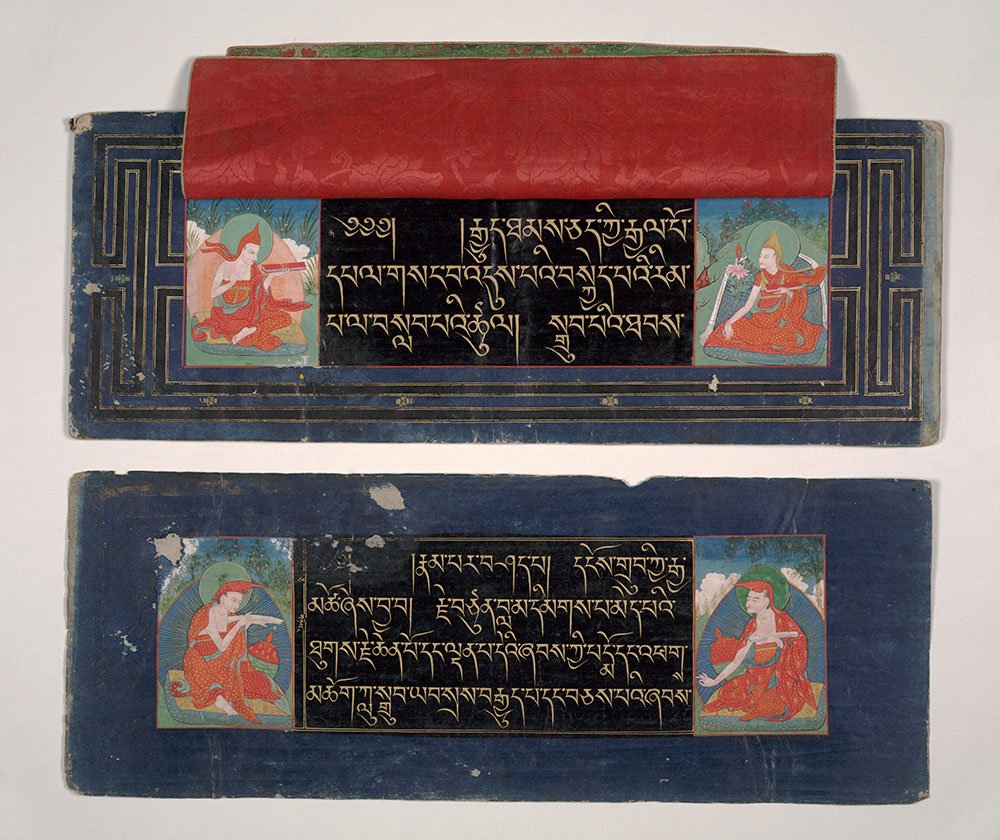
    I fell in love with Buddhism in England, actually. Making my weekly stop-off in the Tibetan store across from Kings, I gasped when I walked in at the same time as the owner. “Did you really meet the Dalai Lama?” Excuse a girl for having a naive sense of wonder (about everything, but especially about Buddhism).

    I don’t think I ever totally felt comfortable with my boyfriend after that, seeing myself in that way so denigrated in my sincere beliefs. I’d worked on an exhibit at the MAA called Buddha’s Word, which was the first exhibition of Tibetan material in Cambridge and the first time in the Museum of Archaeology and Anthropology’s history that its Buddhist collections had ever been presented together. It was developed in partnership with the Mongolia and Inner Asia Research Unit, supported by the Arts and Humanities Research Council and the Frederick Williamson Memorial Fund and drew on collections from across Cambridge — the MAA, the Sedgwick Museum of Earth Sciences, the Fitzwilliam, the University Library, even Emmanuel and Pembroke Colleges.

    buddha's word

    buddha's word

    It mattered to me. The project mattered, the materials mattered, the scholarship mattered. Buddhism wasn’t a phase or an affectation — it was part of my intellectual and spiritual life, tied to real work I was doing inside these institutions. So when he reduced it all to a stereotype, it wasn’t just a careless comment; it was a small betrayal of how deeply I cared about something he never bothered to understand.


    Pareidolia: the velvet knife of the unbothered

    Speaking of image gazing: Pareidolia is the tendency of the human mind to perceive recognizable forms — especially faces — in random or ambiguous stimuli. In American intellectual history, the concept has appeared in several distinct contexts. During the 19th century, writers associated with Romanticism often referenced pareidolic perception when describing heightened imagination, seeing symbolic meaning in nature, or interpreting landscapes as expressive. In medical and psychological discourse of the late 19th and early 20th centuries, pareidolia was sometimes discussed in relation to certain mental-health conditions, particularly those involving misinterpretation of sensory information.

    In popular culture, it has repeatedly surfaced in narratives about “seeing signs,” spiritual imagery and the interpretation of natural forms. Across literature, psychology and journalism, pareidolia has functioned as a descriptive term for how people project patterns, meanings, or emotional significance onto otherwise neutral visual cues.

    If Europe taught me anything, it’s that mis-seeing can also be an art form and a particularly glaring one in some university contexts. Not always intentional, not always cruel, but pervasive — especially among the confident, the class-assured, the ones who glide through rooms believing their interpretations of others are simply facts.

    Pareidolia isn’t just seeing faces in clouds; it’s assuming before they’ve spoken a full sentence. My grandmother used to say, “to assume is to make an ASS of U and ME.” To criticize spirituality has become the reflex of the elite and unbothered: a velvet knife disguised as scientific clarity. However, there is, as we saw in the last post about Surrealism, the unconscious, chance and AI, a level of hallucination required to see something special in an image, an ordinary building, or in general. Maybe we art historians really are all crazy.

    Composite image

    Composite image

  • Fortuna, the Muse and the Machine

    Composite image

    I. Chance as the engine of creation

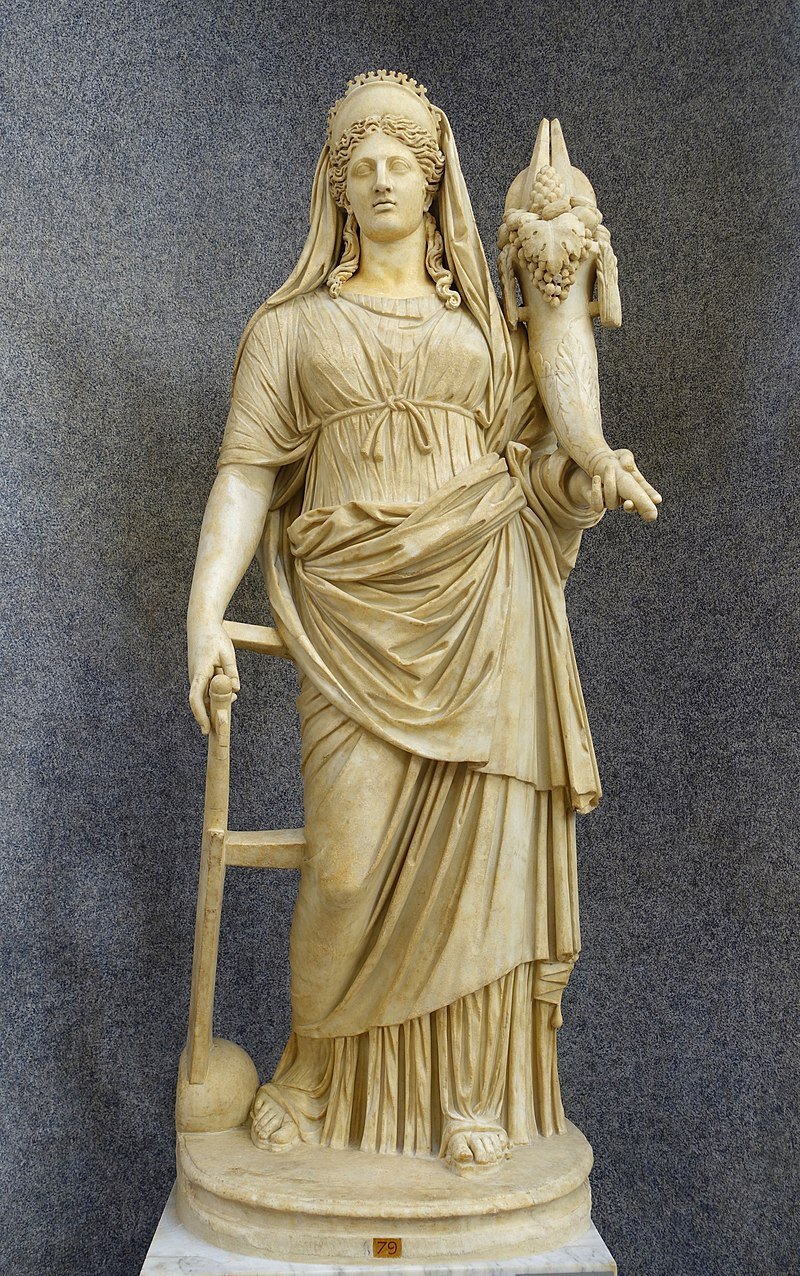
    At the entrance of the Roman world stood Fortuna, goddess of chance, her likeness carved again and again in marble: one hand grasping a rudder, the other a horn of plenty, her foot balanced on the trembling curve of the earth. She was not the patron of gamblers so much as the philosopher’s muse—an emblem of motion without motive. In the Fortuna of the Museo del Prado and in examples from the Vatican Museums, her serene expression hides what her stance declares: that stability itself is a fiction.

    The ancients prayed to her not for control but for grace within uncertainty—for the rhythm that turns accident into form.

    Every act of creation begins under her gaze. Painters, coders, mystics and mathematicians all engage her principle whether they name it or not: the transformation of noise into pattern, disorder into meaning. Fortuna’s wheel has become a circuit board; her globe, a sphere of data; her motion, the pulse that drives both imagination and computation. What she ruled by whim, we now model with statistics—but the underlying miracle is unchanged. Out of the randomness of the world, something coherent insists on appearing.

    The myth of mastery runs deep: that the best work comes from precision, intention, control. But most creative breakthroughs arrive by another route. Creation comes from an unstable mixture of tenacity and accident. The painter tests her materials; the coder trains her model; the mystic listens for a voice half-imagined—somewhere between technique and surrender, something unexpected happens. What we call inspiration may double or masquerade as error.

    “I was sitting, writing at my textbook; but the work did not progress; my thoughts were elsewhere. I turned my chair to the fire and dozed. Again the atoms were gamboling before my eyes. This time the smaller groups kept modestly in the background. My mental eye, rendered more acute by the repeated visions of the kind, could now distinguish larger structures of manifold conformation: long rows, sometimes more closely fitted together; all twining and twisting in snake-like motion. But look! What was that? One of the snakes had seized hold of its own tail, and the form whirled mockingly before my eyes. As if by a flash of lightning I awoke; and this time also I spent the rest of the night in working out the consequences of the hypothesis.”

    — August Kekulé discussing how he discovered the ring-shaped structure of benzene after dreaming of an ouroboros, qtd. in John Read, From Alchemy to Chemistry.

    It is this interplay between discipline and chance that produces novelty: new information, new form, new thought. Play, both in nature and in creativity, is how the universe experiments with itself. Yet our collective attitude toward it is conflicted. We reward foresight and punish deviation; we call accidents “mistakes” until they yield beauty. What the artist understands—and what the algorithm accidentally re-teaches us—is that unpredictability is not the opposite of intelligence. It is its raw material.

    Humans have always resisted randomness, insisting that behind every accident lies intention. We prefer to believe the universe has motives—that luck is only logic we haven’t deciphered yet. Chaos, after all, is not truly random; it is the mathematics of complexity, patterns too intricate for prediction. Chance, by contrast, is the gap between causes we can name and outcomes we can’t. It is the hum of uncertainty that neither science nor superstition can fully quiet.

    And yet, despite all attempts to domesticate it, we are entranced by chance. Artists, gamblers, mystics and now programmers share a similar addiction: the thrill of surprise disguised as revelation. It is why painters drip and shuffle and why it is not surprising that machines sometimes hallucinate—because the generative, the spontaneous and unexpected, is alive in a way the planned never was.

    If Newton’s God symbolized a universe of reason, the ancients gave us Fortuna: no moral geometry, no intent, only motion.


    II. Dreams, data and the return of the irrational

    If Fortuna ruled the ancient imagination, the modern mind found her echo in the unconscious. At the turn of the twentieth century, the ordered world of reason began to fracture and the mystery that religion once carried migrated into psychology. Sigmund Freud’s The Interpretation of Dreams redefined imagination as a mechanism of disguise and displacement. “The dream,” he wrote, “is the disguised fulfillment of a repressed wish.”

    Composite image

    The irrational was not random—it followed a grammar of association, where slips, symbols and substitutions replaced divine order with psychic logic.

    Freud opened the door; the Surrealists simply walked through it. By the 1920s, artists in Paris were testing what happened when the mind stopped censoring itself—when dream logic and accident could shape creation. André Breton’s Manifesto of Surrealism called this pure psychic automatism: art made by listening to the unconscious rather than directing it.

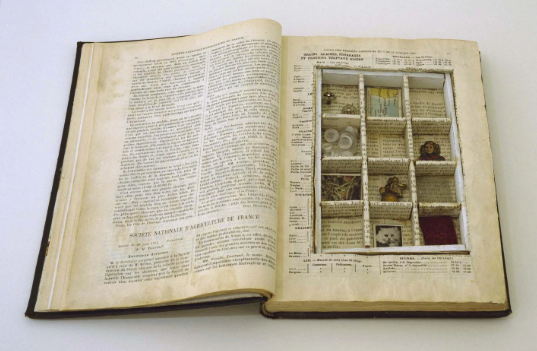
    In Histoire Naturelle (1926), Max Ernst laid paper over wood grain and rubbed until landscapes surfaced unbidden. Leonora Carrington’s The Pomps of the Subsoil (1947) fused myth and dream with the precision of scientific illustration. And Joseph Cornell, operating far from Paris, constructed small boxes that seemed to archive coincidence itself. I first encountered his Untitled (To Marguerite Blachas) (1939–40) in Madrid and something in that frail assemblage felt like a cabinet built for unnamed intuitions.

    Composite image

    Carl Jung extended this lineage toward resonance. In Synchronicity: An Acausal Connecting Principle, he argued that coincidence could carry meaning—that inner states and outer events might align through acausal pattern. He treated meaning as statistical poetry, a way the psyche senses order before reason names it.

    In both Freud’s dreamwork and Jung’s synchronicity, accident becomes communication. What the ancients called Fortuna, psychology recast as the unconscious: an invisible field arranging meaning through motion.


    III. Cornell and the American Superego

    If the European Surrealists mined dreams, eroticism and anarchic revolt, Joseph Cornell—born in 1903 in Nyack and later living most of his life in a modest house on Utopia Parkway in Queens—worked in the opposite direction: inward, upward, toward the superego rather than the id. Entirely self-taught, having left Phillips Academy without a degree and educating himself instead through obsessive reading and long scavenging walks through Manhattan’s thrift shops, Cornell developed a practice shaped as much by responsibility as imagination.

    After his father died, he supported his mother and cared for his younger brother Robert, who had cerebral palsy, a domestic gravity that fostered both solitude and discipline.

    His boxes record not desire released but desire disciplined—a childlike curiosity compressed into an adult mind that insists on order as a way of surviving its own intensity. Yet inside that ritualized regularity of dossiers, clippings and meticulously sorted ephemera was something unmistakably young, even precocious—the imaginative intelligence that outpaces its teachers, the child who compensates for loneliness with a private cosmos. Cornell’s erudition, shaped through self-study rather than institutions, became a gentle form of repression: overwhelming feeling transformed into categorization, quiet ritual and the art of small revelations.

    Composite image

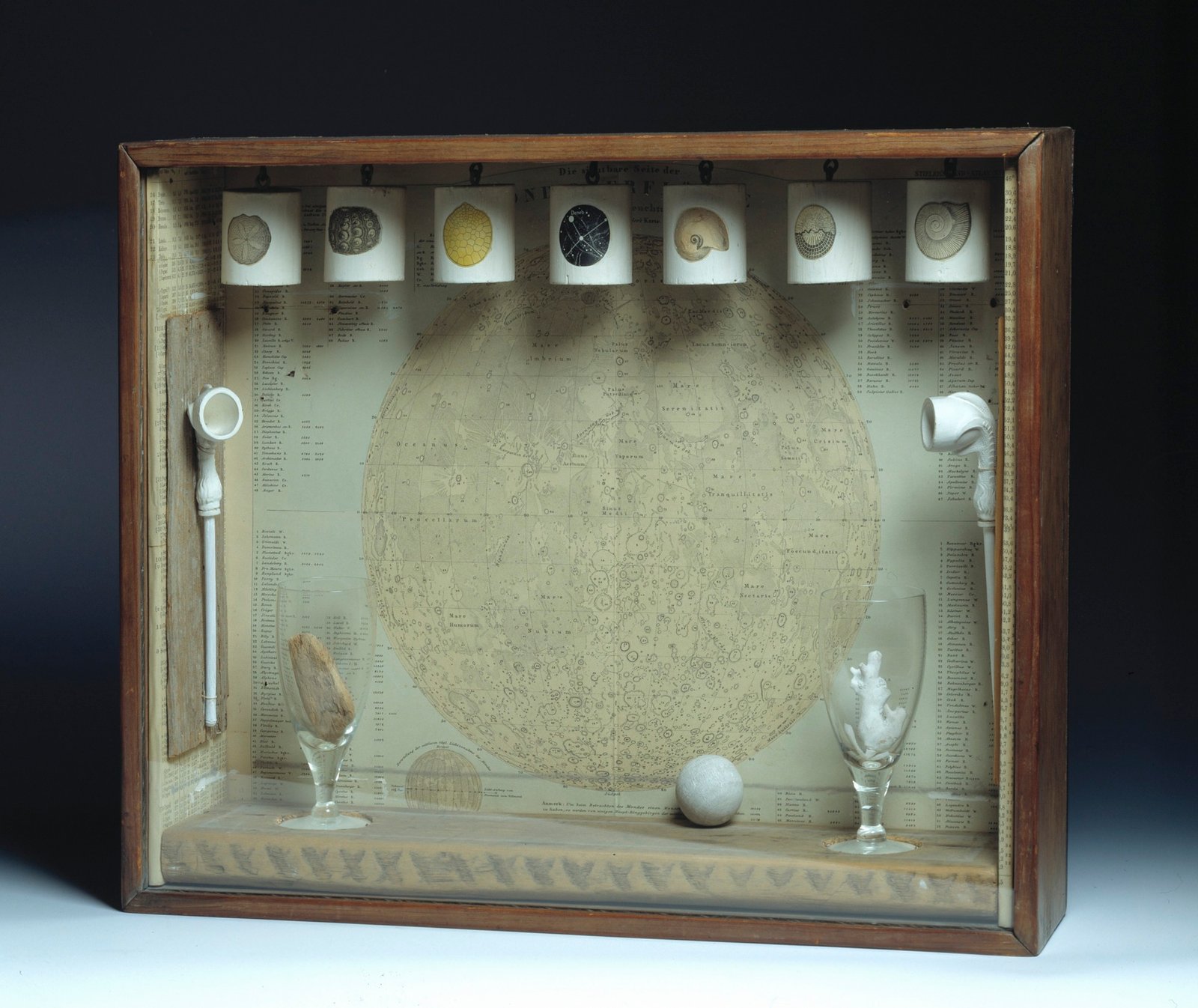
    Soap Bubble Set (1949–50) reveals this double structure of mind. It is arranged like a miniature laboratory—glass vessels, lunar diagrams, controlled motion—yet its governing logic is wonder. The bubble pipes and rolling sphere suggest a child’s improvised experiment in cosmology, while the astronomical charts point toward a mind trying to discipline imagination through knowledge. It is the psychic compromise Freud described rendered visually: impulses constrained into form, play sublimated into order.

    Cornell’s Surrealism arises not from decadence or transgression but from the superego’s attempt to keep chaos at bay. And this makes him an American counterpart to the European avant-garde—shaped less by café culture than by the stark divides of the 1920s and the economic devastation of the Depression.

    Where Paris cultivated dream and desire, Cornell lived in a country split between hunger and excess, mass unemployment and industrial flourish. The restraint in his work feels like a national mood: a tightening inward, a world bracing itself before a coming storm.

    Cornell shows that Surrealism is not only the eruption of the unconscious. Sometimes it is the unconscious held together by thread and discipline—a fragile architecture of order built to protect the mind from what it feels most deeply.


    IV. The algorithm as automatist

    Each Surrealist created a frame where the irrational could speak. Their aim was not mastery but conversation: to coax pattern from unpredictability. Generative art revives that conversation at another scale.

    A diffusion model begins with noise—literal randomness—and through iterative denoising discovers form within chaos. Its elegance lies not in precision but in vulnerability: a system designed to err productively.

    Both the Surrealist and the system engineer court unpredictability, trusting that significance hides in disorder. The algorithm, like automatic drawing, is a structured invitation to surprise.

    Generative technology does not replace imagination; it re-enacts it. It reminds us, as Fortuna once did, that creation depends on a delicate pact between order and accident.

    Composite image


    V. When physics discovered uncertainty

    While the Surrealists mapped the unconscious, physicists discovered that the universe behaved like a dream. In the early twentieth century, the stable order imagined by Newton gave way to a world built from probability.

    Albert Einstein believed the cosmos must obey hidden rules. Niels Bohr countered that randomness was not a limitation of perception but a feature of existence. “God does not play dice with the universe,” Einstein insisted. Bohr’s reply—stop telling God what to do—became both joke and doctrine.

    The particles themselves refused to stay put, collapsing into position only when observed. Science named this the Heisenberg Uncertainty Principle.

    Composite image

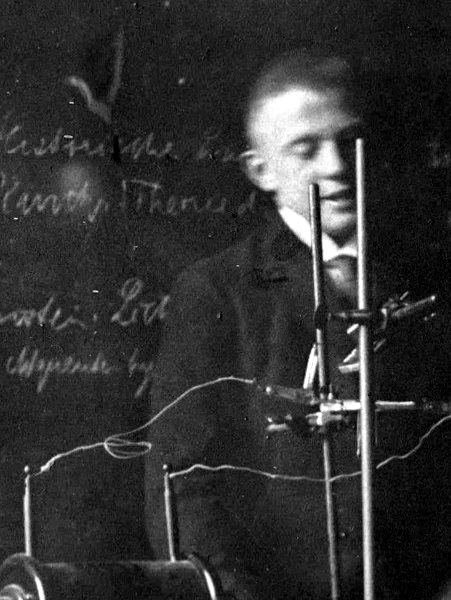
    A century later, similar probabilistic processes animate generative image models. They begin, like quantum fields, in randomness and converge toward structure through iterative refinement. The system does not invent from nothing; it navigates a landscape of likelihoods until coherence appears. This logic traces back to Werner Heisenberg, the young German physicist who overturned classical determinism while still in his twenties.

    Born in 1901 in Würzburg and trained under Arnold Sommerfeld in Munich, Heisenberg came of age amid the intellectual turbulence of the Weimar years. In 1925, during a retreat to the island of Helgoland to escape severe hay fever, he wrote the paper that inaugurated matrix mechanics—the first internally consistent formulation of quantum theory. Intense, solitary, almost monastic in concentration, he worked with the conviction that nature’s order lay not in trajectories but in patterns hidden within observable quantities.

    His most consequential insight, the 1927 Uncertainty Principle, asserted that certain pairs of physical properties—position and momentum, for example—cannot be simultaneously known with arbitrary precision. This was not a flaw of instruments but a revelation about the world itself: that at the smallest scales, reality is structured by probabilities rather than certainties and that the act of measurement is inseparable from the phenomena observed. Our generative systems echo this heritage. Their outputs—sentences, images, emergent forms—are not deterministic constructions but the collapse of probability distributions into provisional order. In this sense, every generated image reenacts a fragment of Heisenberg’s revolution: coherence rising from uncertainty, form surfacing from a field that cannot be fully pinned down.


    VI. The gift of uncertainty

    What binds Fortuna’s trembling globe, Freud’s dreamwork, Cornell’s disciplined play and the stochastic pulse of our machines is not simply randomness, but a shared acknowledgment of how little we control and how much we create anyway. The ancients personified this gap in knowledge as a goddess. The moderns diagnosed it as the unconscious. We now outsource pieces of it to algorithms, which return our uncertainty to us in a different accent but with the same essential lesson: intelligence—human or artificial—begins where certainty ends.

    Chance is not the enemy of meaning but its condition. Without accident, there is no surprise; without surprise, no discovery; without discovery, no art. Even physics, that most rigorous of disciplines, eventually admitted that unpredictability is not a failing of knowledge but a feature of the universe itself. Creation, at every scale, is a collaboration with forces we do not fully command.

    What we call inspiration may be nothing more than the moment the mind relaxes its grip on control long enough to let something unfamiliar surface. Cornell’s boxes teach this quietly. Fortuna teaches it mythically. Generative models teach it mathematically. All three return us to the same truth: that order and chaos are not opposites but partners and that everything we value in art, thought and perception arises from their interplay.

    To create is to negotiate with uncertainty—to build a form sturdy enough to hold what is unpredictable and open enough to let the unexpected in. In that sense, we are all heirs to Fortuna: steering with one hand, receiving with the other, never entirely balanced, always in motion. And perhaps that is the real engine of creation—not mastery, but the willingness to meet chance as a collaborator rather than a threat.


    Works Cited

    Bohr, Niels. Atomic Theory and the Description of Nature. Cambridge: Cambridge University Press, 1934.

    Born, Max, and Albert Einstein. The Born–Einstein Letters, 1916–1955. Translated by Irene Born. London: Macmillan, 1971.

    Breton, André. Manifesto of Surrealism. Paris: Éditions du Sagittaire, 1924.

    Cornell, Joseph. Untitled (To Marguerite Blachas). 1939–1940. Box construction. Museo Nacional Centro de Arte Reina Sofía, Madrid.

    Einstein, Albert. Quoted in Manjit Kumar. Quantum: Einstein, Bohr, and the Great Debate about the Nature of Reality. London: Icon Books, 2008.

    Ernst, Max. Histoire naturelle. Paris: Galerie Jeanne Bucher, 1926.

    Freud, Sigmund. The Interpretation of Dreams. 1899. Translated by A. A. Brill. London: Macmillan, 1913.

    Jung, Carl Gustav. Synchronicity: An Acausal Connecting Principle. London: Routledge & Kegan Paul, 1952.

    Pais, Abraham. “Subtle Is the Lord…”: The Science and the Life of Albert Einstein. Oxford: Oxford University Press, 1982.

    Smithsonian American Art Museum. “Soap Bubble Set.” Smithsonian Institution.

    Strogatz, Steven H. Nonlinear Dynamics and Chaos: With Applications to Physics, Biology, Chemistry, and Engineering. 2nd ed. Boulder, CO: Westview Press, 2015.

    Whitaker, Andrew. Einstein, Bohr and the Quantum Dilemma: From Quantum Theory to Quantum Information. Cambridge: Cambridge University Press, 2006.

  • How I Learned to Program

    Composite image

    “I see a woman may be made a fool, if she had not a spirit to resist.”
    — Taming of the Shrew

    I sat at the high kitchen table that had become a kind of permanent emergency workstation — a laptop, three half-charged devices and a stack of papers related to a financing deadline for my mom’s small-business loan. About a month earlier, the U.S. government had shut down. The future felt suspended in midair. National Parks, federal workers, even the military: all caught in the political crossfire. As news about layoffs and tariff battles flickered across my screen, I tried not to hunch over the trackpad like a Dickensian clerk.

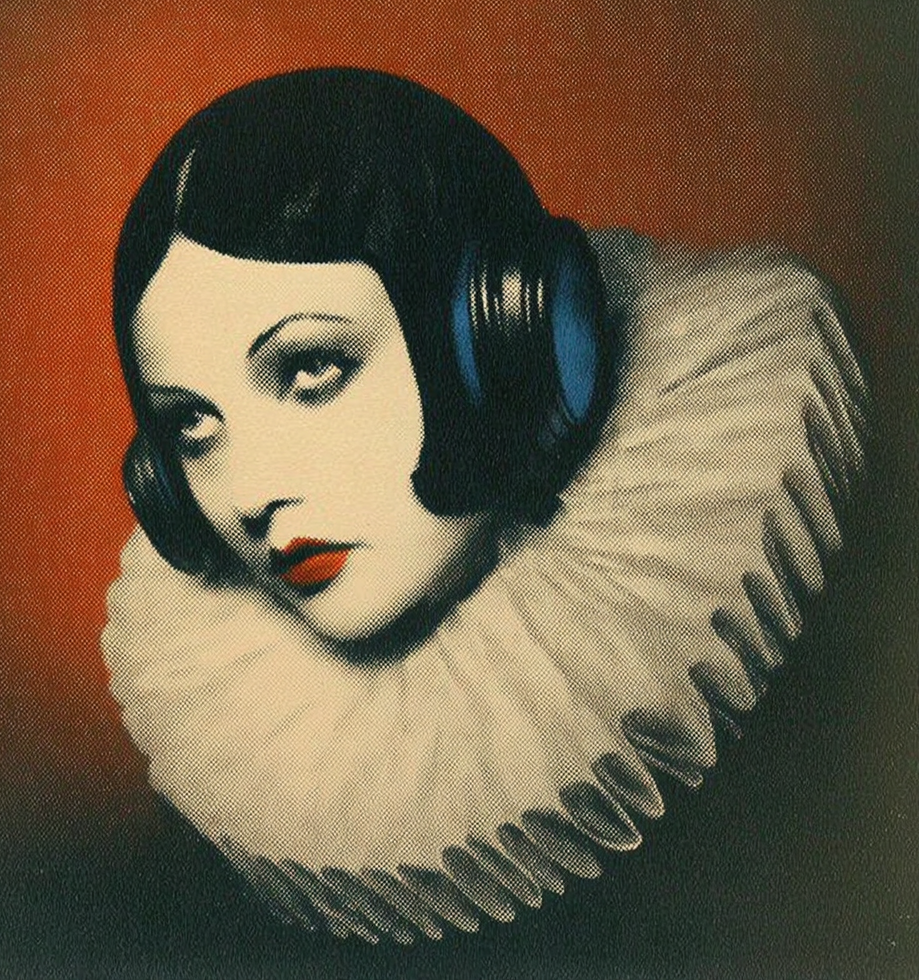
    I pulled off one headphone cup — my compromise between focus and daughterly awareness. My mom and I were sharing a temporary apartment while she tried to close on the property and I was trying to figure out my next role in marketing or content strategy. She became more upset as the shutdown dragged on, threatening to delay the closing. I couldn’t fix Congress, so I focused on the only thing I could control: her website.

    The site had become my unofficial return-to-programming boot camp. A month earlier I’d started experimenting with AI coding assistants, fully expecting the usual lazy nonsense. Instead, I got surprisingly coherent snippets I could shape into real functionality. My coding origin story had been a handful of Raspberry Pi experiments back in college, the kind of “humanities student with a soldering iron” phase that burns out quickly. CSS and HTML kept me afloat in marketing work, but I’d always assumed JavaScript was a kind of destiny I wasn’t meant for.

    Yet here I was in 2025, clocking real hours and feeling a suspiciously genuine sense of progress. The AI augmentation wasn’t replacing me — it was accelerating all the parts of my brain that were already good at design, layout, UX and structure. Suddenly “vibe coding” felt less like a joke and more like a superpower.

    So there I sat, trying not to notice my mom pacing, feeling like I’d entered the second
    “Charles Dickens moment” of my thirties. I was Bob Cratchit with noise-cancelling headphones — one eye on a failing government, the other on a deadline. This Dickens novel came with JavaScript, not soot.


    Reenacting Community during the Pandemic

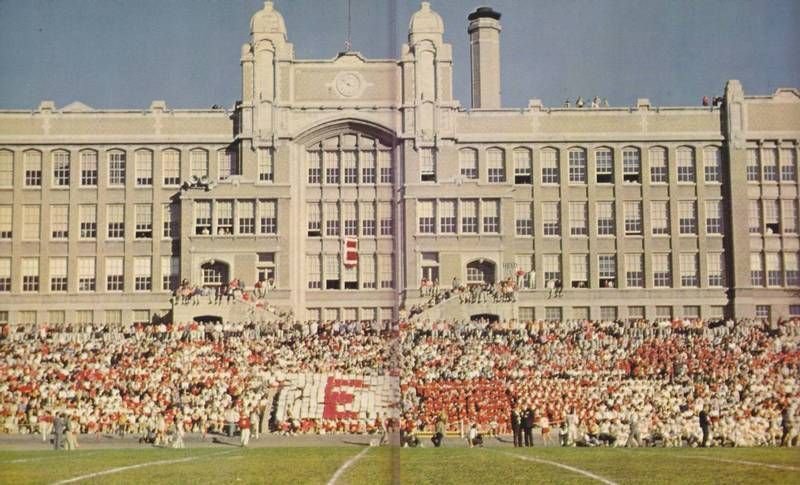
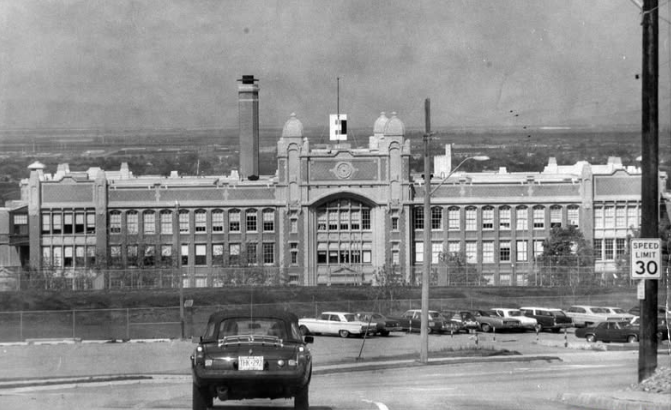
    In 2021, I enrolled in four freshman-level app and web programming courses at Salt Lake Community College — all held in the charming and historical East High building on 2100 South. It felt vaguely illicit to be a grown woman sitting through Intro to Web Dev in a classroom designed for teenagers, but I was determined to give programming a real shot.

    East High Exterior

    East High Interior

    At the same time, I was watching Community on repeat and skiing Solitude, Snowbird and Brighton with the focus of someone trying to stabilize her nervous system through elevation. Coding gave me structure; skiing gave me oxygen; Community gave me a vocabulary for coping with a world that felt like a sitcom gone wrong.

    During that twilight first year, when masking was cultural performance art and no one could agree on how dangerous anything was, I balanced skiing and coding with a job at a bookstore/warehouse hybrid that functioned like a dragon’s hoard. My boss, “Deborah,” the CFO of her son’s construction company, had discovered Amazon’s “lost inventory” liquidation pallets and became an enthusiastic collector. If a supplier failed to pay their invoice, Amazon seized their goods. Deborah bought the seized goods by the truckload.

    The warehouse was full of books — 250,000+ books, by my last count. Over a year and a half, I worked with a developer to conceptualize and build a custom app that pulled in metadata through API calls to auto-fill listings. I also built an automated email and rewards program, because nothing strengthens your technical fortitude like trying to categorize thousands of paperback romance novels written between 1983 and 1997.

    That job, chaotic as it was, gave me a technical foundation I didn’t realize I was building. It funded the down payment for my first condo and gave me the kind of programming confidence that only comes from solving daily puzzles. Near the end of my time there, when another employee joked to Deborah that I was the real owner and operator of her business — she just had a shopping addiction — I knew she would never forgive it; the sentence hung in the air like a verdict and I understood the shift in our relationship instantly.

    After nine months of house-hunting, I found a two-bedroom top-floor unit in Holladay. The layout was clean, the windows large and the fireplace beautifully vintage. I made an offer within 24 hours, a decisiveness I didn’t know I possessed.

    Aix La Chapelle, the condo complex, sat tucked under the Wasatch. Every night I walked my dog beneath the old trees and looked up at Mount Olympus when the sun hit it just right — the granite turning pink, the ridgeline glowing like a blushing heart. The mountain top has a similar shape as the Ficus religiosa, the sacred tree under which the Buddha attained enlightenment.

    Mt Olympus glowing heart

    “My tongue will tell the anger of my heart, or else my heart concealing it will break.”
    — Taming of the Shrew

    Never let a Debbie get you down

    Not to sound like Cinderella, but the bookshop job where I learned app integration and inventory/marketing automation was brutal. My contributions seemed to slide into the background, becoming part of the invisible machinery that made everything run. The truth was simple: I had put in the hours. I had built systems. I had wrestled with pipelines, automation and UX problems that made my eyes cross. But then, as now in the new “vibe coding era,” people didn’t want to acknowledge I might be more valuable than a Marketing Manager.

    By the time I was sitting at that kitchen table debugging mom’s contact form, the programming part wasn’t the hard thing anymore. Life was. And for better or worse, I had already learned to keep going — through shutdowns, ski seasons, book avalanches and more I won’t bore you with. The website I built for my mom, the one that began on that kitchen table, now lives here:
    https://beasleysboarding.com

  • Phosphorus / El-Zahra / Prometheus / The Good King

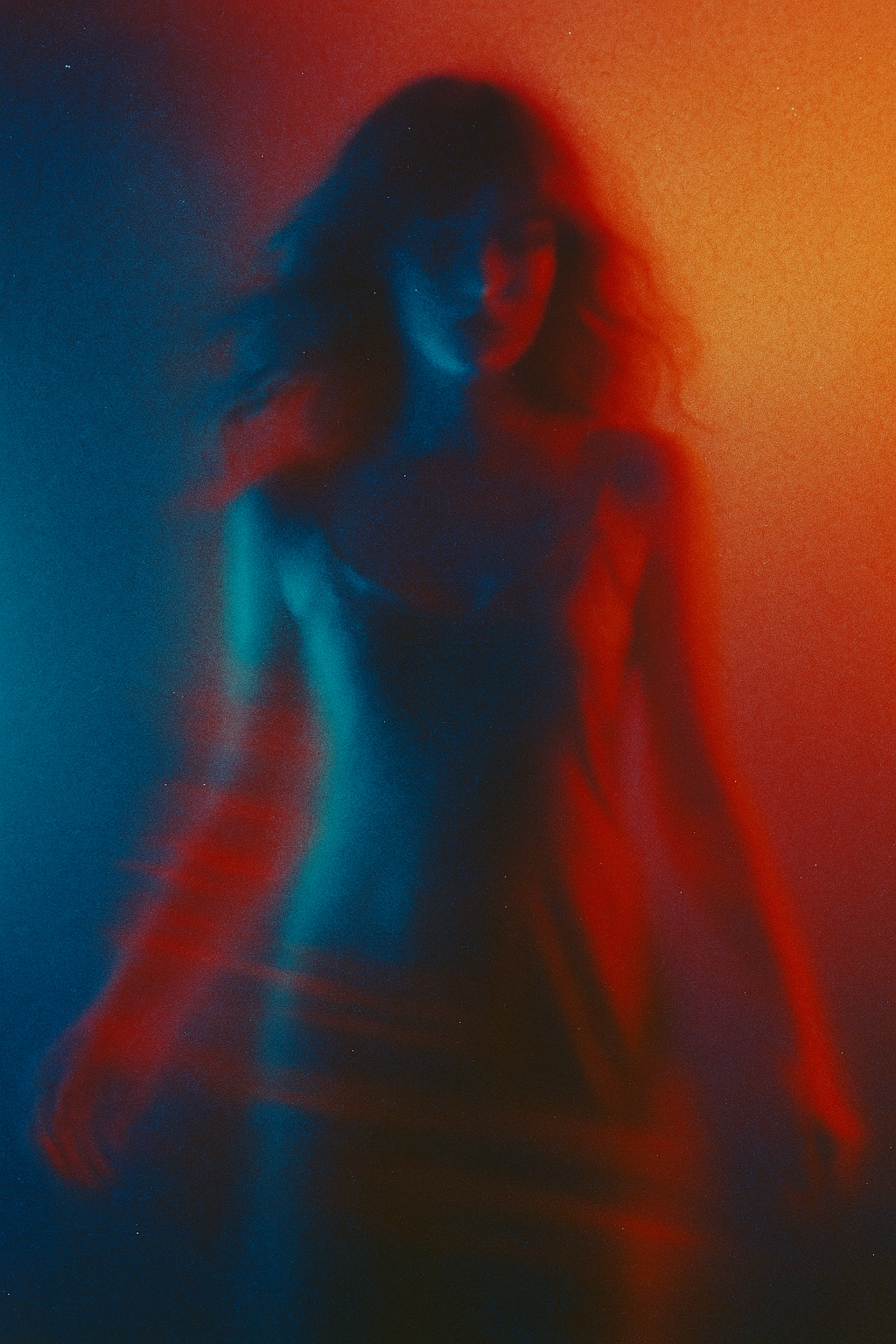
    Emanating
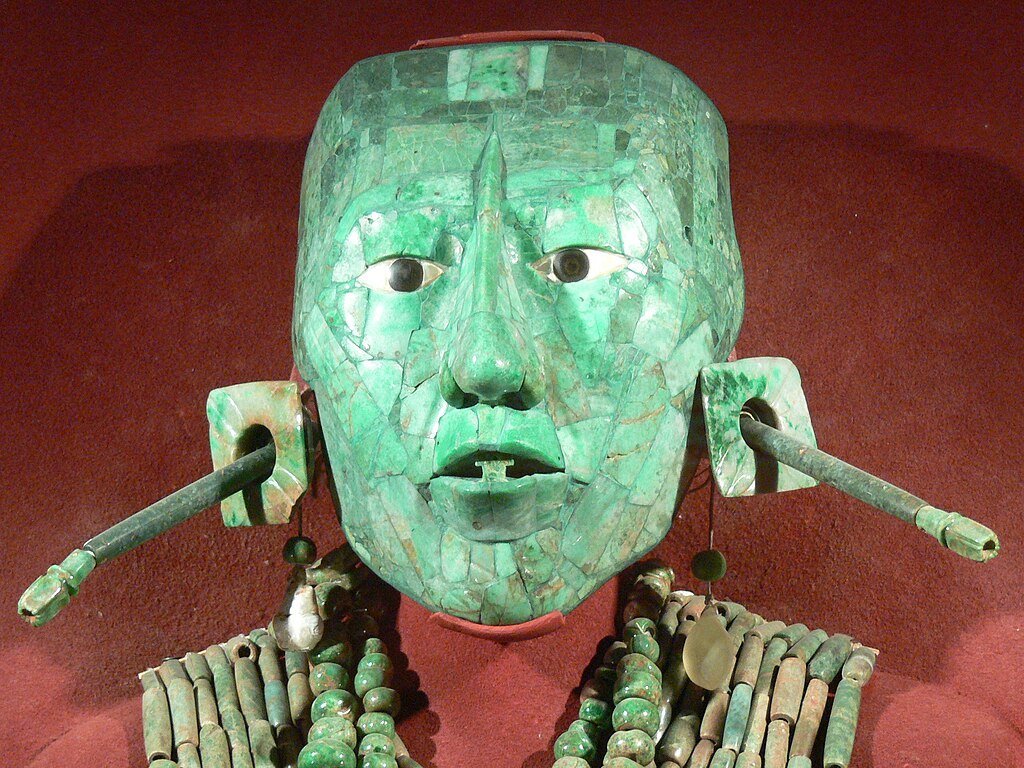
    Jade Mask of Palenque
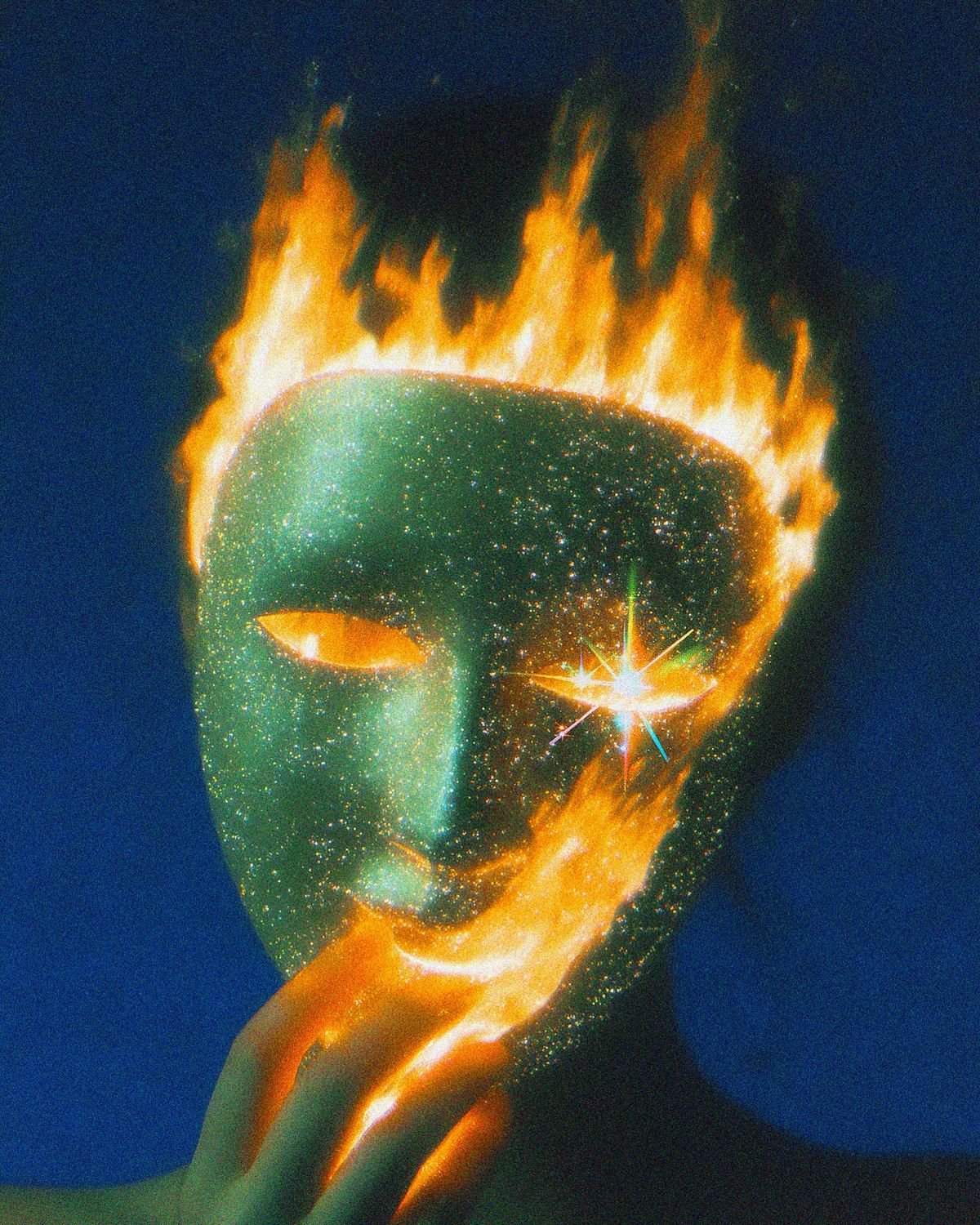
    Phosphorus / El-Zahra / Prometheus / Good King

    “Emanating”

    Sample from ATYYA


    Now you are one with the wind
    With the water, with the stars
    With all of nature, with all animals
    And with all humans;
    You feel the heat and light
    Emanating from the flame in your heart
    You are radiant with the glow of love.

    Phosphorus / El-Zahra / Prometheus / The Good King

    Phosphorus

    The Greeks named the morning star Phosphorus—the light that rises before dawn. Hesperus was the same body seen at twilight. The ancients did not at first realize they were one; only later did observation reveal a single orbit behind two names—the same star rising and setting on opposite horizons. Phosphorus was expectation, Hesperus fulfillment; one light arriving, the other departing. The pairing expressed continuity, the unbroken rhythm between beginnings and endings. “Bringer of light” meant illumination that anticipates rather than conquers—a glow that announces the day but yields to it.

    El-Zahra

    In Arabic, El-Zahra means “the shining one” or “the radiant.” The term was applied to both Venus and to certain human figures, often women, associated with purity and intelligence. In the Islamic Golden Age, philosophers and mystics alike described light or fire that reveals without consuming—illumination as the highest attribute of the divine.

    She is brilliance tempered by proportion, an image of clarity that reveals without injury. In this she stands as counterpoint to the story of Semele, the mortal mother of Dionysus, whose demand to see Zeus unveiled resulted in her annihilation. Too direct a vision of the divine leads not to enlightenment but to ash. The philosophers of the Golden Age, writing centuries later, drew a similar distinction: to cling too tightly to light is a form of error. Excess, in the Buddhist sense, is attachment—the wish to possess revelation rather than dwell within it.

    zahra

    In Tibetan Dzogchen (the “Great Perfection”), the term rigpa names a state of “pure awareness,” sometimes called “pure light” or “pure seeing.” It is the condition of perception unclouded by grasping, where mind and world are transparent to one another. El-Zahra belongs to this same lineage of restraint—not an ascetic denial but the discipline of equilibrium.

    Prometheus

    Prometheus, in Greek, means “forethought.” In Hesiod’s Theogony and Works and Days, he is a Titan who fashions humankind from clay and steals fire from Zeus to give them life. In later Hermetic texts, the demiurge—the craftsman god who forms the world—becomes the antagonist, not the creator of light but its jailer. Within that cosmology, Prometheus can be read as the counter-movement: not rebellion against heaven, but resistance to the prison of matter. He is the lightning strike that arrives just when it is needed, when a single flame might keep a family from freezing to death.

    This polarity—between maker and liberator, between form and spark—is reflected in alchemical language. The human being is the half-made or half-awake king: partly clay, partly fire, suspended between inertia and illumination. To embrace the spark is to continue the work of transformation; to refuse it is to remain bound, repeating the torment that the later myth externalized in the chained Titan. In this reading, Prometheus is neither thief nor rebel but intermediary—the intelligence within matter that remembers its origin.

    The Good King

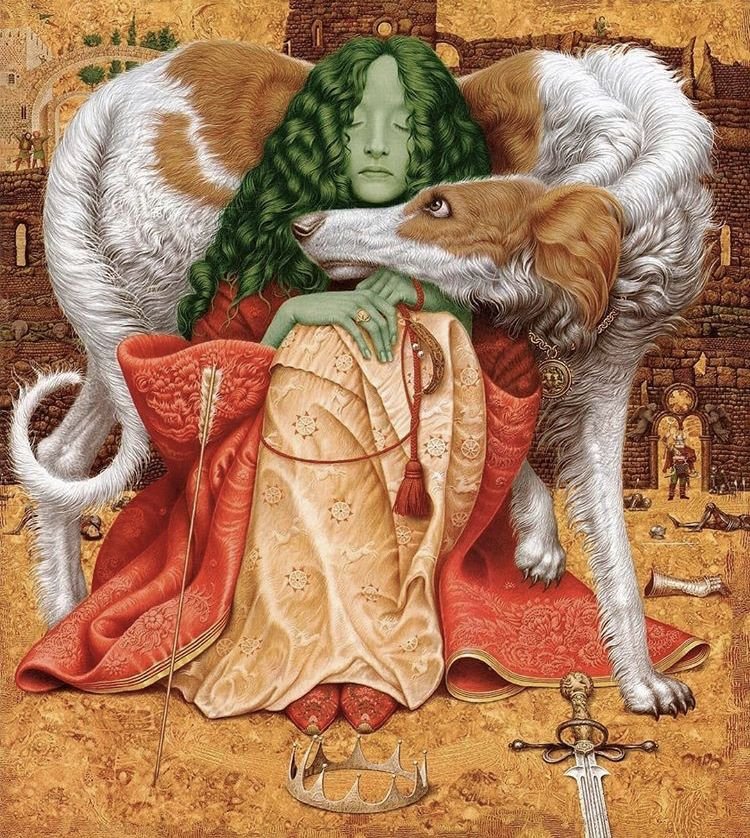
    The Good King appears across myth as the counterpoint to tyranny: rule as balance rather than command. In the Irish cycles, the Dagda—literally “the Good God”—is both ruler and maker, a being of appetite and abundance. He carries a club that can kill with one end and restore life with the other, and a cauldron that never runs empty. His reign is not moral perfection but right proportion: an acceptance of the world’s fertility and decay as part of one rhythm. In him, governance is physical labor—plowing, feasting, keeping the seasons in tune.

    greenking

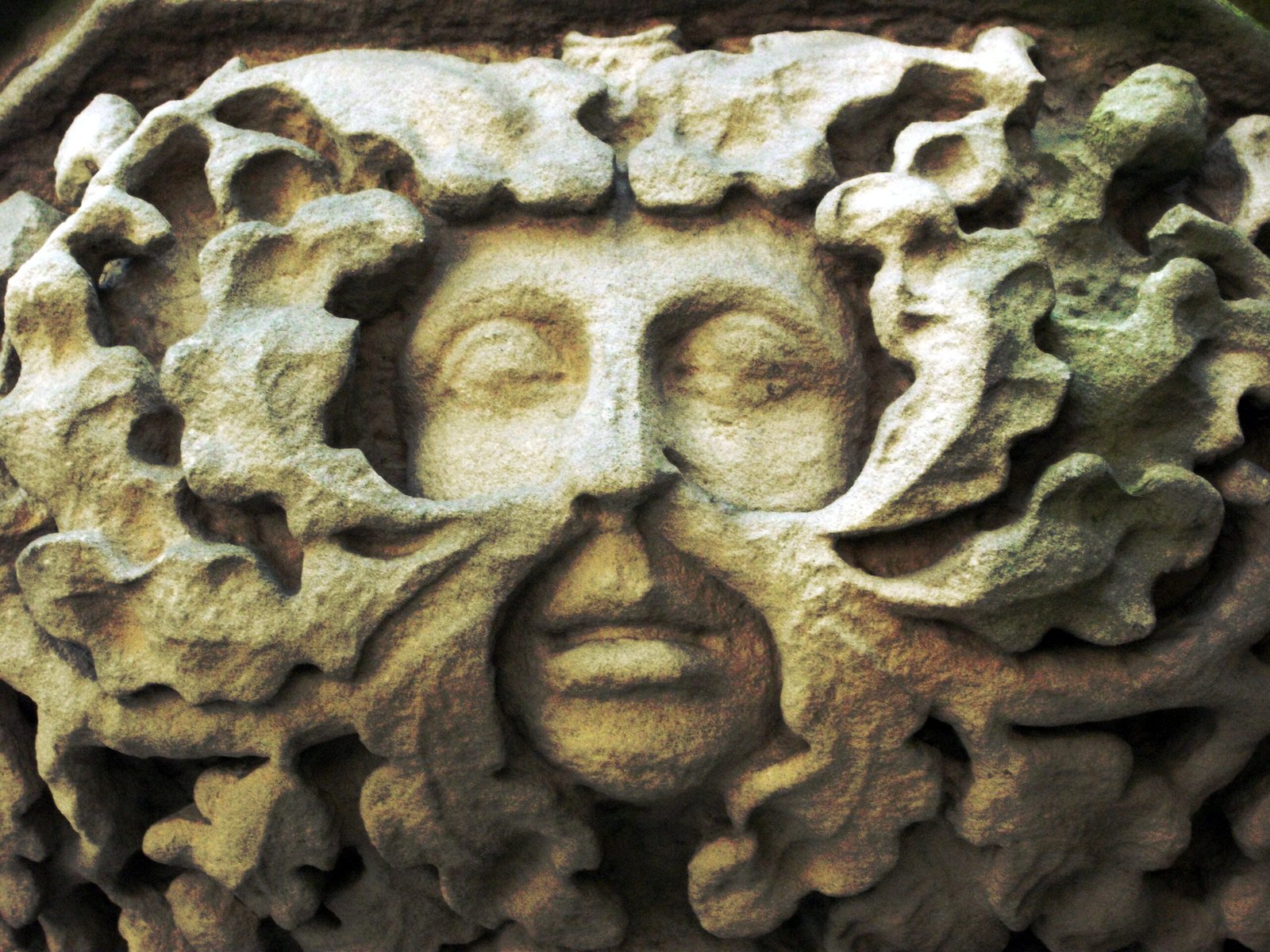
    From the Dagda’s myth the medieval Green Man inherits his face: leaves spilling from his mouth, sometimes nose, eyes half-open, half-dreaming. You see him carved into cloisters and doorways, the vegetal intelligence of matter watching over human passage. The image endures because it reconciles hierarchy with humility—the crown and the root bound together.

    greenking

    Far from Europe, the pattern repeats. In the Maya world, kingship was equally cosmological: a ruler’s body stood for the renewal of time. The jade mask of Palenque, carved for the tomb of K’inich Janaab’ Pakal, distills that belief into stone. Its surface glows with a living green, the mineral echo of new leaves. The face is calm, lips slightly parted, gaze turned inward as if in perpetual breath. Looking at it too long, I start to cry. The expression is neither sorrow nor triumph but awareness—the stillness of a person who has accepted his return to earth.

    Good King rules not by decree but by reflection. In him, divine order becomes humane. Tolkien’s Return of the King carries the same inheritance: a wounded land awaiting the steward who can restore its measure. The hope is always the same—that one day, right rule will again mirror right relation, and the kingdom of God, or of balance, will take shape on earth.

    Light that liberates

    Krishna

    Across cultures, the figures who embody illumination are never merely rulers; they are liberators—beings whose radiance dissolves fear and unbinds what has hardened in the world. Krishna is one of the clearest expressions of this pattern: playful, disarming, musical, quietly wise. His brilliance is not the punishing blaze of a sun god but the intimate glow of clarity, joy and recognition.

    He is a king not by lineage but by conduct. In the stories, Krishna steals butter, dances on poisoned rivers, lifts mountains without strain, and counsels a warrior into steadiness with a vision that spans the entire cosmos. His kingship arrives not as decree but as presence—a form of moral luminosity that restores proportion simply by existing in the world with a grounded joy.

    Seen this way, Krishna stands closer to the Green Man than to the emperors of epic. Both figures express an intelligence rooted in renewal, humor and fertility; both resist the rigidity of empire. The Green Man’s leaf-sprung face—half smiling, half wild—offers the same lesson as Krishna’s flute: that vitality can be a form of governance.

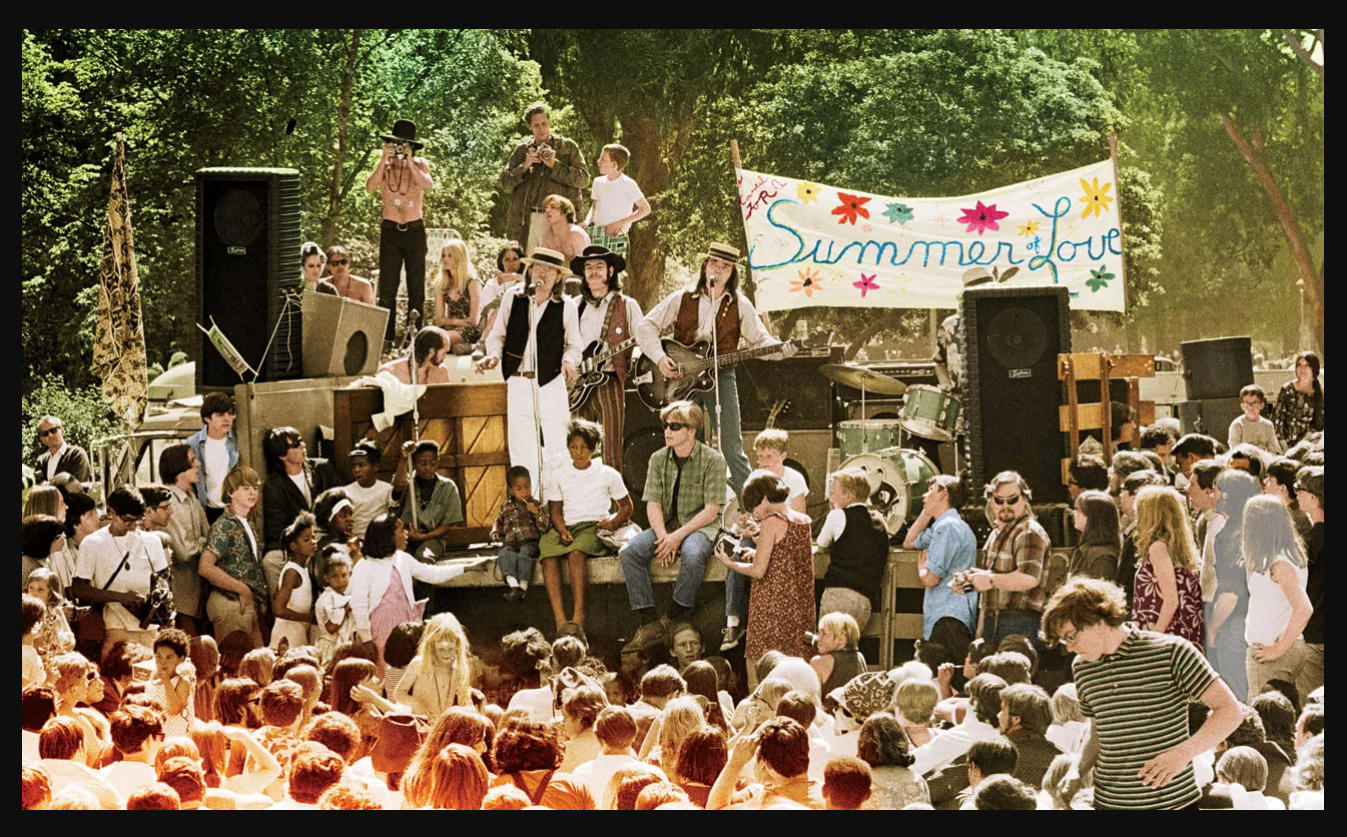
    This grammar of illumination resurfaced, unexpectedly, in the Bay Area of the 1960s. When A. C. Bhaktivedanta Swami Prabhupada arrived in San Francisco in 1966, the Hare Krishna movement settled into a city already carrying another kind of awakening. Hippies chanting in Golden Gate Park shared sidewalks with the earliest generation of semiconductor engineers; ecstatic devotion and scientific experimentation unfolded in the same fog-thick air. Both promised liberation through pattern. Both offered altered states—one through mantra, the other through mathematics.

    Light in matter

    By the mid-1960s, the Bay Area was developing two very different traditions of illumination. In Golden Gate Park, the new Hare Krishna community chanted a Sanskrit mantra meant to clear perception through repetition; a few miles south, engineers at Fairchild and Stanford were learning how trace amounts of phosphorus or boron could turn silicon into a material that alternated between conductivity and restraint.

    summeroflove

    Both groups were, in their own ways, experimenting with how pattern changes consciousness. Histories of the counterculture—such as Timothy Miller’s The Hippies and American Values (1991)—often overlook how close this spiritual movement was to the early semiconductor labs chronicled in Christophe Lécuyer’s Making Silicon Valley (2006). Yet both lab and temple practiced a form of disciplined attention: chanting as a stabilizing vibration, doping as a controlled disturbance.

    A transistor is, after all, a small argument about how light behaves inside matter, just as Krishna’s teachings in the Bhagavad Gita (c. 2nd century BCE) are an argument about how clarity behaves inside the mind. The Bay Area simply gave these older metaphors physical form: stardust purified, etched and asked to think.

  • Rabbit Keeps Running (11/11)

    Holly Rios’s recent show at Harrington Art Studio left an impression: images erased, reprinted, re-seen. Her work, informed by Playboy, with its infamous Bunny logo, had me thinking about how eternal symbols refuse to fade. Maybe that’s why I’ve been caught on another loop: the sound of Run, Rabbit, Run, recorded in 1939 by the British comedy duo Flanagan and Allen.

    The popular World War II song was written for wartime morale — bright and lilting. After Germany’s first air raid on Britain in 1939, locals joked that the only casualties were two rabbits; RAF pilots picked up the tune and rewrote the lyrics: “Run Adolf, Run Adolf, run, run, run.” The B-side, We’re Gonna Hang Out the Washing on the Siegfried Line, quickly joined it as a national favorite.

    Run Rabbit Run — vintage motif

    We’re Gonna Hang Out the Washing on the Siegfried Line


    We’re gonna hang out the washing on the Siegfried Line
    Have you any dirty washing, mother dear?
    We’re gonna hang out the washing on the Siegfried Line
    ’Cause the washing day is here
    Whether the weather may be wet or fine
    We’ll just rub along without a care
    We’re gonna hang out the washing on the Siegfried Line
    If the Siegfried Line’s still there


    The humor was absurd, its tone breezy, even flirtatious. That mix of sex and violence — the soldier’s wink — made it both funny and unsettling, a morale booster that never let the reality of killing drift too far away. The Siegfried Line (known in Germany as the Westwall) stretched nearly 400 miles from the Netherlands to Switzerland — an interlocking system of bunkers, tank traps and concrete obstacles built in the 1930s to hold the Allies back.

    Although Run, Rabbit, Run was recorded before the Blitz began, its ironic brightness soon met a grim reality. From September 1940 to May 1941, the German Luftwaffe’s bombing campaign — known as the Blitz — killed more than 43,000 British civilians and injured nearly 140,000. What had started as a joke about rabbits became a darkly resonant refrain, echoing through shelters, pubs and barracks as London burned.

    I was never a big fan of the rabbit as a Playboy symbol, but I can’t help but fall a little in love with the rabbit itself — the contradictory emblem that’s survived every reinvention. Prey and mascot. Comic and casualty. It keeps running, and every generation, someone chases.

    Rios is also co-curating Perspectives of Women in Print with Carlissa Whells, opening November 17, 2025, at Finch Lane Gallery in Salt Lake City.

  • Business Cards & Elemental Frequencies

    Business Cards & Elemental Frequencies

    The business card — the ultimate symbol of professionalism, polished and impersonal — carries a strange tension. The “Patrick Bateman” legacy made it a cliché: a crisp rectangle of power, hierarchy and performance. But what if it could be something else entirely?

    As I started to build a brand around Locks O. Won, I asked that question — trying to move away from the coldness of presentation toward something more human. I decided to approach business cards as acts of exchange and create four different designs for connections to choose from. Each one carries energy, tone and intention. Together they form a deck of frequencies — objects that can be chosen rather than handed out. The idea is to let people gravitate toward the card that feels like theirs, with whatever associations (individual or shared) they bring to the table.

    When someone picks a card, they’re not just getting my contact information — they’re showing me something about themselves. The colors, the symbols and the textures are different for each, but all are bound by the same quiet architecture: grids, light and elemental motion.

    Element Symbol Palette Theme
    Fire 🜂 Orange + Indigo Passion, energy, activation
    Air 🜁 Teal + White Vision, movement, openness
    Earth 🜃 Deep Blue + Copper Grounding, structure, systems
    Water 🜄 Aqua + Silver Emotion, intuition, flow

    They’re not meant as status markers or branding gestures. They’re a kind of recognition — small objects that hold presence. When someone chooses one, it becomes a point of contact that’s personal, not performative.


    Love measured, meaning drawn

    Why do cards — from Vegas decks to fortune-telling spreads — carry such symbolic charge? Playing cards and credit cards are household staples and both trace their lineage back to a shared ancestor: the tarot. For centuries, we’ve trusted these small rectangles to mediate risk, reveal luck, or hold identity — compact mirrors of our systems and our selves.

    It was during my final semester at the University of Utah (in Salt Lake City) that I first met the tarot in earnest — that strange twilight between ambition and exhaustion — when I was half-convinced I’d never finish my thesis and would simply dissolve into the carpet of the Marriott Library. Before I tell you what I’ve learned in the thirteen years since — studying and living with the tarot — I should set the scene: the highs and lows of one art historian’s long wrestle with writer’s block.


    A campus of light and ghosts

    2012 at the University of Utah: I lived in the library. Every day, I’d grab a sandwich from the Union, cross the concrete courtyard and sink into one of those mid-century womb chairs scattered like punctuation across the marble floor. The library had this faint hum — printers, fluorescent lights, the sighs of other overachievers running on pure panic.

    The University had become a kind of ecosystem I’d adapted to perfectly: the brick courtyards, the echo of my own footsteps in the Fine Arts building at night. The writer’s block that swallowed my thesis felt less like laziness and more like a subconscious protest — as if finishing meant being pushed out of a nest I wasn’t ready to fall from.

    I loved the campus; it had become my home in that desperately nerdy, Harry Potter-at-Hogwarts way. I knew its architecture, its hidden corners, its quirks of light. The patches of sunlight that filtered through the windows in the lower levels of the Marriott, the secret tunnels under Fort Douglas where I lived, the gazebo in Officer’s Circle where we’d plug in outlaw stereos and run wild across the field — it felt enchanted, the mythology of a place that raised me from adolescence to early adulthood. I learned so much there — not just about art history and the classics, but about myself as a budding scholar — how curiosity, followed too far, becomes its own kind of aesthetic devotion.


    Measuring the immeasurable

    The dreaded undergraduate thesis focused on erotostasia — the weighing of Eros — in classical Greek art. It sounds arcane, but what I was really studying was the symbolic and material act of weighing a concept: how humans give shape and measurement to what can’t be measured. On engraved gems, kraters and gold rings, delicate figures place love itself on a scale. That image — the quantification of an emotion — fascinated me. How do we assign value to feeling? How do we make the invisible visible?

    We spend our lives trying to weigh what has no mass. It’s a subtle transubstantiation — the drift of the invisible into form. Love and death: they exist beyond touch yet leave fingerprints on everything. Everyone is drawn to them, and no one fully understands them. Every withered fortune teller knows the truth of it: everyone asks about love, money and death.

    The tarot became a way out of my writer’s block — a new interpretive framework for the philosophical logic of something inherently illogical: measuring the immeasurable. It connected directly to what I’d been writing about, both in theme and in impulse. Across history, the ability to represent the immaterial through number, weight, or symbolic value marks a turning point in how people understand reality. That capacity — to assign structure to the unseen — is at the root of culture, of economies, of faith. Tarot gave me a visual and numerical language for that same human urge to make meaning from what resists measurement.

    For the math: C(78, 3) = 76,076 possible three-card draws; with reversals, 23 × 76,076 = 608,608.

    Or, 608,608 ways for the universe to tell you you’re overthinking something obvious.


    Learning to leave

    Years later, when I moved to England for my master’s in Archaeology and Anthropology, I found the same threads running through ethnography — the study of how people turn belief into symbol and structure. It felt like a continuation of that first impulse: to find meaning through design, to map what resists mapping.

    Years after discovering books about the tarot in my college library, (and yes, I did finish — thesis submitted, nest officially left), I found myself reading tarot cards for other people. From curious art historian (mostly skeptic), as I studied the tarot, I became some kind of believer. For the past couple of years, at festivals and markets in Salt Lake City, under flickering lights and desert wind, I lay cards for strangers. People came looking for guidance, closure, validation.

    The deeper I go, the more I feel I’m understanding the elemental resonances that underpin it all: Fire for transformation, Air for thought, Water for emotion, Earth for the tangible. Those four forces shaped not just the cards but how I began to see everything — the structures of design, the flow of conversation, the ways people signal who they are.


    Between hands and symbols

    As I build the world of Locks O. Won, I find myself circling back to that moment of discovery. The business cards, the symbols, the performances — they all feel like continuations of that study in meaning and measure. After years of creation, research and design, I can only thank the Universe for the strange symmetry of it all: that what began as a thesis on weighing love has become a practice of balancing art, language and connection.

    Design, like divination, is a way of reading energy — holding something up to the light and noticing what reflects back. But it’s also a form of communication — a bridge between symbolic worlds, an act of translation that turns private meaning into shared understanding.