
I’ve always found that my strongest connection to Macbeth comes through horror — an angle that still feels somehow overlooked, given how often the play leans toward the campy, the uncanny, and the animated in its shifts of tone. Macbeth sits quietly at the foundation of the genre, yet many modern adaptations treat it as a straightforward story of political unraveling, closer to Henry VIII than to anything resembling proto-horror.
It was this elasticity of tone that drew me, years later, to Stanley Kubrick’s The Shining, a film that treats horror the way Shakespeare does, as an atmospheric logic rather than a genre, something woven through space, timing, and the emotional weather of a place.
Macbeth reaches toward a kind of supernatural tension and psychological disorientation that wouldn’t have a formal vocabulary for centuries. Shakespeare mixed genres, but film adaptations rarely capture the quick shifts of atmosphere that live theater makes possible — the in-and-out changes of set and mood that can feel like flipping channels on a strange television broadcast, or listening to a radio station mixed in real time by an unseen DJ.
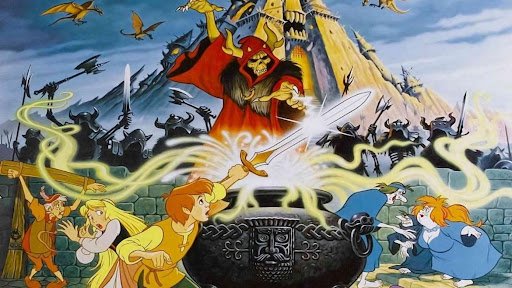
“Come, Graymalkin!” The line holds an eerie shimmer like the dark animated films from the late ’80s-90s. They’re threaded with folk magic, shadowy forests, grotesque little jokes, and a touch of menace too sophisticated for their intended audience. See The Black Cauldron (1985) promo image above.
At its core, Macbeth is a play of tonal whiplash: ragged prophecies delivered on a blasted heath, followed moments later by a drunken porter cracking bawdy jokes at the castle gate; flashes of supernatural spectacle punctuating long, politically anxious speeches; strange bursts of color — torches, blood, banners — interrupting Scotland’s fog. Shakespeare’s tragedy is not one clean descent but a jittery collage of horror, comedy, and moral vertigo. It behaves less like stately history and more like early camp horror, the kind that delights in theatricality while letting the uncanny slip in through the seams.
Living inside a haunted world
Kubrick understood that texture instinctively. Where Shakespeare used rhetorical shifts, Kubrick used décor, framing, and the rhythm of movement through space. His haunted world is not a set of plot devices but an environment you live inside. The Overlook behaves like a theatrical stage expanded to architectural scale: carpets in impossible colors, hallways that seem to inhale and exhale, sudden intrusions of grotesque comedy (the man in the dog suit, the relentless cheer of the bar), all arranged to make the viewer feel not that they are watching a haunted hotel, but that they have been quietly checked into one.
The rules of realism loosen and tighten at odd intervals, like in Macbeth, and that playfulness with tone is what gives both works their durability. Horror becomes a lens, not a genre: a way of understanding mood, memory, and the fractures in our perception.
Maybe that’s why Room 237 — Rodney Ascher’s documentary built from the voices of Kubrick theorists who never appear onscreen — has become my favorite documentary. I rewatched it last night, and it still carries the same strange, absorbing quality it had the first time. The film allows you to wander back through Kubrick’s environments, touching the walls, following the impossible geography, noticing small shifts in color and continuity the way a guest might sense a draft in a sealed room.
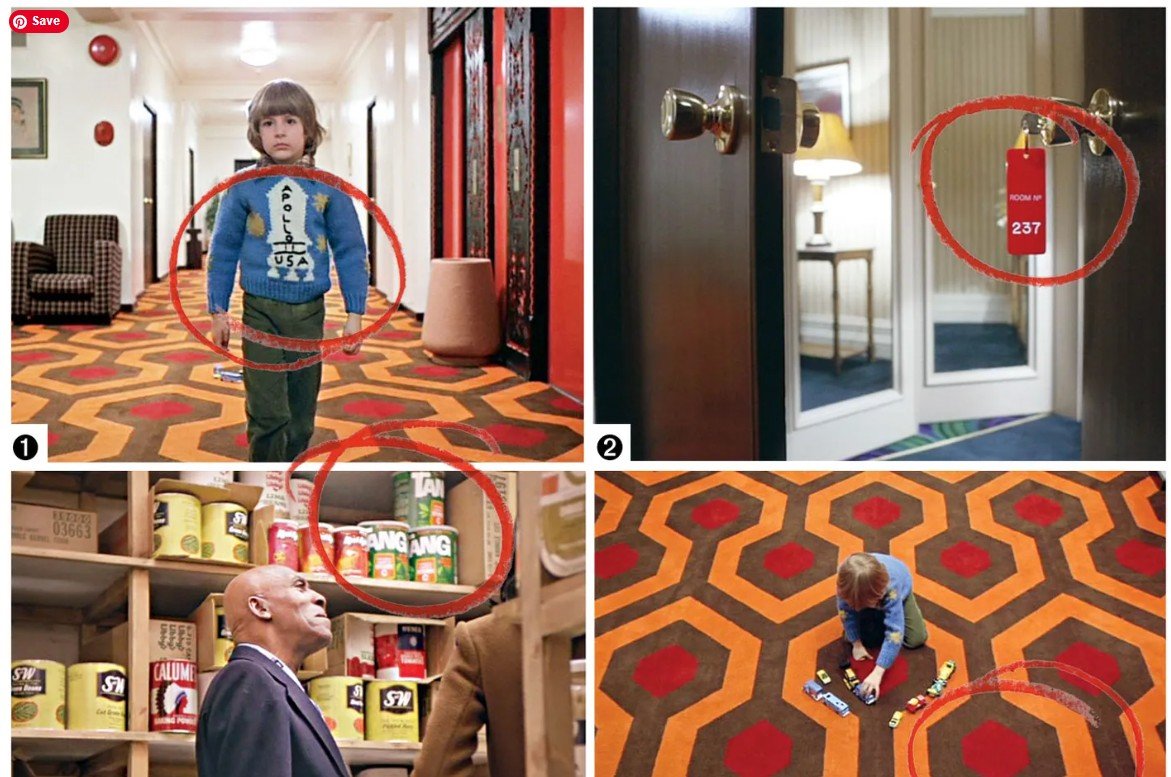
The disembodied commentators move through those spaces like resident spirits — guides who never quite manifest — letting their interpretations drift between the improbable and the unexpectedly revealing. Their voices echo over long, immaculate stretches of footage from The Shining, Eyes Wide Shut, and Kubrick’s earlier films, until the documentary begins to feel less like analysis and more like haunting. For anyone attuned to Kubrick’s sensibility, the film’s rhythm settles in quietly, as if it has been waiting for you to return.
The rooms we return to
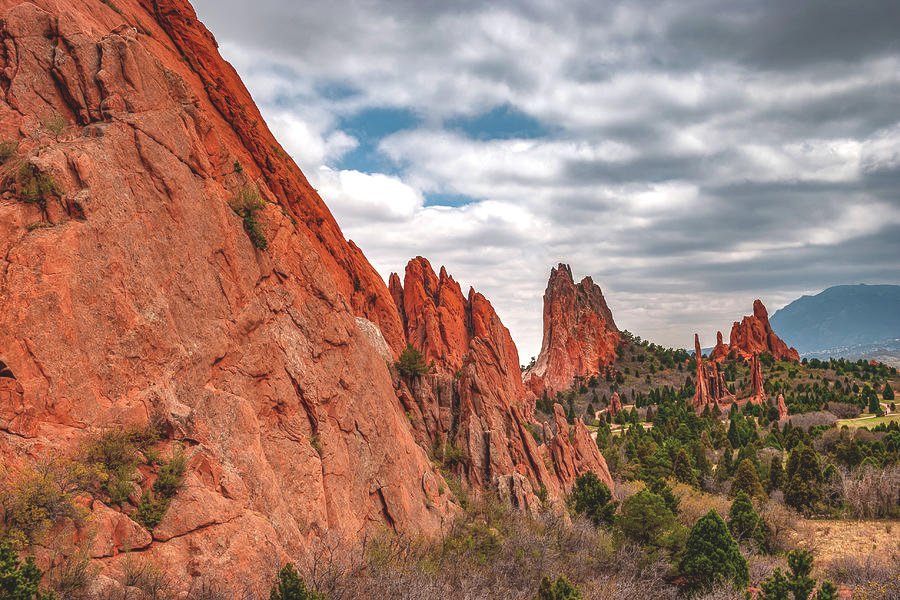
Last month, I wrote about my mother’s attempt to buy a small business and acred property just outside the Black Canyon of the Gunnison : one of those rare corners of Colorado that feels both remote and instantly magnetic. I connected to the land far more quickly than I expected: the stillness, the open sky, the way the air cools as the canyon drops away. I had already begun imagining the winter there — skiing Telluride on weekends, learning the slower rhythms of the towns tucked into that landscape.
We were set to arrive on Halloween. The timing gave the whole experience a kind of playful electricity, packing boxes, sketching out plans, and sensing that faint atmospheric tilt that comes right before entering a new story. It had the early-Shining quality of anticipation rather than dread, a sense of stepping into a place that felt both familiar and a little uncanny.
Then the government shutdown halted the federal paperwork the sale depended on, closing the door as abruptly as it had opened. When I watched Room 237 again last night, the footage from The Shining carried the kind of clarity that only arrives after you’ve witnessed something life-altering, like J.K. Rowling’s moment in Harry Potter and the Order of the Phoenix, when Harry suddenly sees the thestrals, creatures that had been there all along but invisible to him until he had witnessed death.
Symbolic doorways and ruptures
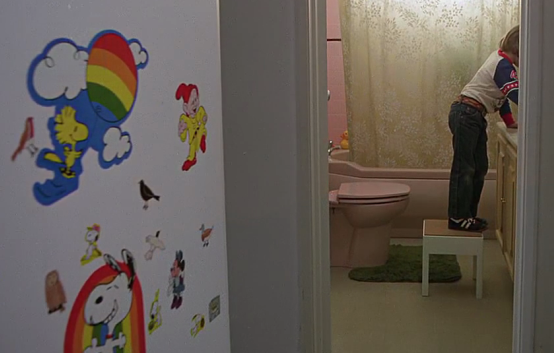
In Room 237, the documentary hinges on a small but important thematic arc: the shift from Danny’s innocence to his initiation. One narrator lingers on the Dopey Disney sticker on Danny’s bedroom door — “he’s ignorant, or a dope” — marking the before moment of a child who hasn’t yet been shown the world’s darker layers. Later, when Tony, Danny’s finger and his inner voice, reveals the vision of blood pouring from the Overlook’s elevator doors, everything changes. That image becomes the after: the moment when he is forcefully given knowledge, or a new reality, that he can’t return from.
Tellingly, the Dopey sticker quietly disappears by the time his worried mother and the pediatrician sit discussing his strange behavior — its absence a small but unmistakable sign that the threshold has been crossed.
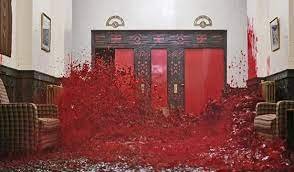
Something the Stephen King book captures better than the film is the Overlook as a wind-up mechanism of its own, part snowglobe, part labyrinth. Danny’s presence doesn’t just perceive the hotel; it activates it, winds it into motion. Kubrick gestures toward this in his opening aerial shot: a benevolent, almost angelic vantage point following the car through the mountains, as if some unseen witness is watching over Wendy and Danny as they approach a building already preparing itself.
Colorado’s unquiet ground
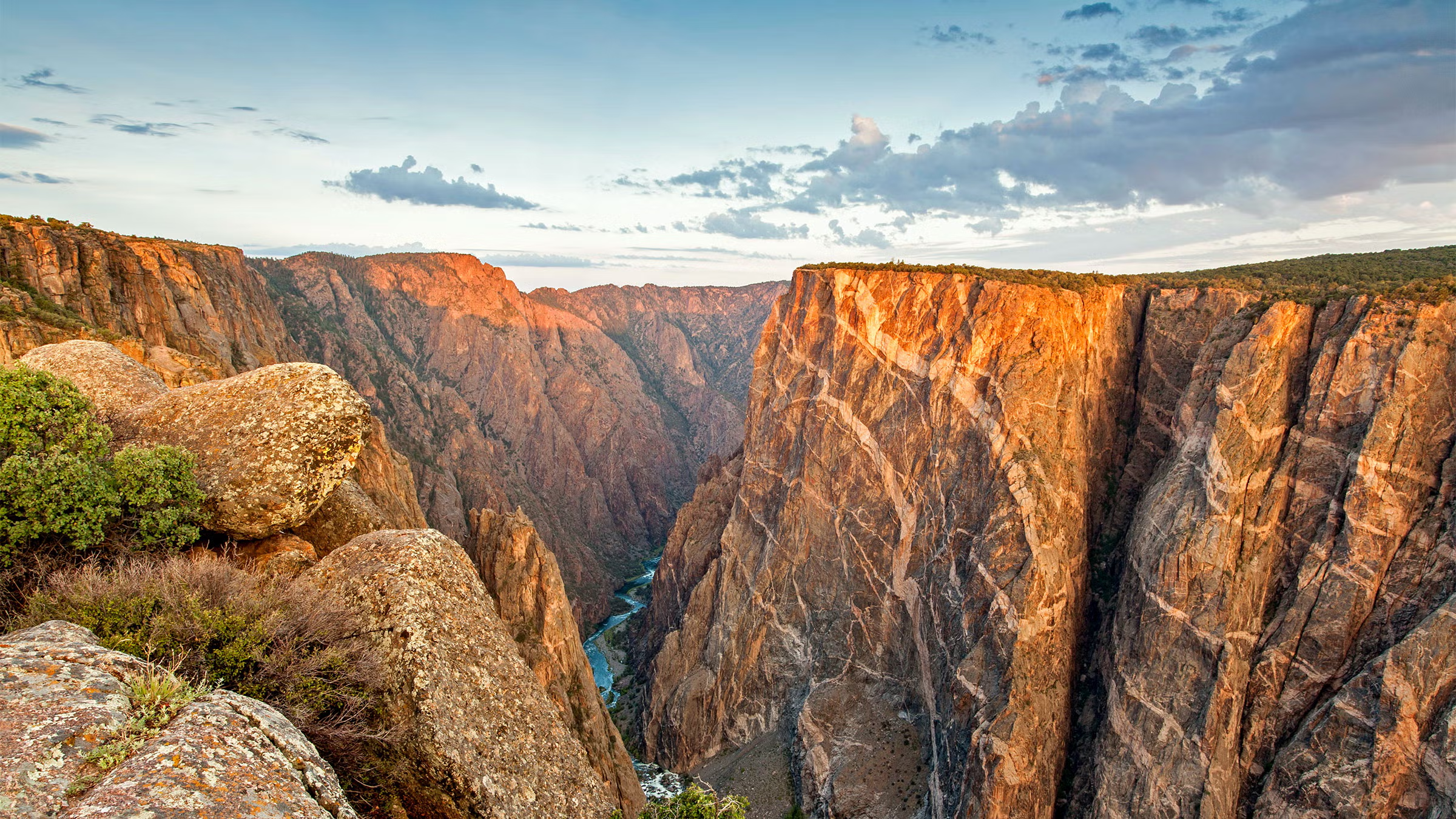
Environments and landscapes are living things. They hold competing interpretations, overlapping needs, and layers of history that rarely agree with each other. Kubrick understood this instinctively. In The Shining, he suggests the repressed and the grief-stricken without accusation, introducing the violence beneath the Overlook, including the history of Native genocide and displacement, not as a lesson but as an atmosphere. He allows the viewer to slip into the world as a local might: aware of something unsettled beneath the surface, but also aware of the beauty and strangeness that coexist alongside it. From what I’ve read, Kubrick learned things while researching in Colorado that stayed with him and haunted him, difficult histories that reframed the landscape in ways he didn’t expect.
I’ve only scratched the surface of that material myself, but I understand the feeling: how the trauma embedded in a place can be almost drowned out by the sweep of desert sky, the brightness of high-altitude light, the resilient life of the region. For Kubrick, the Overlook wasn’t just a set. It was a door to secret knowledge, and stepping through it was its own kind of initiation, as horrifying as it was illuminating.
Erasing the image, losing the memory

I’ve long questioned the wisdom of removing Native American imagery — especially Native-produced brands and symbols — from public view, whether in sports or on packaging. Erasure solves nothing; it tears something vital away from cultural memory. We lose an opportunity for shadow work, for reckoning with dark heritage, when we strip away the images that remind us of the histories beneath our feet. Symbols need room to exist in a neutral space so they can be understood, not feared or hidden. Without that, we risk weakening our collective imagination, and our ability to remain mentally healthy in the face of the past.
Colorado has always complicated these questions for me. It is one of the few places where I feel the beauty of horror without flinching, where the land itself teaches you how to hold darkness and radiance at the same time. The high desert has a way of making even grief look illuminated: red rock catching fire at sunset, abandoned mining sites dissolving into wildflower meadows, old histories rising and fading in the same breath.
Each time I’ve lived near or traveled through Colorado, I’ve felt that double vision settle in — the sense that a place can be breathtaking and wounded at once, and that my role is not to sanitize that tension but to sit with it. Horror, in its best form, does the same thing: it lets the truth stand in its full shape, neither prettied up nor pushed away. Maybe that’s why I return to The Shining so often. Its terror is threaded with beauty, and its beauty refuses to hide the cost of what it remembers. Colorado feels like that too: a landscape that insists on being seen whole.
Leave a Reply